











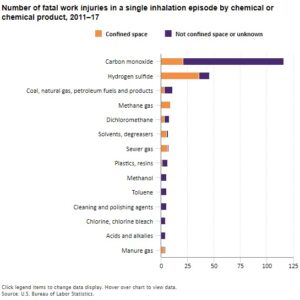
With year 2020 already claiming 7 lives inside PRCSs within the USA, I have to ask the question: Has OSHA’s Permit-Required Confined Space standard meet its goal? In OSHA’s Preamble for 1910.146, published in 1993, OSHA stated:
OSHA has determined that permit spaces pose significant risks to employees (62 fatalities and 12,643 injuries and illnesses annually)...
Read More

Why is this article posted in the Permit-Required Confined Space section of the website? Because there seem to be a large number of safety professionals that are under the impression that ANY occupational hazard can turn a confined space into a Permit-Required Confined Space. Noise is a recognized occupational hazard – I think we can all agree on this; however, noise is NOT a hazard...
Read More
The Joint TDG-GHS informal working group (IWG) dealing with the categorization of flammable gases was organized in Brussels from 9 to 11 March 2015 by the Belgian and the Japanese delegations to the TDG and GHS sub-committees. The participants (physically/by phone) list can be found in Annex 1of this report. The purpose of this IWG was to review the current criteria and discuss possible...
Read More
The requirement for pressure and leak testing on PSV vent piping depends entirely on whether the piping is classified as Boiler External Piping (BEP) or Non-Boiler External Piping (NBEP).
If the vent line is part of the BEP (directly attached to the boiler safety valves under the jurisdiction of ASME Section I), the testing requirements are strict:
…
HomeRead More »
Read More
So many learnings! This happened in the Year 2000. Listen to the radio traffic where the IC is asking for a “headcount”!!!!
Read More
I can still remember the day I was told: “the pipe failed its thickness testing – but don’t worry we are going to use a pipe clamp so we can keep using it”. I had just attended my API 570 and 510 courses to learn all about process equipment inspection protocols. Not once did I hear about any “enclosure” that we could put around a leak or a failed inspection...
Read More
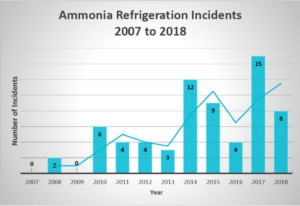
Canada has an interesting requirement for their NH3 refrigeration plants that operate within structures where the general public could be exposed to the NH3. Since the promulgation of OSHA’s PSM standards in 1992, OSHA has shied away from even mentioning “staffing” for a covered process. In the USA, we have plants that run 24/7/365 without trained refrigeration personnel...
Read More
We have yet another failure of enormous proportions. When two workers, one of which is a Supervisor, are opening a liquid chlorine line and they have on supplied-air respirators without the regulator attached to the facepiece we have entered into the Twilight Zone. WorksafeBC has levied a $318,707 fine against the city’s water-treatment plant for:
…
HomeRead More...
Read More
Whether we’re in process safety or just good ole fashioned occupational safety and health, the act of performing hot work (welding to the layperson – my feeble attempt at some Dumb and Dumber humor) can be one of the most dangerous task workers can perform. Add in the fact the hot work is done within a PSM/RMP “covered process” and the risk rise substantially. But...
Read More
We have a machine and this machine has a couple of tasks that have been deemed “minor servicing”. As we walk by we see a worker in the machine and no LOTO in place so of course we stop and ask about the situation. We are told the task being done, “XXXXXXXX”, is indeed a “minor servicing” task approved by the safety department. We continue on our...
Read More
Bollards – a safety engineer’s best friend and a facility engineer’s worst nightmare. I am not quite sure how we lost our way in such a simple design for such a significant safeguard. But the International Fire Code (IFC) since the early 1990’s when I began using it has remained consistent in the design of Bollards. I am not even aware of any other design standard...
Read More
Last year I was attending some continuing education for my hazardous materials work. The instructor was outstanding until he went on his tirade against Nitrogen (N2). He was factually correct when he stated that N2 was a leading killer within confined spaces, but he went off the rails when he tried to convince me that N2 is a toxic hazard and it is this toxic hazard that is killing workers. ...
Read More