













There are solid reasons why OSHA and most other governments have established MINIMUM safety standards for performing Hot Work. This is not the first crazy act we have witnessed at fuel pumps, so I am starting my series… Fiasco @ the fuel pumps. You may want to sit down for this one, at least try not to drool on your keyboard as I know your mouth will fall open…
…
HomeRead...
Read More
This video is exactly why the ASME B31 piping RAGAGEPs prefer hydrostatic pressure testing vs. pneumatic methods. When we take piping up to 400 psi and higher we are creating a serious hazard; thus the code(s) have built-in administrative controls to ensure personnel are NOT near the piping when the test pressure is achieved and LOWERED to the normal operating pressure when welds/flanges are...
Read More
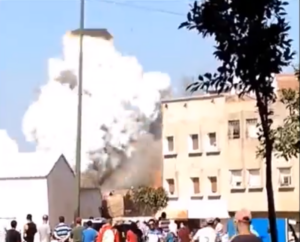
This video was shared with me from outside the USA. The audience certainly does not understand what they are witnessing or they would not be watching so closely. Although we can not see the fire impinging on the vessel, we can see the RV discharge has ignited. Then after a few moments, I’m told this BLEVE occurred rather quickly after the initial fire, we see the failure. ...
Read More
There is just so much to take in from this video! God help us if the “gas can” the attending is using contains actual gasoline!! Of course, he or his partner ensured these “used gas cans” were cleaned thoroughly before filling with water and be used to wet the pavement during the hotwork – BUT WHY in the H_LL would you even use any resemblance of a “gas...
Read More
Respondent is the owner of a food transfer and storage facility and according to their risk management plan for the Facility, Respondent uses approximately 25,225 pounds of anhydrous ammonia in its closed-loop industrial ammonia refrigeration system. On October 2, 2018, EPA conducted an inspection of the Facility to determine whether Respondent was in compliance with Section 112(r) of the CAA,...
Read More
This is NOT my personal interpretation of this ASME B31.3 “leak testing” requirement(s), but it is the official position of the Alberta Canada pressure equipment safety authority. I share this as another “official” explanation of what ASME B31.3 requires in terms of pressure/leak testing and this regulatory agency’s interpretation of how they read this critical RAGAGEP. ...
Read More
This little matter always leads to an energetic discussion during our Emergency Response assessments/planning exercises. But most states have a state code that will read something like this…
Access to refrigeration systems having a refrigerant circuit containing more than 220 pounds (100 kg) of Group A1 or 30 pounds (14 kg) of any other group refrigerant shall be provided for the fire department...
Read More
There is a “Note” in OSHA’s Permit-Required Confined Space (PRCS) Standard(s) that seems to be overlooked by many who read the standard. This “Note” is maybe the most important “Note” I have come across over my nearly 30 years in safety, so I am at a loss as to why so many misunderstand or overlook the “Note”. The “Note”...
Read More
Does the final rule require that employers post load capacity ratings in buildings?
…
HomeRead More »
Read More
A number of revisions were made to the existing general industry standards. Changes and new requirements include: (emphasis by me)
…
HomeRead More »
Read More
This is a MUST READ for safety leaders. It is scientific proof that CULTURE MATTERS to safety, and how we establish a culture of safety is with AUTHENTIC LEADERSHIP (w/ empathy) and how this BUILDS TRUST in the organization – most importantly, how this builds trust with the workers who do the dirty and dangerous work and their immediate supervisor.
Research purpose: This study aimed...
Read More
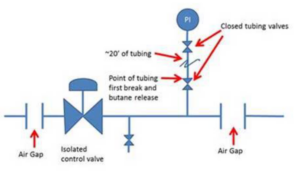
An operator was working to remove a pressure gauge on what was assumed to be depressurized tubing. The upstream piping the pressure gauge tubing was connected to had been isolated, de-pressured and air-gapped so that this section of line was positively and physically isolated from the process. However, during the work to isolate the process line the section of tubing leading to the pressure gauge had...
Read More