










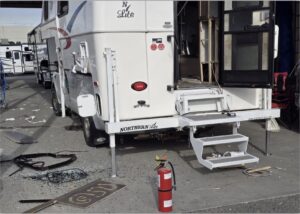
While moving a mattress, employees accidentally bumped a stove knob, turning on the gas, which was left on overnight. This allowed gas to accumulate inside the camper. When the supervisor entered the unit, fresh air mixed with the propane, creating a flammable concentration. Once the power for lighting was restored, the ignition occurred, resulting in an explosion that caused major injuries to three...
Read More
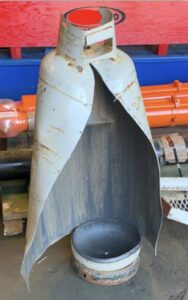
An error in “requalification” of the 60-pound cylinder and an “overfilling event” led to the spectacular catastrophic failure of the 60-pound cylinder. The 60-pound propane cylinder split open instantly, releasing all of its contents. The force of the explosion ripped the metal cylinder cage door off its hinges, dented and deformed other propane cylinders in the cabinet, and...
Read More

The moral of this story, as we do in Emergency Response, is NEVER to rely on a single data source for critical safety information about the chemicals we work with. In ER, we are REQUIRED to use at least three (3) recognized data sources when developing our response plan and making decisions. SDSs can have errors and are typically poorly written, to the point that they don’t meet our needs during...
Read More
An apparent accidental fire from welding brought 11 fire agencies out to the foundry. The Ottawa County Sheriff’s Office (OCSO) said they assisted 11 fire agencies with a building fire at the foundry on Sunday, just before 9:30 p.m. All employees were safely evacuated with no reported injuries, and “initial concerns for chemical exposure were put to rest,” deputies said. Initial...
Read More
Free
Human Factors Engineering
Motivational Safety Materials
OSHA Compliance
Safety Management System
Principles don’t work when safety is not a value among the people they are meant to guide.
In the book “The 7 Habits of Highly Effective People“, Stephen R. Covey discusses the difference between principles and values. He does so to show the difference in those “highly effective people”. I want to use the same framework, but through the lens of “highly effective...
Read More
My team can bring a lot of RISK REDUCTION to your HIGH RISK activities (i.e., SIF) by simply working with you on your:
1) Control of Hazardous Energy (i.e., LOTO) 2) Permit-Required Confined Space Entries, and 3) Electrical Safety Related Work Practices (ESRWP)
No fanfare or shiny objects. Just hardcore safety, exceeding OSHA minimums, and making “safety make sense”. Call it what you...
Read More
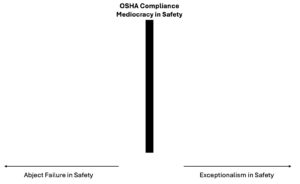
I was taught to do this by ALL my former bosses. My goal was to bring everyone up to my safety expectations while recognizing that “building” means consensus. The idea is that when I had to compromise my expectations, I was ALWAYS still on the right side of the line, pulling others toward me, even as I compromised. NEVER accept anything LESS THAN OSHA minimums.
Screenshot
Read More
All these social media posts decrying the traditional Occupational Safety and Health (OSH) tools are so ridiculous! Most of the people posting such garbage are either academics or marketing people trying to sell the next “silver bullet” in OSH. Most importantly, very few have hands-on experience in developing, implementing, and managing safety and health on a day-to-day basis; yet they...
Read More
I wrote an article last week about how many people did not get the memo about the ladder changes. I’ve done three startups in the past four years, and each one still had cages on its hundreds of fixed ladders. And they were not happy to be told that those were not the correct design. My guess is I was far from the only safety pro informing businesses of these issues, so someone went crying to Dad about...
Read More
Today, OSHA updated its National Emphasis Program, which protects workers from outdoor and indoor heat-related hazards, to direct agency resources where they can make the biggest impact – focusing inspections and outreach in industries and workplaces where heat stress risks are most likely to occur.
Originally issued in April 2022, the revised National Emphasis Program – Outdoor and Indoor Heat-Related...
Read More
Respondent owned a facility that used anhydrous ammonia as a refrigerant for produce processing and packaging. On July 9, 2024, EPA performed an inspection of the Facility to evaluate compliance with the Comprehensive Environmental Response, Compensation and Liability Act (“CERCLA”) Section 103 and CAA Section 112(r). Based upon the information gathered during the Inspection and subsequent investigation,...
Read More

My good friend and colleague Ekin Yurdakul Erkut, Ph.D. – Process Safety Management Engineer (Chemical Engineer) / Safety will be presenting her world-class PSSR system, which we have used at an EV/ESS Battery Manufacturing plant. Be sure to attend her session.
Tree Map PosterDownload
Read More