








Using “bailing wire” to hold open your deadman valves on oil-pots is a really bad idea… leaving the bailing-wire (e.g. evidence) on the valve after each use is just stupid and shows an auditor/inspector that this is an accepted and continual practice! Another tell-tale indication of cheating a deadman valve is the indentions left in the rubberized coating on the handle.
As discussed...
Read More
Respondent is a refrigerated warehousing and storage business which experienced a release of anhydrous ammonia on March 29, 2017 that resulted in a response from the local Fire and Rescue department. Following this event, the facility was requested to provide answers to a Chemical Release Questionnaire (CRQ) by EPA, pursuant to CERCLA § 104(e). Respondent’s answers to the questionnaire stated...
Read More
In the recent OSHRC decision where the ALJ decided that “tight-fitting” doors for an engine room/machinery room doors were not a PSM requirement since “doors” were not part of the covered process. What is confusing is that the company successfully convinced the ALJ that ASHRAE 15 was not their chosen RAGAGEP (even though they stated it was in their PSI) and that the State’s...
Read More
With today’s announcement of the OSHRC decision that the IMC was the facilities RAGAGEP and that the IMC does not require detectors, I thought this record needs to be CORRECTED and CLARIFIED, as the ALJ’s understanding of how the IMC and its requirements apply to an ammonia refrigeration process/system. In the decision, the facility successfully argued that their stated RAGAGEP, ASHRAE...
Read More
This 2019 OSHRC decision is without a doubt the worst excuse for process safety I have seen since I have been involved with process safety (27 years). This case fails to meet the most fundamental basis of how OSHA’s wrote the standard. Employers get to pick their RAGAGEPs, but when they state the “codes and standards employed” those become the basis for their process design,...
Read More
It seems we, as a profession, struggle to get a consensus on those three words/phrase. For me, it is crystal clear, but for many others I find they wish to have some “room to work” in how they understand these terms to be used. I am often told I read the OSHA (i.e. barebones MINIMUM requirements) too literal and that I should be more flexible and help management work to keep employees safe....
Read More
This video is about as picture-perfect as we can get to show us how static is an ignition source. The plastic rolls (commonly called expandable polystyrene or EPS for short is made with Pentane, a highly flammable CAT 1 gas that is heavier than air and has a Minimum Ignition Energy of just 0.22 mJ. When this EPS is made, it must be allowed to “off-gas” for a period of time,...
Read More
There are very, and I mean like I can can the number of audits on one hand, rare that we do a compliance audit and not have a 1910.157 finding. And the kicker of it… OSHA gives employers options on how they manage their use of fire extinguishers. Bottom line… OSHA does NOT require that fire extinguishers be provided; your insurance company may require or your state fire code...
Read More
I am amazed at how technically incompetent our profession is becoming. I guess I need to praise my old bosses/plant managers once again as I grew up being the safety hero in the plants I worked at. You see, it was NOT my role to drive safety (although I was often the one picking up the flag and leading the charge up the hill in battle). My role was to plot the path and develop the safety process, procedures,...
Read More
Respondent operates a petrochemical manufacturing facility (NAICS Code 32511) that produces vinyl chloride for use in the plastics industry. The production areas represent a single RMProgram covered process involving sixteen (16) RMProgram regulated chemicals. At its stationary source, the Respondent has 27,000,000 pounds of vinyl chloride and 6,700,000 pounds of chlorine. At its stationary source,...
Read More
We debated this topic a couple of years back and although I am not sure we came to an agreement, I was, still am, set on the idea that 1910.146(c)(5) and (c)(7) can NOT be used simultaneously on the same PRCS. In other words, the PRCS either qualifies for (c)(5) entry or (c)(7) entry; or of course, we can do a permitted entry using sections (d)-(k). But a while back we were working a turnaround...
Read More
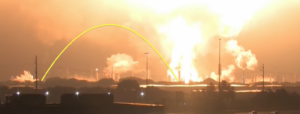
UPDATED on 7/1/2019 – Pics of the tank that “exploded” being recovered from the river
Well, only time will tell, but my best guess from viewing the video footage from several angles is that it appears that a vertical atmospheric storage tank did go airborne and this resulted in a large fireball. I have no idea what was in the tank, but each video makes it appear that this was...
Read More