










This study essentially concerns refrigeration installations using ammonia as a refrigerant. However, in order to better understand and to place the risks associated with these installations in perspective, quantified information has also been collected on numerous accidents, both French or foreign, in other industrial or agricultural activities and in the field of transport....
Read More
Inside a vinegar plant, a 150-m³ tank containing 38.5 m³ of an alcohol vinegar mixture exploded around 9:40 am. The 3,000-m² site had been in activity start-up mode, but engineering works were still underway. The tank bottom became detached from the shell. It’s upper part, measuring 13 m high, 4 m in diameter and weighing some 3.5 tonnes, was projected upwards, by missile effect....
Read More
Ten kilos (22 pounds) of hydrogen chloride gas was released from a flange that had been fitted by a contractor just a few weeks earlier, triggering alarms and resulting in an internal emergency intervention. The incident had no significant consequences. A contractor performing maintenance was instructed to remove the pressure sensor from a device and replace it with a blind...
Read More
A contractor at an upper-tier Seveso plant was cleaning an underground tank so that it could be filled with a different product. The tank was located in an outdoor area comprising 12 horizontal underground multi-compartment tanks, each having an overall capacity of 60 m³ (nominal compartment capacities of 10, 15 and 35 m³) and containing flammable liquids (solvents or petroleum...
Read More
At around 11:00 p.m., phosgene (COCl2) and chlorobenzene began leaking inside the containment building of a chlorinated chemicals plant. The leak was detected at levels between 13 and 22 ppm by analyzers inside the containment. The analyzers’ control system automatically directed the air inside the containment towards the caustic scrubber. Technicians began looking for...
Read More
The irony in this post is thick with sulfur smoke!
SAFTENG Members can read my 2012 article Sulfur sticks and ammonia leaks… are you in compliance when using these leak detection devices?
This video shows us what happens when we introduce a lit sulfur stick into an NH3 gas leak. Imagine someone doing this in a larger leak without the ability to measure the concentration and they are placing...
Read More
Words still mean something! There is a reason why OSHA (and EPA) use the word “Management” in the titles of their process safety standards. Sorry to state the obvious, but the standards are NOT called “process safety managER” for a really good reason. I have been serious about process safety since 1993 and the one thing I have learned…
there is no single...
Read More

SAFTENG Members can get a sneak peek at our presentation before Wednesday. Come and see Jonathan and I present our Top 10 Myths and Misconceptions or to just say Hi and catch up.
Misconception #1 1910.146 applies ONLY to General Industry workplaces and 1926.1201-.1213 applies ONLY to Construction worksites
Misconception #2 Anyone can evaluate a CS to determine...
Read More
Respondent owns and operates a cleaning and maintenance product manufacturing and supply facility where greater than 15,000 pounds of vinyl acetate monomer in a process at its facility. On or about April 4-5, 2017, EPA conducted an inspection of Respondent’s facility to determine compliance with Section 112(r) of the CAA and 40 C.F.R. Part 68. From the time Respondent first had on site greater...
Read More
OSHA has cited a food facility after a worker required medical treatment due to an anhydrous ammonia leak in the packaging house. OSHA found issues with the Emergency Action Plan and Employee Alarm System, RAGAGEP compliance with IIAR standards, PSM Initial and Refresher Training, HAZCOM Training, PSM Incident Investigation Procedures, Lack of an Emergency Response Plan for responding...
Read More
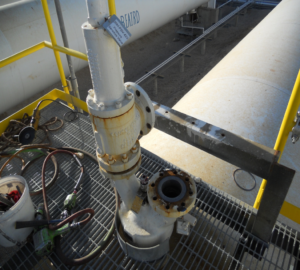
An ammonia storage tank was taken out of service for its 10-year non-destructive examination. After the tank was purged and opened, two (2) contractors were removing two (2) relief valves for their 5-year inspection and tests. The two (2) relief valves are 8 bolt flanged connected to a wye piping fitting equipped with a selector valve (as shown in the picture to the left). The selector valve...
Read More
Back in December 2017, I wrote about a change in the Anhydrous Ammonia fertilizer industry that would most likely require the industry to perform an MOC and PSSR. (A new grade of anhydrous ammonia fertilizer means a MOC, PSSR, etc.) Now that the product has received its official approval and has found its way into the industry, we have learned even more about these additives and how they will impact...
Read More