









At approximately 7:00 p.m. on November 15, 2006, Employee #1 was a process operator at the Chlorine Liquefaction Unit, Block A-19. He was preparing to bleed off chlorine on a process line, to clear the line for maintenance work. The valve handle indicated that it was in a CLOSED position. Employee #1 opened the cap to the bleed valve to insert a tube to clear the chlorine. However, the bleed valve...
Read More
At approximately 2:30 p.m. on March 2, 2011, six workers were employed as milling or planing machine operators at a corn and flour milling facility in Lincoln, NE. A chlorine leak was detected in the chlorine room, so the milling superintendent and a miller/operator entered the chlorine storage room and closed a manual valve on a manifold. The facility was evacuated, and members of the local fire department...
Read More
This is a lesson in why “Unloading” any hazardous material is such a high-risk task. In this incident, the facility had their connections locked (but the driver was told the combination), they were using the driver’s procedure, the connections were properly labeled, the driver could not see the tank he was pumping to, the company dock attendant who was supposed to be involved...
Read More
At approximately 5:00 a.m. on February 8, 2014, Employee #1, a K2 Pure Solutions operator, was depressurizing a line that contained chlorine gas. Two attempts were made to depressurize the line. The first attempt resulted in a small chlorine release and employees having to evacuate to shelter and the second attempt resulted in the employee opening a valve upstream of the 2 in. bleed valve releasing...
Read More
PRESSURE TEST, then LEAK TEST piping BEFORE the introduction of the Hazardous Material!
At 8:30 p.m. on May 11, 2017, two employees had been welding a pipe assembly and installed it on a chlorine tank. Employee #1 opened a valve to transfer the liquid chlorine from a supply tank into the weigh tank. A flanged fitting was not tightened and both employees were sprayed with liquid chlorine. Both employees...
Read More
At 9:15 a.m. on June 17, 2017, an employee was conducting routine daily checks on Well Number 1 and Well Number 2 chlorine cylinders and noticed that they needed to be changed out for full chlorine cylinders. The employee noticed the regulator was feeding chlorine gas without the pumps running and noted that there was a chlorine leak somewhere. The employee checked all connection and found no leaks...
Read More
Respondent owned and operated a facility that stored and used sulfur dioxide, a “regulated substance” under 40 C.F.R. § 68.3, at the facility when it brined cherries. At all times relevant to this CAFO, Respondent’s brining process contained more than the threshold quantity (5,000 pounds) of sulfur dioxide. Respondent’s brining process did not meet the eligibility requirements...
Read More
OSHA has cited a meat packing company for exposing workers to releases of hazardous chemicals. The company faces $615,640 in penalties. OSHA determined that the meat-packing facility failed to implement a required Process Safety Management (PSM) program for operating an ammonia refrigeration unit containing over 10,000 pounds of anhydrous ammonia. The employer also failed to provide fall protection,...
Read More
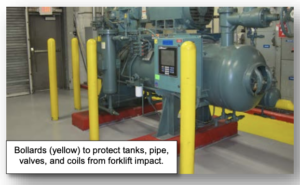
Bollards… they are more than sticks in the ground! In fact, there is an actual code design basis for bollards (i.e. posts). There are six (6) CRITICAL METRICS for bollards, of which five (5) we can see and one (when done properly) is invisible to those of us who inhabit the surface of the earth. So what can we see with the EPA’s picture from their...
Read More
On October 4, 2005, Employee #1 was working as a refrigeration mechanic. An ammonia system valve in freezer Number 7 was being turned, when the bonnet came loose with the wheel, releasing approximately 100 to 200 lbs of ammonia. Employee #1 was 35 feet up without fall protection, and he had to slide down racking to escape. He gave notification to shut the system down and summoned the city’s hazard...
Read More
As I have written about numerous times… PRESSURE TESTING a process is not only a “good idea” – it is REQUIRED for those of us in the process safety world. It is a critical path in process safety, ensuring our “primary containment” system (e.g. piping) was installed properly and can withstand process pressures. But with these tests comes some inherent risks and as...
Read More
Here is a look at OSHA’s Emergency Action Plan (1910.38) compliance activity in 2018 (October 2017 – September 2018). As you can see, OSHA issued 80 citations from 66 inspections for a total of $155,698 in fines. Here is a quick breakdown of activity:
49311 / General Warehousing and Storage with 4 citations totaling $21,878
32221 / Paperboard Container Manufacturing...
Read More