













OSHA's "paperwork" requirements clarify expectations in the Confined Spaces in Construction Standard
The following sections describe who uses the information collected under each requirement, as well as how they use it. Employers and employees would use these information collection requirements when they identify a confined space at a construction worksite. The purpose of the information would permit employers and employees to systematically evaluate the dangers in confined spaces before entry is...
Read More
Just when you think you have seen it all, some business steps up and surprises me once again! This time we visit a refrigeration process at a cold storage facility that specialized in fruit juice concentrates. This team did not like to “defrost” their evaporators the traditional way using hot gas; so much that they preferred to let their evaporators run until the ice...
Read More
At approximately 12:10 p.m. on January 21, 2014, Employee #1, Employee #2, a 36-year-old male, and a coworker, a 39-year-old male with a truck washing business, were engaged in cleaning out the interior of the tanker trailer. The equipment involved was a 6,500-gallon tanker trailer which was pulled in for interior cleaning. This tanker trailer was manufactured in May 1991. The cleaning process involved...
Read More
At 12:15 a.m. on June 21, 2017, an employee was unlocking manual valves of a digester. As the valves were loosened, sulfur dioxide leaked from the drain and contacted the employee’s face. The employee sustained irritation to his lungs and eyes, which he was hospitalized and received treatment.
…
HomeRead More »
Read More
This recent event is an excellent example of why vessels have Minimum Design Metal Temperatures (MDMT) and what can happen when they are exceeded. It also is a nice example of how API RP 579-1 / ASME FFS-1, Fitness-For-Service standard can be used to ensure a vessel is fit for continued service.
On January 22, 2018, workers discovered a release of liquefied natural gas (LNG),...
Read More
Industrial
Carbide Industries employee dies after ‘workplace accident’ (CPR was performed on the employee and he was rushed him to a Hospital, but it was too late – no details available)
UPDATE on CRANE FATALITY UPDATE 3rd worker dies from Manitowoc Crane accident (a third man, 38, has died of injuries he sustained in an accident at the Crane manufacturing plant – he died of...
Read More
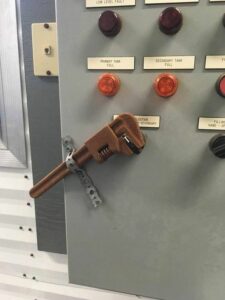
The lengths humans will go to bypass a safety system…
Read More
This report presents the results of the Occupational Safety and Health Administration’s (OSHA’s) “Lookback” review of the Agency’s Control of Hazardous Energy Sources standard, also known as the Lockout/Tagout standard. The standard, which is codified in OSHA’s general industry standards at 29 CFR 1910.14 7, establishes requirements employers must follow to disable...
Read More
This National Safety Alert provides an update to National Safety Alert No. 5, Cell Phone Results in Fire, dated March 6, 2002, which addressed a flash fire on a platform in the Gulf of Mexico OCS. As detailed in National Safety Alert No. 5, a contract panel specialist was working on an open platform master control panel that used supply gas for the instrumentation. The contractor stated he was carrying...
Read More
In early 1999, a number of reports were circulated in the news media and on the Internet suggesting that cell phones could cause a fire or explosion if used at gas stations. Although the reports were speculative and unconfirmed, the issue gained impetus when warning labels began to appear at service stations. In response to these events, this study was initiated to define and investigate the extent...
Read More
The State of Ohio’s EPA performed “Business Impact Analysis” on their version of the Risk Management Plan, as part of an Ohio requirement. The Ohio EPA RMP rules, which are consistent with federal requirements, became effective August 13, 1999. Ohio EPA received “Delegation of Authority” for the Accidental Release Prevention Program, or Risk Management...
Read More