











In this profession we have a saying when it comes to written safety programs… “steal with pride”. We learn early on in our careers that not much changes in OSHA standards so finding someone who already has a written program, training powerpoint, permits, checklist, etc. that we can just “steal it” rather than “recreating the wheel”. This practice has been...
Read More
Sometimes we can find the most concise explanations from OSHA in these Extensions of the Office of Management and Budget’s (OMB) Approval of Information Collection (Paperwork) Requirements. This week OSHA posted an extension notice regarding the paperwork requirements found in 1910.178 Powered Industrial Trucks Standard. It is in this posting that OSHA does such a nice job stating...
Read More
As almost everyone has felt the financial squeeze at some point during their career and we seem to be feeling it more and more these days. As auditors that travel the world, we are still seeing the negative ripple effects of the 2009/2010 recession in the United States in 2017 and probably will continue to see them in 2018 in the EHS arena. The effect I want to talk about in this article is the change...
Read More
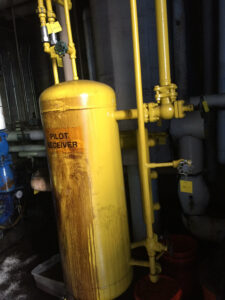
This fatal anhydrous ammonia accident occurred in March 2016 at a seafood processing plant in Boston, MA. The Boston Fire Department (BFD) is one of the top fire departments in the United States. These radio communications are being shared as a “learning opportunity” for SAFTENG members. Not only is the radio traffic telling by the items discussed, the timeline is also...
Read More
Respondent is the owner and/or operator of a stationary source that uses, handles, and/or stores more than a threshold quantity of anhydrous ammonia, a regulated substance, as specified at 40 C.F.R. §§ 68.115 and 68.130. EPA conducted an inspection of the Facility on December 12, 2016 and EPA observed alleged violations of 40 C.F.R. part 68. The alleged violations involve:
maximum...
Read More
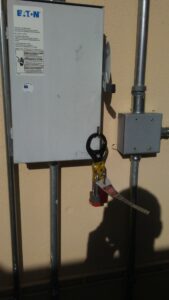
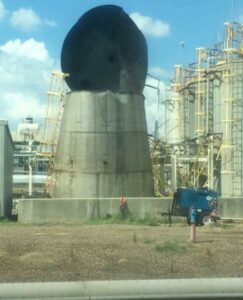
This week we saw another fatal hot work explosion associated with welding on a container/vessel. This time we lost a 29-year-old father, who was supposedly standing on or next to the tank when it exploded. He was found 75′ away...
Read More
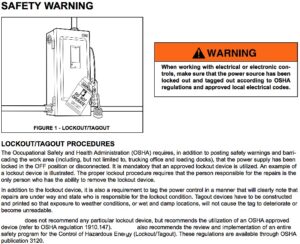
March 2018 UPDATE – OSHA has cited an egg processing facility for multiple safety violations after an employee suffered fatal injuries when he was struck by a dock leveler. A dock leveler is a device that allows a forklift to move between a loading dock and a trailer. One of the employer’s dock levelers was undergoing maintenance. OSHA investigators determined that the employer failed to properly...
Read More
On or about September 14, 2016, representatives of the EPA conducted an inspection (the inspection) of Respondent’s Facility to determine compliance with Section 112(r) of the CAA and 40 C.F.R. Part 68. Information gathered during the EPA inspection revealed that Respondent’s Facility had greater than 10,000 pounds of anhydrous ammonia in a process. From the time Respondent first had...
Read More
EPA found that Respondent had violated regulations implementing Section 112(r) of the Act at 40 C.F.R. Part 68 by failing to comply with the regulations as noted below. Four EPA representatives inspected the facility on August 13, 2014. In consideration of Respondent’s size of business, its full compliance history, its good-faith effort to comply, and other factors as justice may...
Read More
Identifying Facilities as High-Risk and Regulating Site Security, the CFATS regulatory program uses a risk-assessment methodology to identify high-risk chemical facilities. DHS determines risk profiles by requiring facilities that possess specific quantities of chemicals of interest (COI) to complete a questionnaire, known as a Top-Screen, on their chemical holdings. Facilities determined to be high-risk...
Read More