










VIEWER DISCRETION ADVISED!
Read More
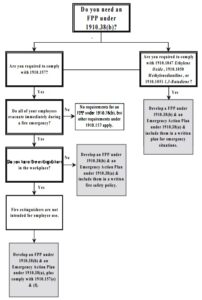
Much like the Emergency Action Plan (EAP) requirements, a WRITTEN FPP is ONLY required when your business/facility falls under some other OSHA standard. And in the case of FPPs, there are ONLY three (3) OSHA standards requiring a FPP:
Ethylene Oxide, 1910.1047
Methylenedianiline – 1910.1050
1,3-Butadiene – 1910.1051
Here is a nice flowchart from OSHA on making your decision:
…...
Read More
So what exactly does OSHA mean when they say…
Develop and implement the means, procedures, and practices necessary for safe permit space entry operations, including, but not limited to, the following:…1910.146(d)(3)(iii) Isolating the permit space
It is not uncommon to find spaces entered with NO isolation of the space and there tends to still be some “behind scene” arguements/debates...
Read More
Back when OSHA was writing their Permit-Required Confined Space standard (1910.146) their review of accident data indicated that most confined space deaths and injuries were caused by atmospheric hazards. And yet, still today, we see entrant, attendants, and entry supervisors; and even safety personnel, not understanding the atmospheric hazards associated with PRCSs. I hope to shed some...
Read More
Violation Summary
Serious
Willful
Repeat
Other
Unclass
Total
Initial Violations
15
15
Current Violations
15
15
Initial Penalty
$128,562
$128,562
Current Penalty
$75,000
$75,000
Violation Items
#
ID
Type
Standard
Curr$
Init$
LastEvent
1.
01001
Serious
1910.119(d)Process...
Read More
In OSHA’s LOTO standard (1910.147), the agency included in their definition of a “lockout device” a “blank flange” and “bolted slip blind” when in fact, these devices are actually “energy isolation devices.” So why would OSHA consider these devices a “lockout device”?
NOTE: I am not in agreement with this and have never called a...
Read More
In the Final Rule, OSHA determined that lockout is a surer means of ensuring equipment is de-energized than tagout and is the preferred method. However, the Agency also recognized that tagout will nonetheless need to be used instead of lockout where the energy control device cannot accept a locking device. Where an energy control device has been designed to be “lockable”, the standard REQUIRES...
Read More
On April 11, 2014, OSHA promulgated a final rule revising the general industry and construction standards for work on electric power generation, transmission and distribution installations. On February 13, 2015, OSHA entered into a settlement agreement with the Edison Electric Institute, the Utility Line Clearance Coalition, and the Tree Care Industry Association resolving legal challenges to that...
Read More
Scenario: Some equipment manufacturers believe that all equipment used in combustible dust atmospheres, including non-electrically powered vacuum cleaners, requires NRTL listing/approval.
Question: Could OSHA clarify the NRTL listing/approval requirements for non-electrical vacuum cleaners used in combustible dust atmospheres?
…
HomeRead More »
Read More
This is helmet camera footage from one of the first firefighters to arrive at one of 2015’s largest loss fires in the USA. $110,000,000 loss dues to an inadequate sprinkler system due to changes in occupancy over the years!
Read More
I have been given permission to OPEN up a PSM Training course in April to other clients/members. This is a 4.5 day training course and involves field-work, so you will need to bring your PPE (Safety Glasses, Safety Boots, Hard-Hat, and FRC if you have it). The course will be taught with a focus on Category 1 FLAMMABLE HHC, but this is such a detailed course we learn principles and...
Read More
This case is yet another example of how “legal” and “safety” can be so far apart from each other. This case was won by the company because OSHA did a horrible job in defending their citation; and yet, it will become ammo for companies to use in future cases. Let’s not fool ourselves into believing that a 1/4″ opening around a conveyor does not present...
Read More