










This is NOT an endorsement of any kind, but this video does an EXCELLENT job explain the difference between the three (3) most common types of “blinds” used in energy isolation.
Read More
OSHA responded to a report of unsafe working conditions May 17, 2016, after two employees lost consciousness and collapsed. The workers were exposed to hazardous gas while entering a sewer system. OSHA investigators found the company allowed the workers inside a confined space without having tested the space for hazards. OSHA issued citations for six serious violations and one willful violation. The...
Read More
Much like OSHA’s Letter of Interpretation, EPA has a series of “Frequently Asked Questions (FAQ)” in regards to their Risk Management Plan rule. Recently EPA answered a question regarding their take on “co-location” in which a tank with 1,000,000 pounds of toluene diisocyanate (TDI), which is covered under the RMP rule, but not under OSHA PSM. Considered by...
Read More
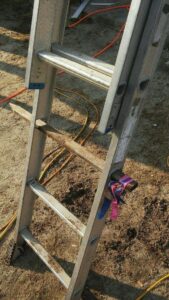
With OSHA’s new Walking-Working Surfaces and Personal Protective Equipment (Fall Protection Systems) standard comes some new requirements for protecting workers in “hoist areas”. Paragraph (b)(2) establishes fall protection requirements for workers who work in “hoist areas” that are four (4) feet or more above a lower level. The final rule defines a “hoist...
Read More
With OSHA’s new Walking-Working Surfaces and Personal Protective Equipment (Fall Protection Systems) standard comes some clarification as to when “stairs” must be provided vs. using a ladder. In the new standard, paragraphs (b)(7) through (9) specify when and where employers MUST provide standard stairs, and under what conditions employers may use spiral, ship, or...
Read More
This weeks video is all about “seeing is believing”! The video is from a series of training videos made back in 1947 for the US War Department to training workers in the factories making war products. These videos may be old, but they are timeless as the chemistry of flammable liquids and gases have NOT changed! This video is one of my favorites as they use special back...
Read More
OSHA’s new Fall Protection standard for General Industry has a lot of MAJOR changes (for the better!) that we will be dealing with over the next several years (up to 20 years for some). One that caught my eye was the new requirements for our maintenance personnel who may be doing work on low-sloped roofs (defined as a roof having a slope less than or equal to 4 in 12 (vertical to horizontal)....
Read More
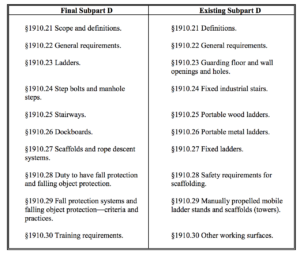
Tomorrow OSHA will publish their new standard Walking-Working Surfaces and Personal Protective Equipment (Fall Protection Systems) in the Federal Register. This means that 60 days later (January 17, 2017), the standard will be EFFECTIVE, with some provisions having delayed enforcement dates. This rule, in the making since the 1990’s, will essentially change the way FALL...
Read More
As you have figured out I am all about having a “safety process” rather than a bunch of “safety programs” and one thing I learn in my Six Sigma days is that a “safety process” MUST function exactly like our quality processes to be as successful. This means we HAVE TO continually “sample” our safety process, just like QC is pulling samples from the...
Read More