












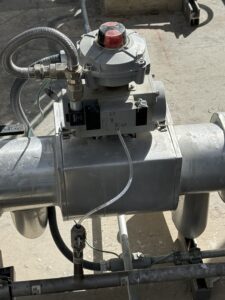
Do you see it? The safety system. It’s right there in front of your eyes.
This is a PSM-covered process involving flammable liquids. And what we are seeing is an air line made of plastic. This is intended to melt in a fire scenario, which would release the air, and the Fail-Safe-CLOSED valve will close.
…
HomeRead More »
Read More

Respondent operated a facility (the “Facility”) that utilizes anhydrous ammonia to provide cooling capabilities to package, refrigerate, store, and ship cherries and grapes. On September 16, 2021, EPA performed and inspection of the Facility to evaluate compliance with the Comprehensive Environmental Response, Compensation and Liability Act Section 103, EPCRA Sections 304-312, and CAA Section...
Read More
Respondent has a chemical and allied product merchant wholesalers process at the Facility, meeting the definition of “process”, as defined by 40 C.F.R. § 68.3. 35. Respondent is a wholesale chemical distributor that primarily repackages, stores, and distributes industrial chemical raw materials and allied products. Hydrochloric acid (36%) is an extremely hazardous substance within the meaning of Section...
Read More
Question: Would stairs built after January 17, 2017, be in compliance with 29 CFR 1910.25(c)(3) if they have an angle between 49 and 50 degrees and tread depth of 9.5 inches (with 8 inches run and a nosing of 1.5 inches) as shown in the below picture?
…
HomeRead More »
Read More
Background: 29 CFR 1910.178(l)(2)(iii) states:
All operator training and evaluation shall be conducted by persons who have the knowledge, training, and experience to train powered industrial truck operators and evaluate their competence.
…
HomeRead More »
Read More
OSHA has addressed two (2) PRCS questions related to the Isolation of Piping that does NOT terminate within the space. This was a long time coming, as NFPA 350 and several trade groups have stated that piping that does NOT terminate within the PRCS need not be isolated. OSHA agreed, as long as six (6) criteria are met related to said piping…
NOTE: Please keep in mind, this LOI is focused on...
Read More
U.S. Environmental Protection Agency (EPA) and the U.S. Chemical Safety and Hazard Investigation Board (CSB) announced a settlement with an Electric Utility, resolving a violation of the Clean Air Act (CAA) and the CSB’s 2020 Accidental Release Reporting rule. This is the first time EPA has taken an enforcement action and reached a settlement with a company for violations of the 2020 rule.
On...
Read More
Natural Gas is a hazardous material commonly found in nearly every structure in the USA. It is so abundant that many have lost respect for this highly flammable gas. I deal with NG nearly every month, either as a utility to appliances within a facility or as a “critical utility” to a PSM/RMP-covered process. Recently, a facility experienced a severe leak, which triggered an “emergency...
Read More
This is WHY we ALWAYS pressure test and then leak test welds on our Primary Containment Systems!
…
HomeRead More »
Read More
At 10:00 p.m. on October 10, 2024, an employee (33) and a coworker, both boilermakers for a facilities support service, were working on a 12-inch pipe to flip the blind. The pipe released hydrogen sulfide gas, exposing the crew. The employee died from poisoning from the hydrogen sulfide gas.
…
HomeRead More »
Read More
On the evening of 20 April 2022, the chemical tanker was anchored at anchorage 8 in the North Sea. The recently unloaded vessel had discharged its cargo ofpalm oil in Rotterdam, and was being prepared to take on a new cargo of gas oil in Amsterdam. To receive the new cargo, the tanks first had to be filled with inert gas (nitrogen, N2). In accordance with the procedure, the tanks had to undergo a final...
Read More
Oxygen-containing air released from his breathing air helmet came into contact with the catalyst on top of him, causing it to ignite.
On the morning of Friday, February 3, 2023, an employee of XXXXXX Service Catalyst Handling (the contractor) lost his life in an accident at the oil refinery. This happened while removing the catalyst from a reactor. Catalyst used in a reactor must be replaced periodically....
Read More