














Many THANKS to my NEWEST and RENEWING Corporate Partners in Safety…
since 2008
since 2010
since 2005
since 1/2013
2013 Fatality Tracker
Electrical
7
(2012 = 68)
(2011 = 81)
(2010 = 90)
(2009 = 100)
Forklift/Manlift
12
(2012 = 52)
(2011 = 84)
(2010 = 110)
(2009 = 88)
Mining*
20
(2012 = 92*)
(2011 = 248)
(2010 = 480)
(2009 = 586)
*no...
Read More

This is one of the top emergency response questions we receive each year. It seems there are some facilities that feel the Incident Command training their personnel receive in their 16-hr Operations Level and 24-hr Technician Level training qualifies those personnel to be an Incident Commander. The question is… is the training offered in these courses adequate to training a person...
Read More
The Food and Drug Administration (FDA) is proposing to require the filing of a premarket approval application (PMA) or a notice of completion of a product development protocol (PDP) for the following class III preamendments devices: Automated external defibrillators systems (AEDs), which includes the AED device and its accessories (i.e., pad electrodes, batteries, and adapters). A review of Medcial...
Read More
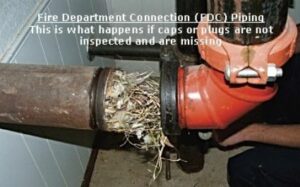
Experienced safety professional will often admit it took them years before realizing that a “general industry” workplace can fall under construction standards (1926) and vice-versa. I know I was well into my career before I came to understand this and once it was explained to me I could see how my maintenance team could fall under both standards depending on the actual work they were...
Read More
This is a very common question when auditing “older plants”, say plants built prior to 1960 (not a specific date with any meaning). For example, during an audit it is discovered that a vessel was built to a RAGAGEP that no one had even heard of or maybe there is NO documentation as to what the vessel was built to. Is this a compliance issue and if it is what must the facility do to meet...
Read More
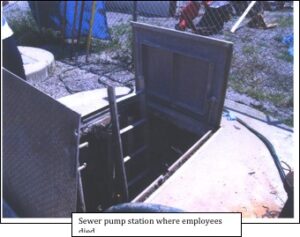
Two water and sewage treatment plant operators, one a 49-year-old and the other a 21-year-old, died when they entered a permit-required-confined space and could not exit safely. Three employees and one supervisor were assigned to replace a bracket on a pump inside an underground pump station. The pump station measured nine feet in diameter by 15-25 feet in depth. The supervisor entered the pump...
Read More
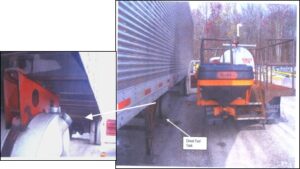
A 46-year-old shipping and receiving clerk died from burns he received in an accident involving the ignition of diesel fuel. The victim’s duties included checking the level of fuel in the fuel tanks on refrigerated trailers that would be used the next day to transport processed product and refill the tanks if needed. On the night of the accident, he drove his fuel truck to where two refrigeration...
Read More
A 51-year-old sanitation worker at a frozen-food packaging facility died after he collapsed while cleaning one of the conveyor lines. He was assigned to clean the North Pea Line. He opened the access doors on both sides of the cleaning pan blower housing in preparation for the cleaning. The equipment was not shut down nor locked out; the victim was not an authorized employee and,...
Read More
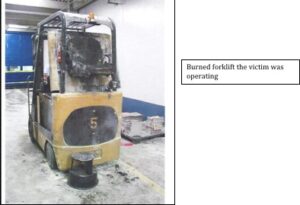
A 61-year-old powered-industrial truck operator died after his forklift ruptured a pipe containing a solvent mixture and the vapors ignited. The victim was operating his forklift in an area between a stacker and a printing press in order to pick up a waste pallet and transport it to the recycling area. Some part of the forklift struck an overhanging pipe containing toluene and ethyl benzene...
Read More
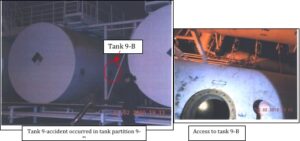
A 49-year-old contract worker died when he entered a chemical storage tank to clean and inspect the tank. The victim was assigned to conduct scheduled inspections and maintenance at a chemical tank farm. Before arriving on-site, the victim received e-mails from the chemical company manager outlining the projects that he was to complete. On his first day on site, the plant manager...
Read More