











At 10:20 a.m. on August 1, 2024, an employee, 53, was working inside a transformer. The employee entered a permitted confined space filled with nitrogen and asphyxiated due to overexposure to nitrogen. The employee was killed.
…
HomeRead More »
Read More
At approximately 9:20 a.m. on December 1, 2010, Employee #1, #2 and #3 were working on the barge of an oilrig (Rig Number 1). They were removing a Christmas tree flange, an assembly of valves, spools, and fittings used to control the flow of oil or gas out of the well, with a cutting torch. As Employee #2 and #3 assisted Employee #1, he cut the last bolt of the flange when gas ejected from the control...
Read More
When we think the task is to improve safety for an entry, we may lose sight of the risks associated with opening process equipment, specifically flanges in the event. On July 23, 2009, Employee #1 and a coworker, both contract employees specializing in preparation of refinery equipment for entry, were installing blinds in piping preparatory to confined space entry for inspection and maintenance. The...
Read More
At 9:00 a.m. on October 6, 2019, an employee was attempting to open a flange. Steam released, burning the employee’s legs and lower body. The employee was hospitalized.
29 CFR 1910.269(d)(2)(iv)(D): The procedure did not clearly and specifically outline specific requirements for testing a machine or equipment to determine and verify the effectiveness of lockout devices, tagout devices, and...
Read More
I see many contractors still arguing that Pressure Testing and Leak Testing are the same test. This is incorrect, as I have often discussed in my ramblings on this website. This post breaks down the requirements of the most common “leak test,” called the “bubble test.” ASME B31.3 refers us to ASME BPVC Section V for guidance on performing the “bubble test” on our...
Read More
I see this often, a contractor wants to save some $ so they think they can make up their own “bubble-test” solutions. However, not only is this a very bad idea from a QA perspective, it is actually NOT TO CODE, as ASME Section V, MANDATORY APPENDIX I BUBBLE TEST — DIRECT PRESSURE TECHNIQUE, I-1032 BUBBLE SOLUTION contains a very specific and clear statement…
(emphasis by me)...
Read More
We must battle the need to believe that when a worker has some type of bad outcome, that adverse outcome happens because the worker becamemomentarily incompetent. Our thinking is driven by a bias toward bad things happening because someone did something bad. The bias that worker became stupid is really a strong force in how we learn from events. Thinking that the worker is stupid sends you down the...
Read More
B31.3 imposes the following requirements, which are only a few of the elements of a leak testing plan:
…
HomeRead More »
Read More

EPA developed the following key safety measures for the inspection of ammonia refrigeration systems and reviewed them with the International Institute of Ammonia Refrigeration. These are measures that EPA has determined should be in place, regardless of an ammonia refrigeration system’s age or size. This is not intended to be a complete list of important safety measures but rather a subset of easily...
Read More
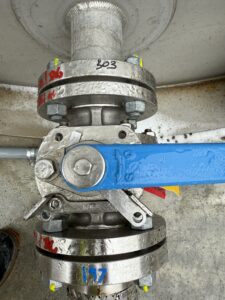
I came across this arrangement, and we debated the position of this valve for 20 minutes, and 7 of us never came to an agreement. We even looked at other tanks that had this valve, and they were different. The valve shown below had its handle reversed as the tank’s ladder was in the way of the valve handle when it was “CLOSED.” The tank next to this one had its handle cut short to...
Read More
The 2024 IFC does a nice job of defining our options for work areas where compressed gases that are ASPHYXINATS are stored or used. A client wanted to use Argon, Nitrogen, and Helium in their Labs, and we were asked if this posed a hazard. We took the “inherently safe design” option first, which is to LIMIT the amount of gas that can be inside the room such that if all the gas were to...
Read More
The following describes the NIOSH policy for determining the attenuation provided by hearing protection devices for individual workers. This statement updates the 1998 NIOSH Criteria for a Recommended Standard—Occupational Noise Exposure.
RecommendationNIOSH recommends employers use individual, quantitative fit testing to evaluate the attenuation received by workers from their hearing protection...
Read More