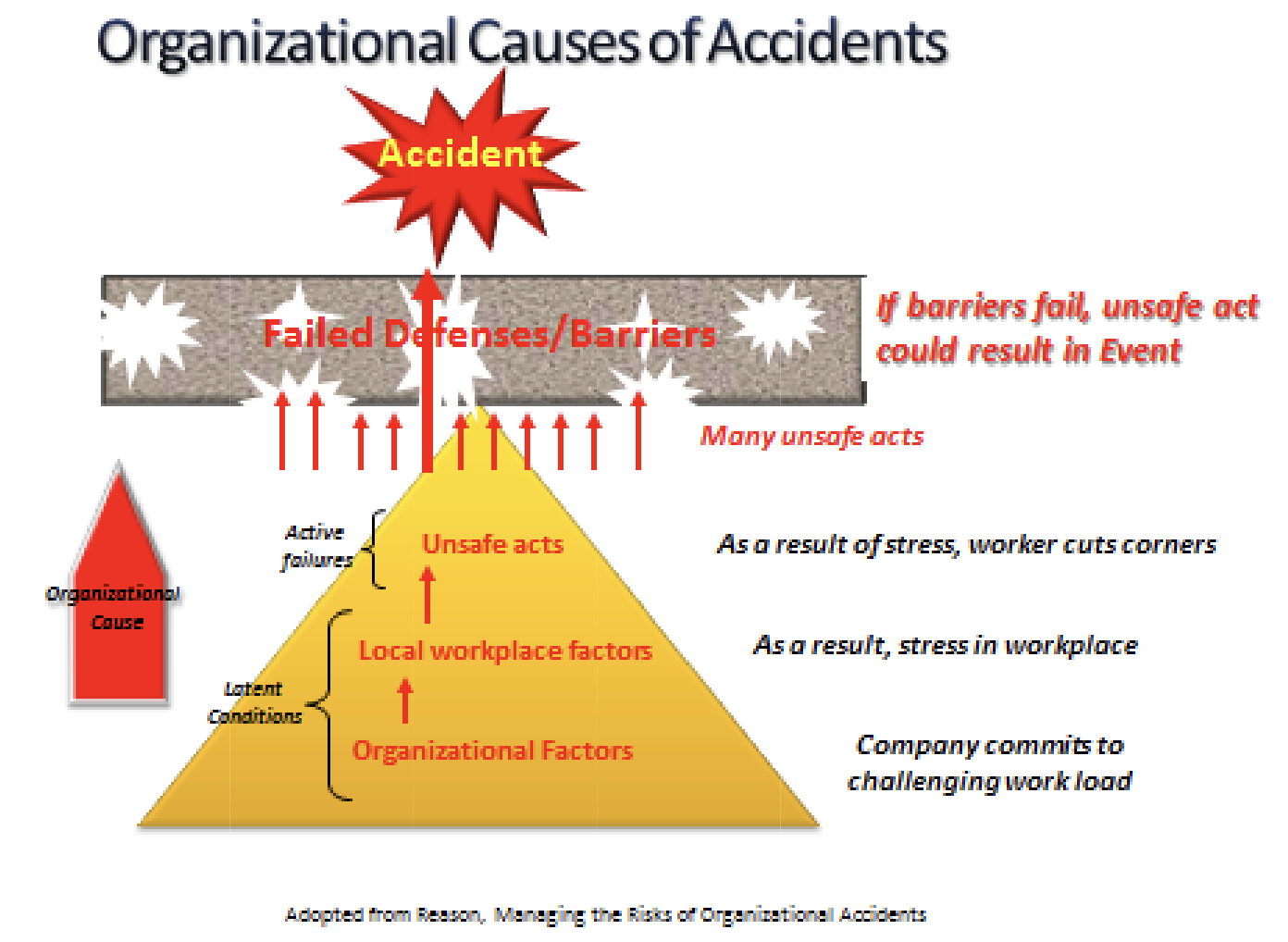
Reason’s 3 C’s

Three (3) ingredients are vital for driving the safety engine, all of them the province of top management or what the organizational theorist, Mintzberg, has termed the strategic apex of the system. These driving forces are:

  1. commitment,
  2. competence and
  3. cognizance

Reason’s three C’s.

Commitment has two (2) main components:

  1. motivation and
  2. resources

The motivational issue relates to whether an organization seeks to be the model for good safety practices or is simply content to keep one step ahead of the regulators; the difference between generative and pathological organizations.

High levels of commitment are comparatively rare and hard to sustain. This is why the organization’s safety culture is so important. Top management comes and goes. More organizational leaders are appointed to revive sagging commercial fortunes than to improve indifferent safety records. On the other hand, good safety culture is something that endures beyond these palace revolutions and provides the necessary driving force irrespective of the inclinations of the latest CEO. The second issue concerns the resources allocated to the achievement of safety goals. This is not just a matter of money. It concerns quality and quantity and has to do with the caliber and status of the people assigned to direct the management of safety. Within some organizations, safety jobs are seen as being in the fast lane of career advancement. In all too many companies, however, they are regarded as long-term parking areas for underpowered or burned-out executives.

But commitment alone is not enough. The organization must also possess the technical competence necessary to achieve its safety goals. Competence is very closely related to the quality of the organization’s safety information system.

  • Does it collect the correct information? 
  • Does it disseminate it?
  • Does it act upon it?

Paired comparison studies examining pairs of companies matched in all respects except for safety performance have shown that the two (2) characteristics most likely to distinguish safe organizations from less safe ones are top-level commitment and, secondly, the possession of an adequate safety information system.  Neither commitment nor competence will suffice unless the organization has a correct awareness or cognizance of the dangers that threaten its operations. Two (2) features are symptomatic of organizations lacking this necessary level of cognizance.

  • The first is the positional paradox, where those at the top of the organization, possessing the largest degree of decisional autonomy, blame most of their safety problems on the personal shortcomings of those at the sharp end who, for the most part, simply follow procedures and work with the equipment provided.
  • The second symptom is the tick-off phenomenon. This is something that can afflict technical managers assigned to safety jobs. They treat safety measures like pieces of equipment. They put them in place, then tick them off as another job done. Most pieces of equipment do what they are supposed to do.  Switch them on, and they function as specified.

But safety measures involve both a product and a process. Simply implementing them is not enough. They have to be watched, worried about, tuned, and adjusted. Items of equipment are nearly all products and very little process. However, safety measures are more like religion-there is a great deal of praying (process) but few miracles (product).

Cognisant organizations understand the true nature of the “safety war.” They see it as a long guerilla struggle with no final, conclusive victory. For them, a lengthy period without a bad accident does not signal the coming of peace. They correctly see it as a period of heightened danger, so they reform and strengthen their defenses accordingly.

Scroll to Top