
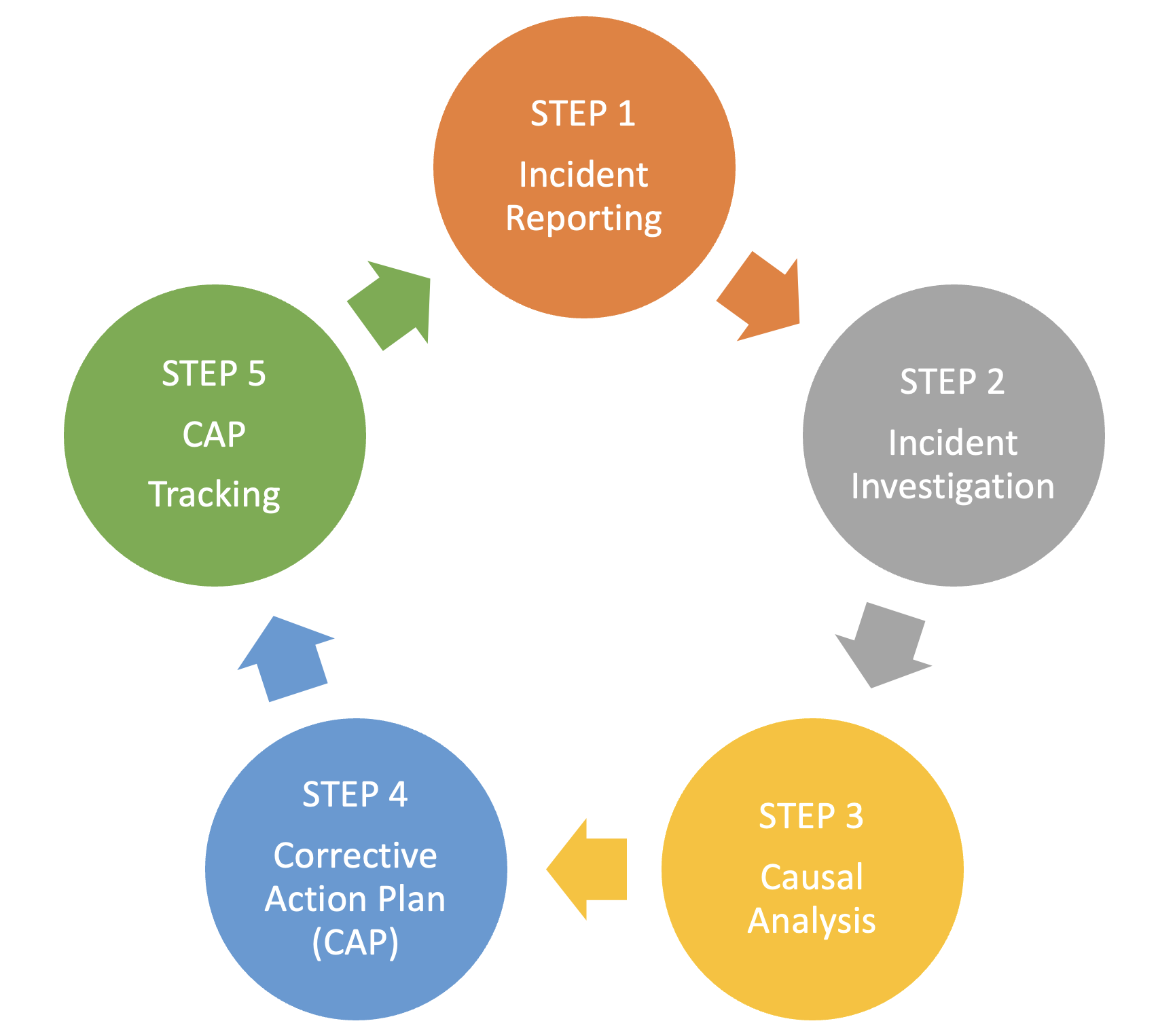
This “process” must be in place within any SMS Incident Management Element, including a Process Safety Management System. This process is used for ALL UNPLANNED events, not just EHS-related events.
Although this process appears simple, it can be full of challenges and very error-prone, eroding trust and credibility.
There can be variations in each step of this process. Quite frankly, we need defined variation in each step to keep the process “real.” Too much emphasis on some steps for minor incidents will eventually impact Step 1 – Reporting, just as too little emphasis on serious incidents can have a stifling effect on reporting.
Each step MUST be DEFINED and QUANTIFIED to provide the structure needed to ensure quality results from each process step. For example, we can use $ Loss to quantify the levels of Step 2 and 3. Meaning, based on the $’s lost we will establish the level of Investigation and the required Causal Analysis Methodology.
But when we define and quantify the expectations in each step of this process, we establish the “floor” (minimum expectations); we can always exceed the minimums, but we can NEVER deviate below them.
Personnel participating in these steps need training and skills to be successful in their role(s). EHS may be the leader in Step 2 – Investigations and 3 – Causal Analyses, but they should NOT be the owners of the entire process. Senior Management MUST own Step 4 – CAPs and Step 5- Tracking.
Step 1 – Incident Reporting (IR)
This may be the most challenging step to implement and manage, as it requires TRUST and CREDIBILITY with the SMS. This element also has the potential to do long-term damage to the culture. As I said earlier, too much emphasis on minor incidents will cause reporting to go underground; not enough emphasis on major incidents or those that have the potential for major consequences will also cause reporting to decline.
This step requires us to DEFINE and QUANTIFY incidents, which will dictate the path forward!
Step 2 – Incident Investigation (II)
The step requires specialized skills, which only a limited number of personnel will possess.
I should also point out that OSHA’s and EPA’s process safety standards actually dictate WHO has to participate in this step of the process. Please understand that investigating the incident is DIFFERENT from the causal analysis step. The investigation phase is the “fact-finding” phase, and we then take those “facts” and “analyze” them in the Causal Analysis step.
Step 3 – Causal Analysis (CA)
The step requires specialized skills, which only a limited number of personnel will possess.
Depending on how we “classified” (e.g., defined and quantified) the incident in Step 1, our chosen Causal Analysis will reflect the level of our RCA.
Step 4 – Corrective Action Plans (CAP)
Once we have completed the causal analysis, a team will develop corrective action plans to address the event’s causes. This process requires some special skills to keep it on track, as this step has the chance to go straight into the ditch! This step dictates senior management’s participation. I am of the opinion that ONLY senior-level management will be assigned Corrective Actions (CAs). This does not mean they will actually do the work in the CAP, but they are ultimately responsible for ensuring their team has the time and resources to complete the CAP(s). Trust me – this approach works!
One minor twist that many miss in this step is that we need to apply our CAPs across the entire organization where there is a risk the incident could occur again. This means other facilities may need to implement the LEARNINGS from incidents that occurred outside their span of control and may even need to implement SPECIFIC and ACTIONABLE items that came out of the RCA.
Step 5 – Corrective Action Plans (CAP) Tracking
Last but certainly not least comes tracking our CAs to their closure. Also, in this step comes the means to verify the CA was implemented properly and is providing the business with the value that is needed. This step also includes managing the action items, the owners, and the due dates; there needs to be a procedure for modifying actions, the owner(s), and due dates.

