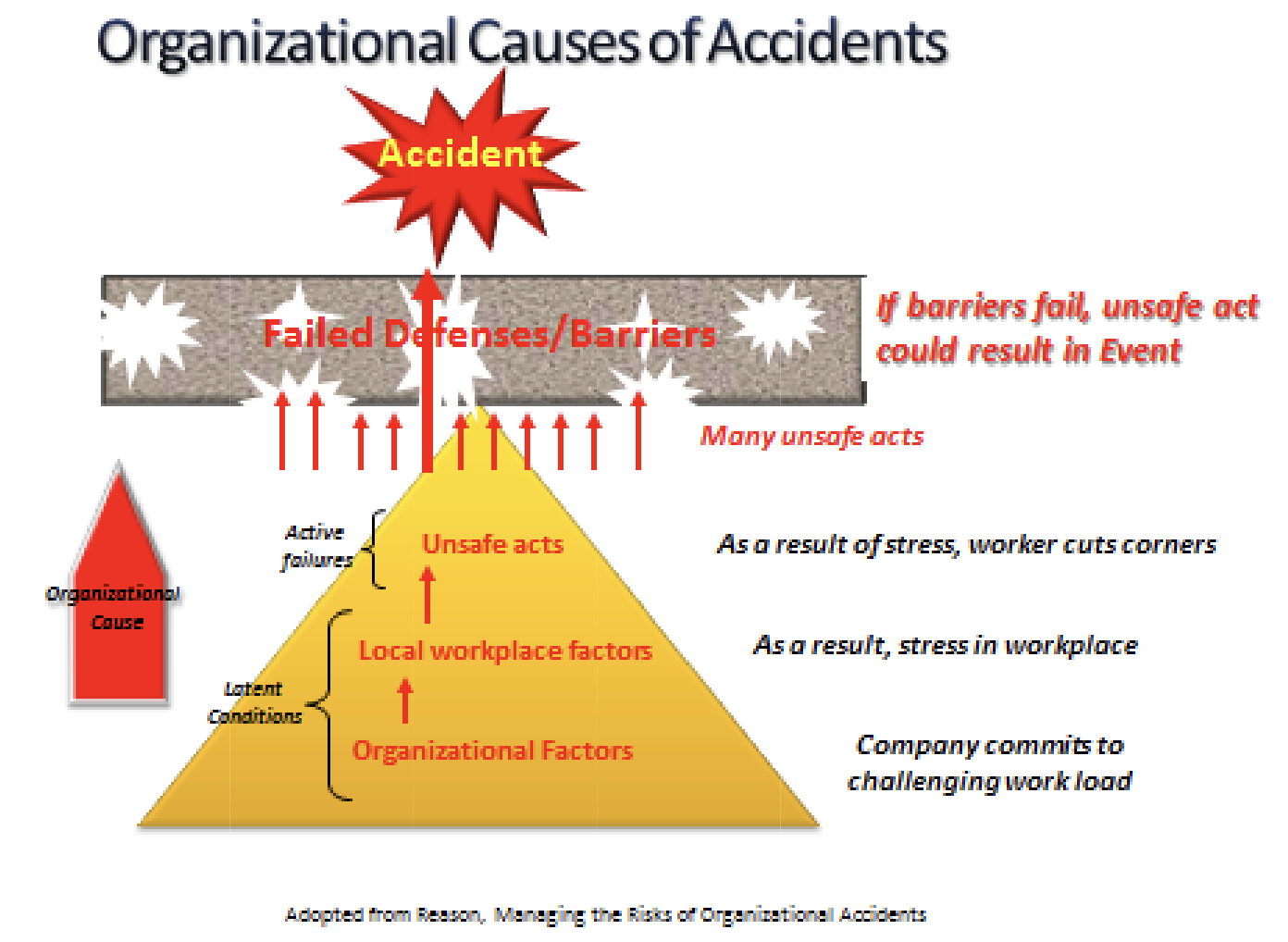
James Reason’s Human Failure Model: Active and Latent [Organizational] Failures
As safety professionals, we need to understand that we ALL make errors, mistakes, and violations. When we are asked to facilitate a causal analysis, it is incumbent upon us to keep the team aware of this fact and educate them on the differences between Active and Latent [Organizational] failures.
“The latent [Organizational] failure model thus distinguishes between active and latent [Organizational] failures:
Active failures are “unsafe acts” whose negative consequences are immediately or almost immediately apparent. These are associated with the people at the “sharp end,” that is, the operational personnel who directly see and influence the process in question.
Latent failures are decisions or other issues whose adverse consequences may lie dormant within the system for a long time, only becoming evident when they combine with other factors to breach the system’s defenses (Reason, 1990). Some of the factors that serve as “triggers” may be active failures, technical faults, or atypical system states. Latent failures are associated with managers, designers, maintainers, or regulators – people who are generally far removed in time and space from handling incidents and accidents.”
Source: Behind Human Error, Second Edition, David D. Woods, Sidney Dekker, Richard Cook, Leila Johannesen & Nadine Sarter, 2010