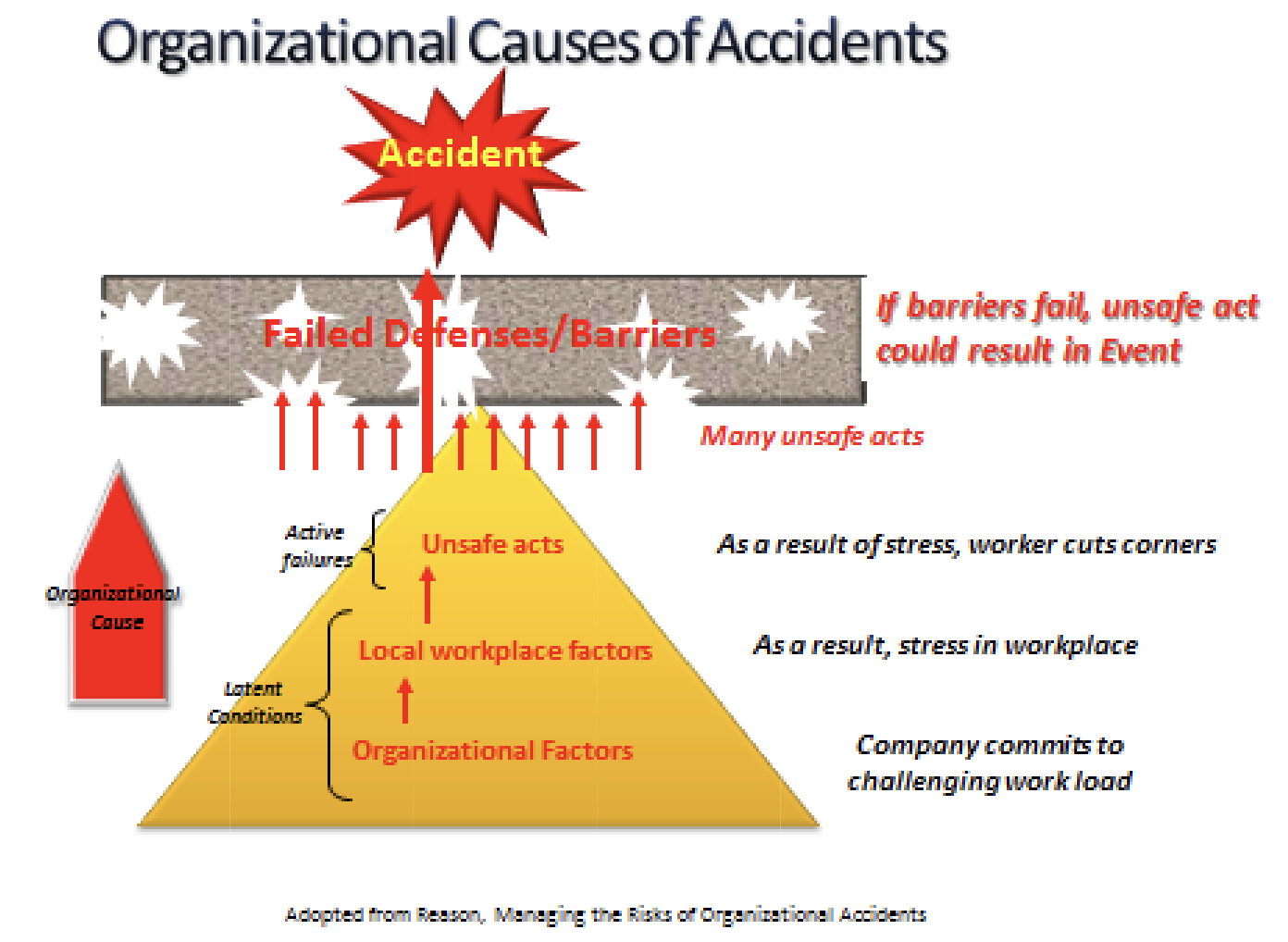
It is suggested that LATENT ORGANIZATIONAL failures are analogous to the “resident pathogens” within the human body, which combine with external factors (stress, toxic agencies, etc.) to bring about disease. Like cancers and cardiovascular disorders, accidents in complex, defended systems do NOT arise from single causes. They occur through the unforeseen (and often unforeseeable) concatenation of several distinct factors, each one necessary but singularly insufficient to cause the catastrophic breakdown.
This view leads to a number of general assumptions about accident causation:
1️⃣ The likelihood of an accident is a function of the total number of pathogens (or latent organizational failures) resident within the system. All systems have a certain number. But the more abundant they are, the greater is the probability that a given set of pathogens will meet just those local triggers necessary to complete an accident sequence.
2️⃣ The more complex, interactive, tightly coupled and opaque the system (Perrow 1984), the greater will be the number of resident pathogens. However, it is likely that simpler systems will require fewer pathogens to bring about an accident as they have fewer defenses.
3️⃣ The higher an individual’s position within an organization, the greater is his or her opportunity for generating pathogens.
4️⃣ It is virtually impossible to foresee all the local triggers, though some could and should be anticipated. Resident pathogens, on the other hand, can be assessed, given adequate access and system knowledge.
5️⃣ Therefore, safety specialists’ efforts could be more profitably directed towards the proactive identification and neutralization of latent organizational failures rather than towards the prevention of active failures, as they have largely been in the past.
Source: The contribution of latent human failures to the breakdown of complex systems, J.Reason, 1990