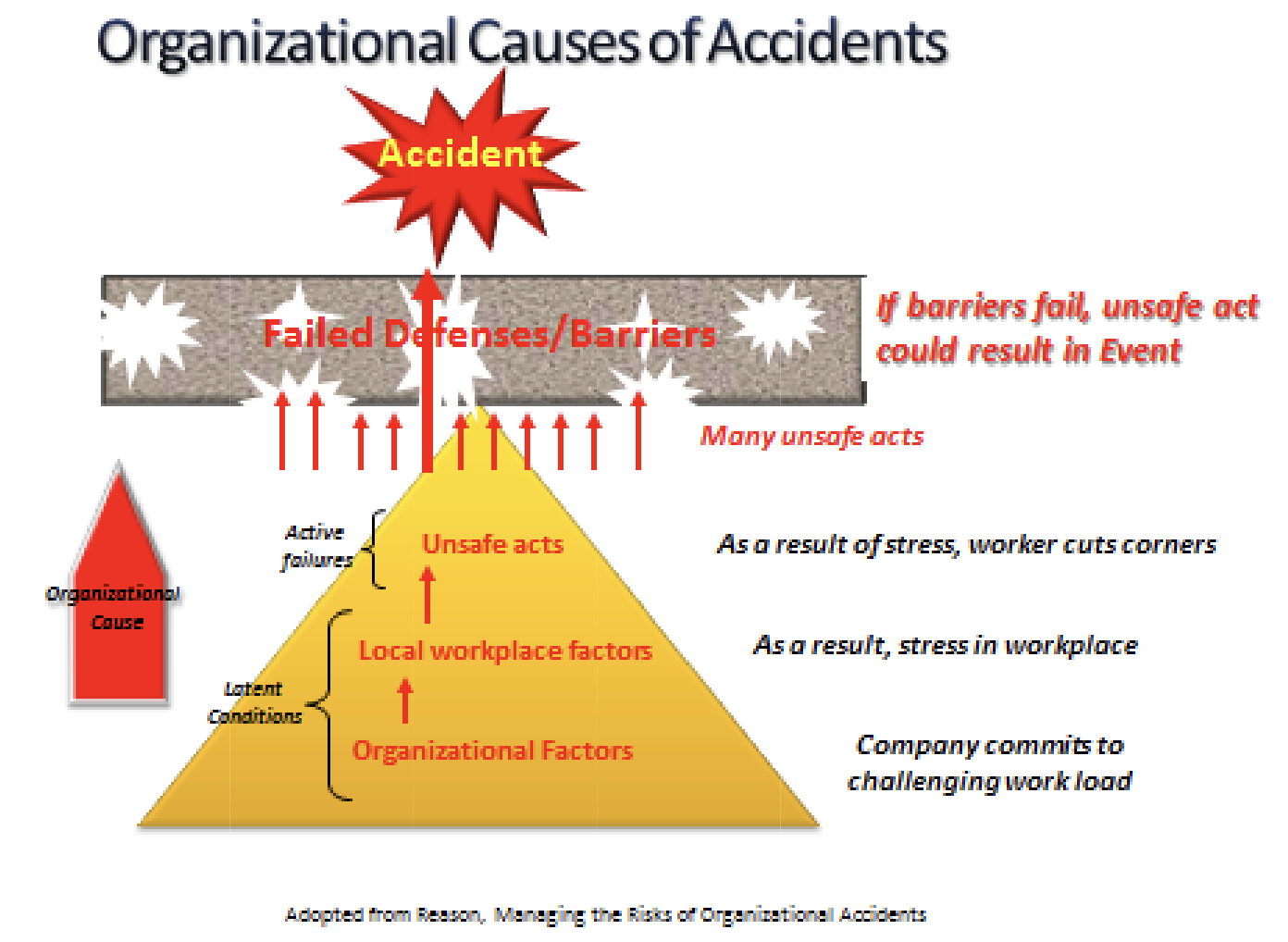
Keep in mind the following was published in 1997 in Managing the risks of organizational accidents by James Reason. And he was not the first to say it, but he may have been the best at explaining it! Many organizations could make substantial improvements in their safety performance if they would just start measuring the “safety process” that is intended to reduce the injury rates rather than simply measuring and rewarding those rates. We hear a lot about “Zero Harm” and “Goal Zero” these days – it was recognized as a flawed approach 25 years ago, and it is still a flawed approach today. Having aspirations of zero harm is what most safety pros want; but aspirations are not the same as measurable goals.
Here is how Reason said in 1997…
The key to navigating the safety space lies in appreciating what is manageable and what is not. Many organizations treat safety management as a negative production process. They set reduced negative outcome targets for the coming accounting period (e.g., “Next year, we’ll reduce our lost-time accidents by half”). But accidents, by their nature, are not directly controllable. So much of their causal variance lies outside the organization’s sphere of influence. The organization can only defend against hazards, it cannot remove or avoid them and still stay in business. Similarly, an organization can only strive to minimize unsafe acts, it cannot eliminate them altogether.
Effective safety management is more like a long-term fitness program than negative production.
Rather than struggling vainly to exercise direct control over incidents and accidents, managers should regularly measure and improve those processes-design, hardware, training, procedures, maintenance, planning, budgeting, communication, goal conflicts, and the like-that are known to be implicated in the occurrence of organizational accidents. These are the manageable processes determining a system’s safety health. They are, in any case, the processes that managers are hired to manage. In this way, safety management is not an add-on, but an essential part of the system’s core business.
The only attainable goal for safety management is not zero accidents, but to reach that region of the safety space associated with maximum resistance-and then staying there. Simply moving in the direction of greater safety is not difficult. But sustaining these improvements is very hard. To hold such a position
against the strong countervailing currents requires navigational aids.
More specifically, it requires a safety information system that is not only capable of revealing the right conclusions about past events (reactive measures), but that also facilitates regular ‘health checks’ of the basic organizational processes (proactive measures) which are then used to guide targeted remedial actions.