A fair number of you are with me on my approach to industrial safety. I am a believer and user of HOP, SIF, and Psychological Safety, the three (3) major moevements in safety these days. But these movements NEED STRUCTURE to thrive inside a workplace. They are NOT standalone “programs,” and any snake oil salesperson trying to sell you their product as such is not a safety professional; they’re a sales professional!
I have had some great discussions this past couple of months about what should already be in place so that any of these movements can COMPLIMENT your organization’s safety efforts. And the discussions always go back to the fundamental safety management system (SMS) model:
- Identify Hazards
- Analyze the hazard(s)
- Assign a risk level to the hazard(s)
- Mitigate the risk(s) with the hazard(s)
HOP, SIF, and Psychological Safety play a role in this 4-Step model, as well as the other elements of an SMS. So I will be writing a series of articles to demonstrate how HOP, SIF, and Psychological Safety can enhance our safety efforts while we stay grounded in our fundamentals of safety management 101.
Hazard identification may sound simple, but most seasoned safety pros have learned the hard way… what a hazard is to one person may not be considered a hazard to others. So it is KEY that we DEFINE and, in some ways, QUANTIFY what a hazard is.
I actually like the Cambridge dictionary definition, although its simplicity is what causes the problem.
hazard
something that is dangerous and likely to cause damage:
a health/fire hazard
The busy traffic entrance was a hazard to pedestrians.
For the SMS to be effective, our FIRST and some would say the most critical element is Hazard Identification. Without the ability to identify a hazard, minus our experience and biases, the workplace will continue to present unnecessary risks to our employees. Hazard ID is actually an ACQUIRED SKILL through proper training. Experience in using this training makes us better; however, experience alone is a horrible measure of one’s ability to identify hazards. In fact, hazards can be industry-specific, so someone who is trained to ID hazards in one industry may struggle in a different industry. But this “outsider” can be a great tool in Step 3 – Assigning risks to the hazards, and we will discuss that in Article #3 of this series.
One thing that drives me mad in the realm of “psychological safety” is the idea/concept that we simply need to ask the workers doing the dirty and dangerous work to tell us what the hazards are and the best way to fix them. In my experience in doing this, although we called it “employee participation,” it is similar to asking a drug addict if they have a drug problem. Without proper training on Hazard ID, the vast majority of workers will be unable to identify hazards and, in fact, will challenge the findings of a professional trained in Hazard ID. Take machine guarding, for example… we walk up to a machine and begin discussing with the operator any safety concerns they may have about their work. A new or long-time employee will typically point out hazards that are superficial to their safety. These will be legitimate hazards, so I am not making light of them; however, they will most likely not be centered around their actual work with the machine. But as we stand there talking, we (the trained Hazard ID professional) begin to notice missing guards, interlocks that are bypassed, 2-hand controls manipulated, etc. And when the discussion shifts to these hazards, the worker will honestly be surprised and may even take a defensive position such as… “yeah, sure, you come out here and won’t fix my fan and just make my job harder”. Ever happened to you? If this scenario has never happened to you, here is some friendly advice – you need to spend more time in the actual workplace!
Workers will become “conditioned” so that what they viewed as a hazard when they started working is no longer a hazard. This is based on the fact that they have been working around said hazard, AND it has not caused them any injuries, AND it allows their work to be easier – thus, that hazard is no longer a hazard in their eyes. So this concept of walking out and engaging the employees in the Hazard ID exercise is simple, is very far from reality. We MUST ABSOLUTELY get the employees to participate in the Hazard ID exercise in their immediate work area. I believe that we need to train a number of these employees in Hazard ID and have them participate in Hazard ID exercises.
NEVER FORGET, all safety efforts are about THEIR SAFETY, not some number or management –
it is ALL ABOUT the men and women doing the dangerous and dirty work.
Our baseline Hazard ID protocols have actually already been established. We start with OSHA compliance; this is our STARTING POINT. The very basics, but OSHA has DEFINED and QUANTIFIED some basic hazards. I’ll use machine guarding again to explain…
I think we can all agree that having the ability to:
1) Identify that a guard is off a machine,
is very different than
2) Identify the need for a guard on a machine
These skill sets are both parts of a Hazard ID process but require a different level of training. #1 can be taught to a wide assortment of employees, but #2 requires a much more detailed level of training. This is how a safety professional and a safety committee made up of non-safety personnel work together to achieve world-class safety. We, the safety professional(s), are responsible for identifying hazards that NEED GUARDING on the machines. We document this assessment so that the other employees can utilize our assessment in their Hazard ID exercises to identify missing guards when operating the machine. Yes, one could call these Hazard ID exercises an audit/assessment; nevertheless, we have employees using a tool to identify workers who are being exposed to a hazard. We have set the stage (via our professional guarding assessment), and the employees are dancing the dance on that stage. BOTH activities REQUIRE proper training to ensure PROPER application. And just because we are degreed safety engineers, CSPs, CIHs, OSHTs, etc., this does NOT mean we are machine guarding (e.g., Hazard ID) experts. We too will most likely need specialized training to improve at ID’ing hazards in the workplace, especially if we are in a new industry where we have zero to very limited experience with the industry hazards.
How does SIF play a role in our Hazard ID efforts?
Serious Injuries and Fatalities (SIF) should be at the top of our list of concerns. Granted, in some workplaces, SIF may not be a wise model to implement and could cause a loss of focus. But in workplaces where many of the hazards are lethal or have the ability to cause life-altering injuries, SIF can be a great tool to shift the focus away from only those High Frequency – Lower Severity type injuries that drive the “injury rate” to a focus on those Low Frequency – High Severity events. I call this “managing risks vs. managing a rate.”
With the introduction of SIF to a mature SMS, we shift some of our Hazard ID efforts to identifying those hazards that have the ability to cause a serious injury and/or fatality. We do NOT take our eye off the lesser hazards, but we do make a formal and concerted effort to ID those hazards that may have not yet caused a SIF and may not have even been recognized as a hazard. This goes back full circle to what we discussed above…
workers doing certain acts or working around certain equipment that they are accustomed to without any consequences, thus their inability to recognize the hazard.
Remember, the ability to RECOGNIZE a HAZARD BEFORE it is a REALIZED HAZARD makes an organization world-class in safety.
For SIF to be truly successful and to deliver all it has to offer an organization, it MUST be a part of a mature SMS. For those of us who have implemented a formal Hazard ID process, we know all too well the struggles of convincing a workforce, workers, and management that something is a “hazard.” It is very difficult to get an organization to be able to RECOGNIZE a hazard when it has never REALIZED the consequences of the said hazard. We will hear comments like…
It has always been that way
or
We have been doing it that way for 100 years and nothing bad has happened
The fact that an injury or an undesired event has not happened yet lends itself to a RISK discussion – NOT a hazard discussion! We will discuss risk in Article #3 of this series.
Now consider the pushback an immature SMS/Culture will produce when we want to identify serious hazards that have never caused serious injuries, although we know the reason is ONLY the frequency of exposure. Remember the risk formula?
RISK = Frequency X Severity
SIF is NOT concerned with the frequency/likelihood part of the formula; it is focused on the severity part. This means it will be much more difficult for management and workers in an immature SMS/culture to grasp the efforts of the SIF model. In other words, it is much easier to get a consensus on a hazard that has caused three fewer injuries than it will be to get a consensus on a hazard that has never caused an injury, much less on a SIF. Getting management to spend thousands of dollars on the lesser injuries that cause the injury rate to increase vs. getting them to spend the same to abate a hazard that has caused NO injury is what SIF is all about. And it takes a level of safety maturity for SIF to be successful.
How does HOP play a role in our Hazard ID efforts?
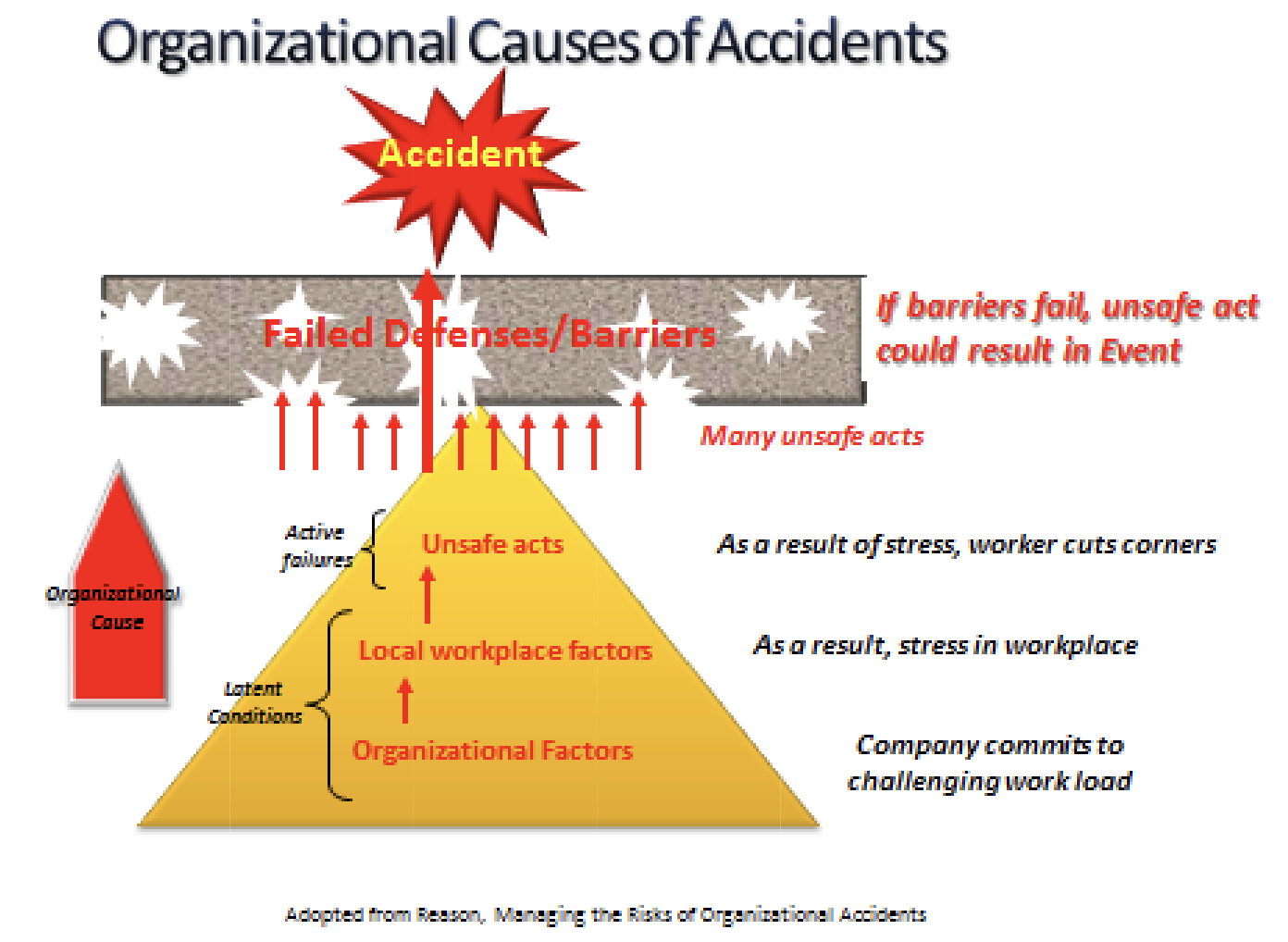
Human and Organizational Performance (HOP) is VITAL to getting an organization to understand that the LATENT failures of the organization play as big, if not the biggest, role in accidents. HOP is a cultural tool, NOT a technical safety tool; as such, it does not play a direct role in Hazard ID efforts, but we have to balance our technical and cultural efforts in safety.
I view HOP as our efforts to swing the Behavior Based Safety (BBS) pendulum back to the center. BBS was literally hijacked in the early 2000s and was bastardized to hell and back. It seems it is easier to blame the worker’s ACTIVE FAILURES (e.g., their actions) at the time of the accident than to do an old-fashioned causal analysis using a recognized methodology. After all, those causal analyses always found some management system failures (which are much harder to fix), which just “muddied the waters.” After all, we have all been told that 85% (or use whatever number you want) of accidents are caused by human behaviors. We can’t really argue with the 85% number, but we can argue with WHY those behaviors occurred, which is what we call the LATENT organizational failures.
HOP teaches us:
1) People make mistakes
2) Blame fixes nothing (don’t confuse this with accountability)
3) Context drives behavior
4) Learning is vital
5) Response matters
See my The five (5) principles of Human and Organizational Performance (HOP VIDEO w/ Conklin)
The bottom line, in my professional opinion, is HOP ends the madness of simply blaming the ACTIVE failures for accidents. That is NOT saying that we end accountability for one’s actions. But HOP, with a really good causal analysis tool, will end the practice of looking at only the ACTIVE failures at the time of the event and will also look at the LATENT organizational failures that allowed those conditions and attitudes to align to create the incident.
For too long, accident investigations have been nothing more than a blame game, oftentimes pointing at violations of safe work practices and just ending with that “root cause.” HOP teaches us that we need to understand WHY that employee did not follow the SWP. HOP is built upon the work of James Reason’s Human Failure Model from the 1970s-1990s. Read a book on HOP and then read any book by Dr. Reason, and you will see the similarities – just different packaging to make a sale.
NOTE: I have over a dozen articles discussing Dr. Reason’s models – his principles should be core to all SMS’s in my opinion.
As you can see, HOP, SIF, and Psychological Safety COMPLIMENT a basic SMS, of which HAZARD ID is Step #1. They are NOT standalone packaged “flavor of the month” safety efforts. They work within the SMS, improving the SMS in their unique way. Without the other elements of the SMS, these movements will fall short of what they have to offer. Look at it this way, in my SMS model (represented as a 16-spoke wheel) HOP, SIF, and Psychological Safety are NOT represented as a “spoke” in the SMS. They are not even mentioned, as they are an APPROACH to managing the SMS and not actually a SMS element. So trying to implement them as such, they may be doomed to fail from the start.