
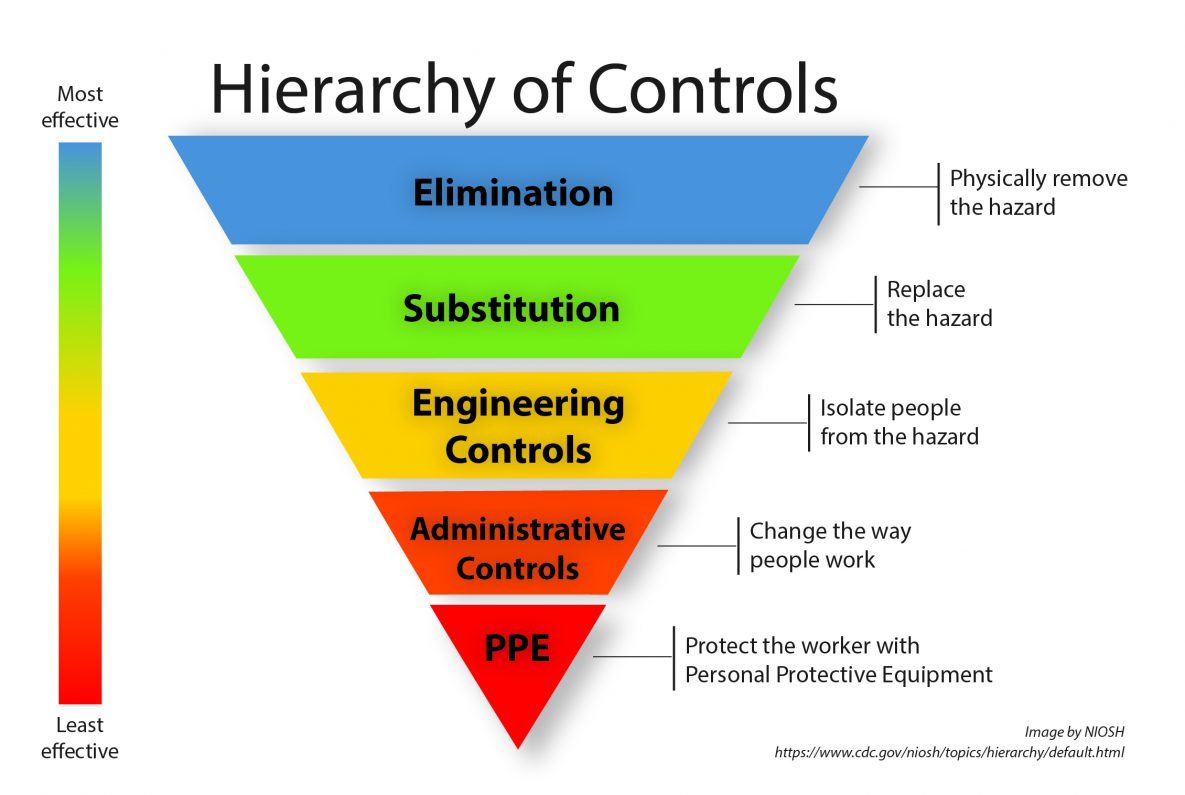
A lot has changed over my career; some things I thought were so concrete and fundamental to OSH that they would never change. Boy, was I ever WRONG! Take, for example, the “hierarchy of controls” – quite possibly the primary building block of OSH and Industrial safety for the past 73 years. When I was in school in the early 1990’s, we learned the basic five (5) tier model:
- Elimination
- Substitution
- Engineering
- Administrative
- PPE
These were put in place in 1950 by the National Safety Council. And just last October, the NSC published an article in their magazine titled The Hierarchy of Controls – A step-by-step path to eliminate or reduce hazards where they discussed this 5-tier model. OSHA, NIOSH, EPA, DOT, ANSI, all recognize this 5-tier model and incorporate it in their approach to SMS and enforcement. For those who read my articles here at SAFTENG.net, you will recognize my love for this model in all of my safety efforts. Let’s take a look at how each level plays a role in our SMS and how we can combine controls to manage a single hazard/risk.
ELIMINATION
Elimination REMOVES the hazard at the source. This could include changing the work process to stop using a toxic chemical, heavy object, or sharp tool. It is the preferred solution to protect workers because no exposure can occur.
SUBSTITUTION
Substitution is using a safer ALTERNATIVE to the source of the hazard. An example is using plant-based printing inks as a substitute for solvent-based inks.
When considering a substitute, it’s essential to compare the potential new risks of the substitute to the original risks. This review should consider how the substitute will combine with other agents in the workplace. Effective substitutes reduce potentially harmful effects and do not create new risks.
Elimination and substitution can be the most difficult actions to adopt into an existing process. These methods are best used at the design or development stage of a work process, place, or tool. At the development stage, elimination and substitution may be the simplest and cheapest option. Another good opportunity to use elimination and substitution is when selecting new equipment or procedures. Prevention through Design is an approach to proactively include prevention when designing work equipment, tools, operations, and spaces.
ENGINEERING CONTROLS
Engineering controls reduce or prevent hazards from coming into contact with workers. Engineering controls can include modifying equipment or the workspace, using protective barriers, ventilation, and more. The NIOSH Engineering Controls Database has examples of published engineering control research findings.
The most effective engineering controls:
- are part of the original equipment design
- remove or block the hazard at the source before it comes into contact with the worker
- prevent users from modifying or interfering with the control
- need minimal user input for the controls to work
- operate correctly without interfering with the work process or making the work process more difficult
Engineering controls can cost more upfront than administrative controls or PPE. However, long-term operating costs tend to be lower, especially when protecting multiple workers. In addition, engineering controls can save money in other areas of the work process or facility operation.
ADMINISTRATIVE CONTROLS
Administrative controls establish work practices that reduce the duration, frequency, or intensity of exposure to hazards. This may include:
- work process training
- job rotation
- ensuring adequate rest breaks
- limiting access to hazardous areas or machinery
- adjusting line speeds
PPE
PPE is equipment worn to minimize exposure to hazards. Examples of PPE include gloves, safety glasses, hearing protection, hard hats, and respirators. When employees use PPE, employers should implement a PPE program. While elements of the PPE program depend on the work process and the identified PPE, the program should address:
- workplace hazards assessment
- PPE selection and use
- inspection and replacement of damaged or worn-out PPE
- employee training
- program monitoring for continued effectiveness
Employers should not rely on PPE alone to control hazards when other effective control options are available. PPE CAN BE ADEQUATE ONLY WHEN WORKERS USE IT CORRECTLY AND CONSISTENTLY. PPE might seem to be less expensive than other controls but it can be costly over time. This is especially true when used for multiple workers daily.
When other control methods are unable to reduce the hazardous exposure to safe levels, employers must provide PPE. This includes:
- while other controls are under development
- when other controls cannot sufficiently reduce the hazardous exposure
- when PPE is the only control option available
Administrative controls and PPE REQUIRE SIGNIFICANT AND ONGOING EFFORT BY WORKERS AND THEIR SUPERVISORS. They are useful when employers are in the process of implementing other control methods from the hierarchy. Additionally, administrative controls and PPE are often applied to existing processes where hazards are not well controlled.
Source: https://www.cdc.gov/niosh/topics/hierarchy/default.html

