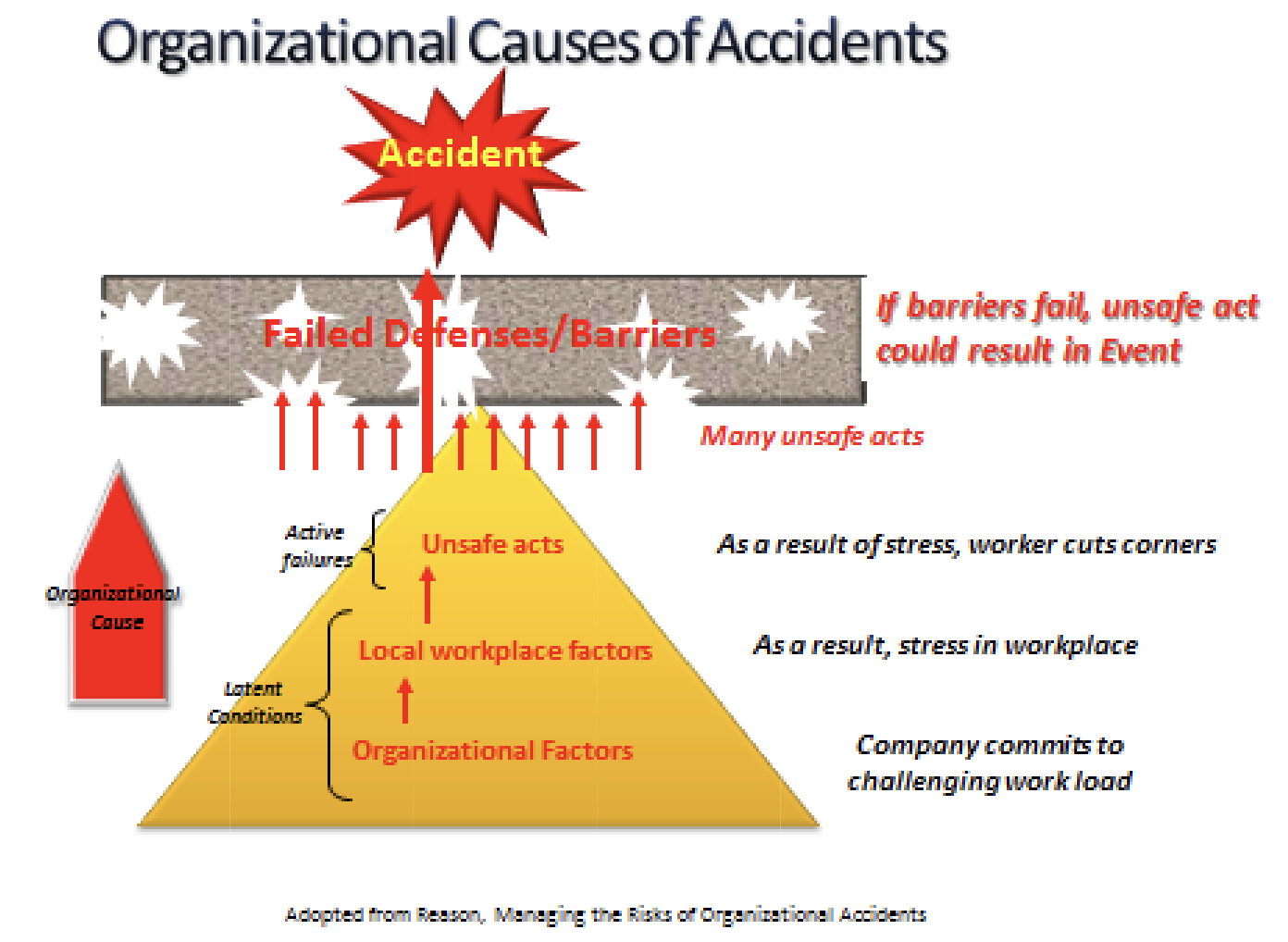
The accident sequence begins with the negative consequences of organizational processes (i.e., decisions concerned with planning, forecasting, designing, managing, communicating, budgeting, monitoring, auditing, and the like). Another very influential factor is the system’s safety culture.
Some of the latent conditions thus created are transmitted along departmental and organizational pathways to the various workplaces where they show themselves as conditions that promote errors and violations (e.g., high workload, time pressures, inadequate skills, and experience and poor equipment)
At the level of the individual at the ‘sharp end,’ these local latent conditions combine with psychological error and violation tendencies to create unsafe acts. Many unsafe acts
will be committed, but only very few of them will penetrate the many defenses and safeguards to produce bad outcomes.
The fact that engineered safety features, standards, administrative controls, procedures, and the like can be deficient due to latent conditions, as well as active failures, is shown by the arrow connecting the organizational processes to the defenses.
It is clear that the people at the human–system interface – the ‘sharp end’ – were not so much the instigators of the accident; rather, they were the inheritors of ‘accidents-in-waiting’. Their working environments had been unwittingly ‘booby-trapped’ by system problems. When systems have many layers of defenses, they are largely proof against single failures, either human or technical. The only types of accidents they can suffer are organizational accidents, that is, ones involving the unlikely combination of several factors at many different levels of the system that penetrate the various controls, barriers, and safeguards.

Organizational Accidents Revisited, James Reason, 1997