One of the most critical fundamentals of Occupational Safety and Health and Process Safety, yet it is wildly unknown and rarely used in most workplaces we visit. Still, in the 21st century, we find employers handing out PPE like candy on Halloween without understanding the limitations of that PPE and even if the PPE protection level is adequate for the hazard level. This information and graphics are FREE and come from OSHA’s Safety Management page. I highly recommend that ALL management and Front-Line supervisors be trained in the proper application of the Hierarchy of Controls using this information. It may be some of OSHA’s best work yet!
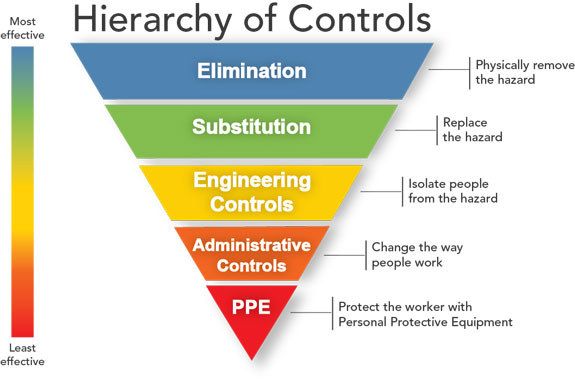 |
The Hierarchy of Controls is a method of identifying and ranking safeguards to protect workers from hazards. They are arranged from the most to least effective and include
Often, we’ll need to combine control methods to protect workers best. For example, a local exhaust system (an engineering control) requires training, periodic inspections, and preventive maintenance (administrative controls). You will also need to consider the feasibility of the necessary controls.
|
| Elimination |
ELIMINATION makes sure the hazard NO LONGER EXISTS. Examples:
|
|
Substitution
|
SUBSTITUTION means changing out a material or process to REDUCE THE HAZARD. Examples:
|
|
Engineering Controls
|
ENGINEERING CONTROLS reduce exposure by PREVENTING HAZARDS FROM COMING INTO CONTACT WITH WORKERS. They still allow workers to do their jobs, though. Examples:
|
|
Administrative Controls
|
ADMINISTRATIVE CONTROLS change the way work is done or give workers more information by providing workers with relevant PROCEDURES, TRAINING, OR WARNINGS. They’re often used together with higher-level controls. They include:
|
|
Personal Protective Equipment
|
Personal protective equipment (PPE) includes clothing and devices to protect workers. PPE needs constant effort and attention (including proper use and training) from workers. Higher-level controls aren’t always feasible, and PPE might be needed in Examples:
|
What Are Feasible Controls?
To decide if a control is feasible, you need to know how well it can protect workers and whether it can be implemented successfully. Consider whether it is:
- Right for the hazard
- Appropriate, given how likely injuries/illnesses are
- Consistent with employer policies, laws, and regulations
- Not too burdensome to workers
- Recognized as an appropriate practice in the industry
- Effective, reliable, and durable
- Readily available
- Cost-effective, short- and long-term
How Can You Use the Hierarchy of Controls?
First you must identify the hazard(s) you are trying to control with workers and their representatives’ participation.
Then, think about how you can block the path between the worker and the hazard. Brainstorm ways the hazard can be eliminated, substituted, engineered out, administratively controlled, or what PPE can be used with other controls. Ask:
- What are the pros and cons of each method?
- Are the controls feasible in our workplace? Why or why not?
- Where do the feasible controls fall in the hierarchy?
Collaboratively choose the control(s) that falls highest on the hierarchy. If it will take time to implement, use one or more of the lower options you identified as interim controls until the permanent solution is in place. Remember that you may need a combination of control methods (such as engineering controls plus administrative controls) to provide the best level of protection. Be sure to
comply with any workplace regulations which may require specific types of control for certain hazards.
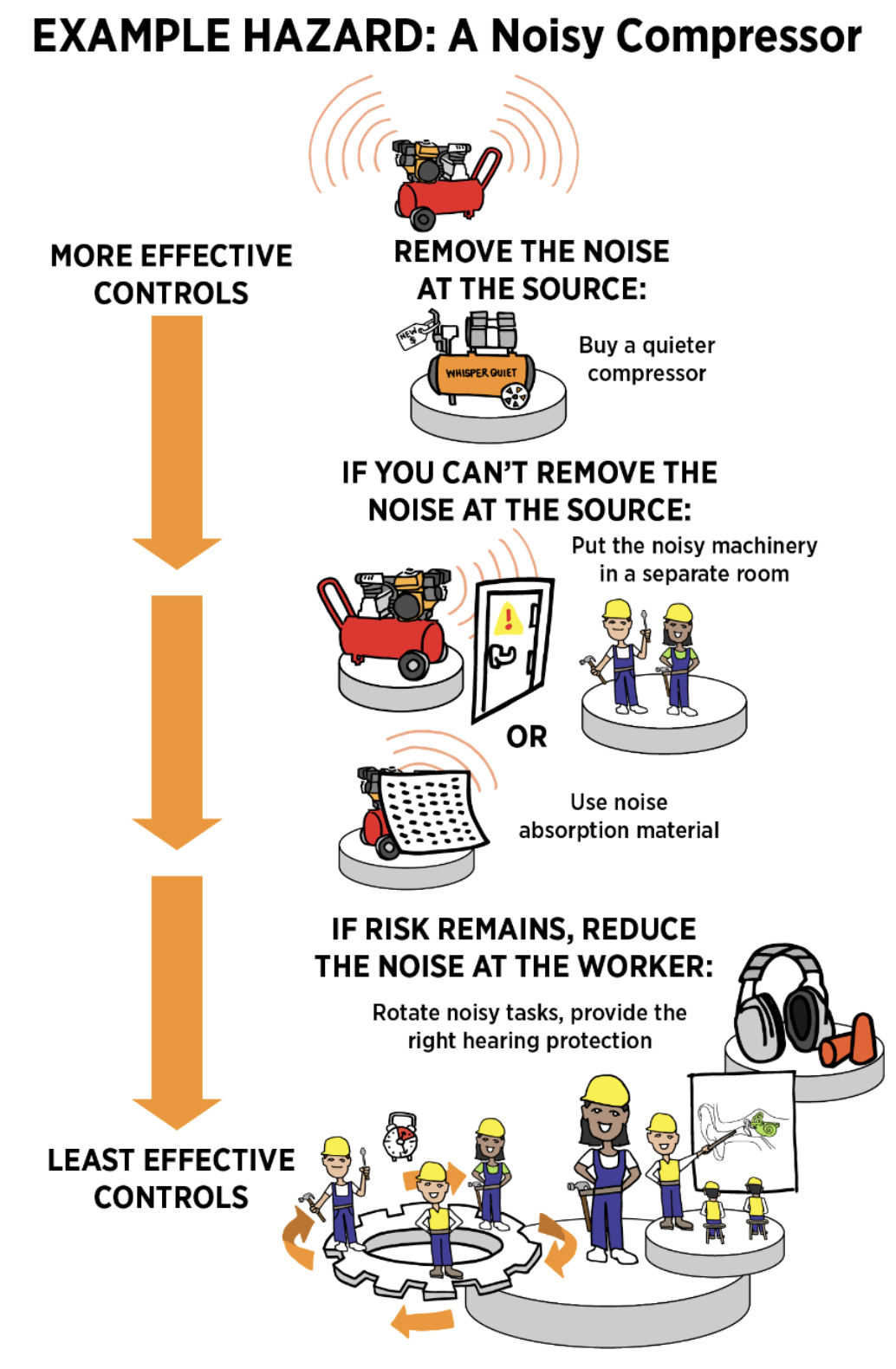
See Members Area/Document Library/Safety Management System for my PowerPoint