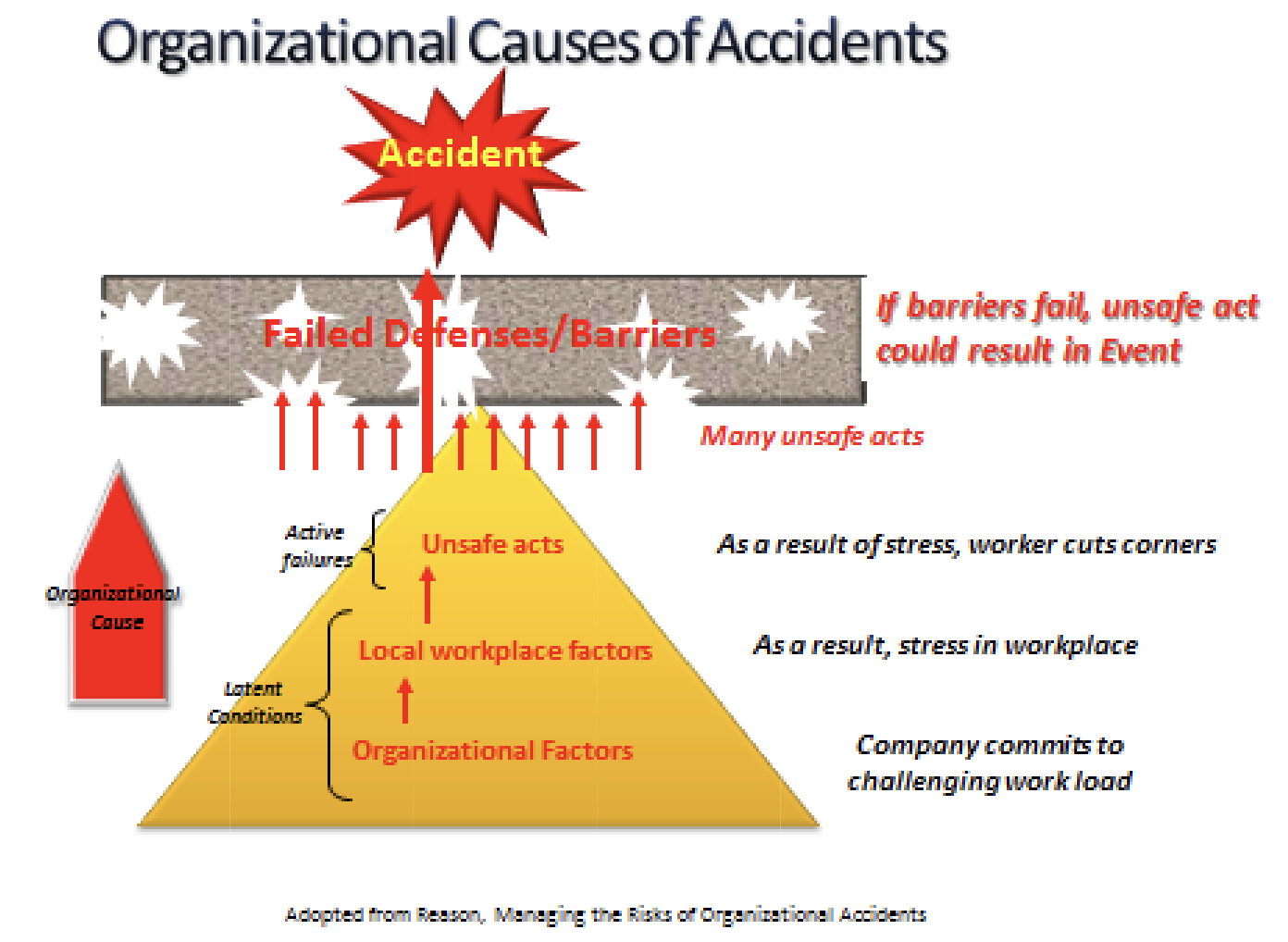
In almost all of the accident investigations I have been asked to participate in, the local management team was very quick to blame “active failures”. This almost always involves some blame being placed on the human; after all, they were directly involved, and had they “not made the mistakes,” the accident would not have occurred. Hard to argue with such blatant facts. However, as investigators, it serves us well to understand any “latent failures” that were in place that simply set the worker up to fail. We coin the phrase… “it was an accident waiting to happen” when we are really saying there were “latent failures” that contributed to the incident. And in some investigations, I walk away convinced that the “latent failures” played more of a role than the active failures that occurred the moments leading up to the consequence. Here is a breakdown of what “active” and “latent” failures are:
Active Failures have an immediate consequence and are usually made by front-line people such as drivers, control room, and machine operators. These immediately preceded and are the direct cause of the accident.
Latent failures are those aspects of the organization which can immediately predispose to active failures. Common examples of latent failures include (HSE 1999):
- Poor design of plant and equipment;
- Ineffective training;
- Inadequate supervision;
- Ineffective communications; and
- Uncertainties in roles and responsibilities.
Latent failures are crucially important to accident prevention for two reasons:
- If they are not resolved, the probability of repeat (or similar) accidents remains high regardless of what other action is taken;
- As one latent failure often influences several potential errors, removing latent failures can be a very cost-effective route to accident prevention.
Classifying Active Failures
Dr. James Reason (1990 Swiss Cheese Model) distinguishes between intentional and unintentional errors in his classification of active failures. Intentional errors are described as violations, whilst unintentional errors are classified as either slips/lapses or mistakes. These types of human failure are shown in the diagram below:

Slips and Lapses: These occur in routine tasks with operators who know the process well and are experienced in their work:
- They are action errors that occur whilst the task is being carried out;
- They often involve missing a step out of a sequence or getting steps in the wrong order and frequently arise from a lapse of attention;
- Examples are operating the wrong control through a lapse in attention or accidentally selecting the wrong gear.
Mistakes are inadvertent errors and occur when the operator considers the elements of a task.
They are decisions that are subsequently found to be wrong, although the operator would have believed them to be correct at the time. There are two types of ‘mistake’ (HSE, 1999), rule-based and knowledge-based:
- Rule-based mistakes occur when a series of rules govern the operation at hand. The error occurs when an inappropriate action is tied to a particular event.
- Knowledge-based errors occur in novel situations when you are beyond your skills and the provision of the rules, and you have to rely entirely on adapting your basic knowledge and experience to deal with a new problem.
Violations are any deliberate deviation from the rules, procedures, instructions, and regulations deemed necessary for the safe or efficient operation and maintenance of plant or equipment. Breaches in these rules could be accidental/unintentional or deliberate.
Violations occur for many reasons and are seldom wilful acts of sabotage or vandalism. The majority stem from a genuine desire to perform work satisfactorily given the constraints and expectations that exist. Violations are divided into three categories: routine, situational and exceptional (HSE,1999).
-
Routine Violations are ones where breaking the rule or procedure has become the normal way of working. The violating behavior is normally automatic and unconscious, but the violation is recognized by the individual(s) if questioned. This can be due to cutting corners and saving time. or be due to a belief that the rules are no longer applicable.
-
Situational Violations occur because of limitations in the employees’ immediate workspace or environment. These include the design and condition of the work area, time pressure, number of staff, supervision, equipment availability, and design and factors outside the organization’s control, such as weather and time of day. These violations often occur when a rule is impossible or extremely difficult to work to in a particular situation.
-
Exceptional Violations are violations that are rare and happen only in particular circumstances, often when something goes wrong. They occur to a large extent at the knowledge-based level. In attempting to solve a novel problem, the individual violates a rule to achieve the desired goal.
Latent Failures
Latent failures are the factors or circumstances within an organization which increase the likelihood of active failures. Consider some examples of latent failures in relation to the example accidents given earlier.
Other latent failures common in industrial settings are:
Attitudes to Safety: An organization’s safety culture is established, in part, by the attitudes to safety shown by management and supervisory staff. Unless managers lead by example and visibly demonstrate their commitment to safety, no amount of hard work in preparing and establishing rules and procedures and providing training will have any lasting effect.
Rules & Procedures: Rules and procedures provide the framework upon which safety assurance is built and are claimed to be effective control measures. However, this is little more than an assumption rather than a proven reality. Studies have shown that safety rules and procedures are often:
- Written negatively, concentrating on what should not be done rather than on what should be done;
- Impractical;
- In conflict with other rules
Training: Little consideration is given to evaluating its effectiveness within training programs. It cannot be assumed that by simply attending a training course means that one is adequately trained. Other common problems with training programs include:
- Hazard awareness is often assumed rather than training;
- Training should concentrate on what is safe, rather than unsafe, what to do, rather than what not to do.
- Training is not always consistent with the rules and procedures.
Equipment design & Maintenance: limitations in the standard of ergonomics applied to the design of the equipment/plant increase the risk of human error. Whilst it is usual to associate design limitations with unintentional errors, i.e. slips & mistakes, poor designs also motivate operators to violate safe working procedures.
Conclusions:
- Human Error is more than operator error. Everyone makes errors no matter how well trained and motivated they are.
- It is useful to distinguish between active and latent failures.
- Active failures are those hands-on operator errors that immediately precede an accident.
- Latent failures are the factors or circumstances within an organization which increase the likelihood of active failures. Latent failures lie hidden until they are triggered at some time in the future.
- Active failures are analogous to the immediate cause, and Latent failures are analogous to the underlying or root cause.