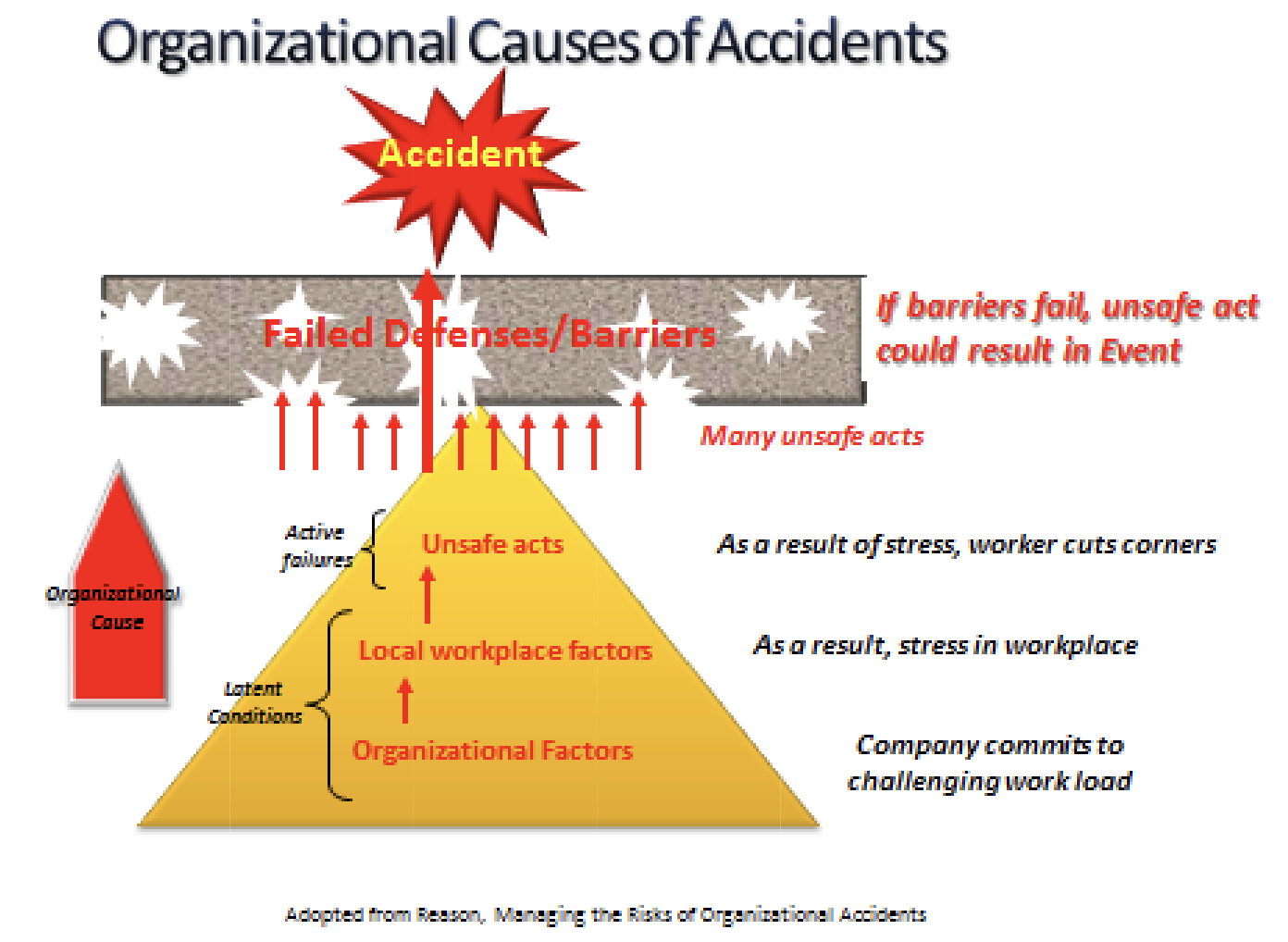
Taking from the “Five Themes for Excellence in Safety Management Systems (SMS)”, we can look at a facility’s incident investigation process through this lens of excellence and measure the maturity of the safety culture. To recap the progression, here are the five levels:
- Ad-Hoc
- Managed
- Standardized
- Predictable
- Excellence
Using an organization’s incident investigation process, we can see where they lie on the path to SMS Excellence.
Ad-Hoc – Evidence of a blame culture when something happens
- There is no evidence of effective investigations, and the organization’s culture is to find someone to BLAME.
- Employees do NOT believe it safe to speak up and, therefore, tend to COVER UP GENUINE ERRORS.
- The organization focuses on the actions of the individuals RATHER THAN LOOKING TO CHALLENGE THE ADEQUACY OF SYSTEMS AND RISK CONTROLS.
- No training in investigation techniques, no independent investigators.
- No joint investigations of incidents during collaborative ventures.
Managed – Culture is to accept inconsistencies in investigations and superficial recommendations which do not improve risk management
- Incidents are investigated, but only where the organization’s guidance directs. The investigation process followed is not proportionate to the risk.
- Frequently, only immediate causes are identified and investigated.
- The range of incidents investigated is LIMITED TO ACCIDENTS.
- Recommendations are limited to preventing the same thing at the same location from happening again. They do not identify areas for broader improvement.
- Investigations are carried out only by safety professionals and managers who are not independent of the incident.
- Inconsistent use of investigations during collaborations.
- Confidential incident reporting is embedded in the investigation process.
Standardized – general understanding of the importance of quality investigations into a range of occurrences generating recommendations that improve systematic control of risks
- The defined management arrangements for when and how investigations are carried out are followed consistently across the organization.
- The underlying causes of an incident are identified and investigated. Investigations are also carried out after a near miss or near hit and H&S complaints.
- The investigation team selected is proportionate to the type and severity of the matter under investigation.
- Employee representatives participate in the investigation.
- There are systems in place to ensure that the competence of investigators is maintained.
- The investigation procedures include collaborative working and the need to investigate reports of non-compliance, non-conformance, near miss / hit reports and H&S complaints.
- Human factors and human performance are considered as part of the investigation and the training for investigators.
Predictable – Investigations and recommendations arising from them are generally accepted as ESSENTIAL WAYS OF IMPROVING RISK MANAGEMENT
- The quality of investigation produces recommendations that can be applied across the entire organization.
- The range of incidents investigated includes, where appropriate,
- non-compliance,
- non-conformance,
- near miss/hit reports, and
- health and safety (H&S) complaints or disruptions to work and where expected outcomes are not achieved.
- Investigations produce recommendations that can be applied across the organisation and relevance outside the organisation is routinely considered as is the impact of the recommendations on risk management.
- Employee representatives, including, where appropriate, trades union safety representatives, are actively involved in investigations.
- The effects of recommendations from investigations on risk control in collaborative working are themselves reviewed to demonstrate improvements in
risk control.
Excellence – There is a ‘just’ organizational culture where all employees openly and honestly participate in the investigation. All employees see Incident investigation as an opportunity to deliver CONTINUOUS IMPROVEMENT, and managers respond fairly
- The organization actively seeks to implement findings from EXTERNAL investigations to support continuous improvement.
- Managers and board members have objectives to review reports of external investigations from the industry and other sectors to identify opportunities for CONTINUOUS IMPROVEMENT.
- Relevant investigation outcomes are routinely shared within and outside of the organization.
- Board members and executive leadership actively promote and support the development of techniques and training for investigations.
- Collaborative working incidents are investigated to learn lessons that aid continuous improvement.
Source: RM3, 2019 – The Risk Management Maturity Model (UK’s HSE)