To improve safety performance, coherent action is required in three (3) areas:
- technical aspects,
- safety management, and
- human and organizational factors
These different “pillars” all influence the “culture of safety” within an organization. It should be emphasized that, in any given organization, safety priorities have undergone several phases of chronological development, with each new area of concern being added to the previous in order to improve safety performance:
- a phase focusing on actions in the technical sphere (facility design, equipment quality, redundancy, fault sensors, automated protection systems, etc.);
- followed by the development of safety management systems (SMS, formalization of all processes, procedures and rules implemented to promote safety); and finally, more recently,
- recognition of the importance of human and organizational factors (HOF), or in other words the identification and integration of the factors necessary in order for a human activity to be conducted efficiently and safely
These three “pillars of safety” – namely the technical aspects, the SMS, and HOF – are, of course, not independent from one another: well-designed and well-maintained facilities, along with clear, applicable rules contribute to safe human activities. In this three-pillar representation, some place “safety culture” in the “human and organizational factors” category, by focusing the approach on the behaviors of individuals. But an organization’s culture is also directly influenced by the technical aspects and by safety management.
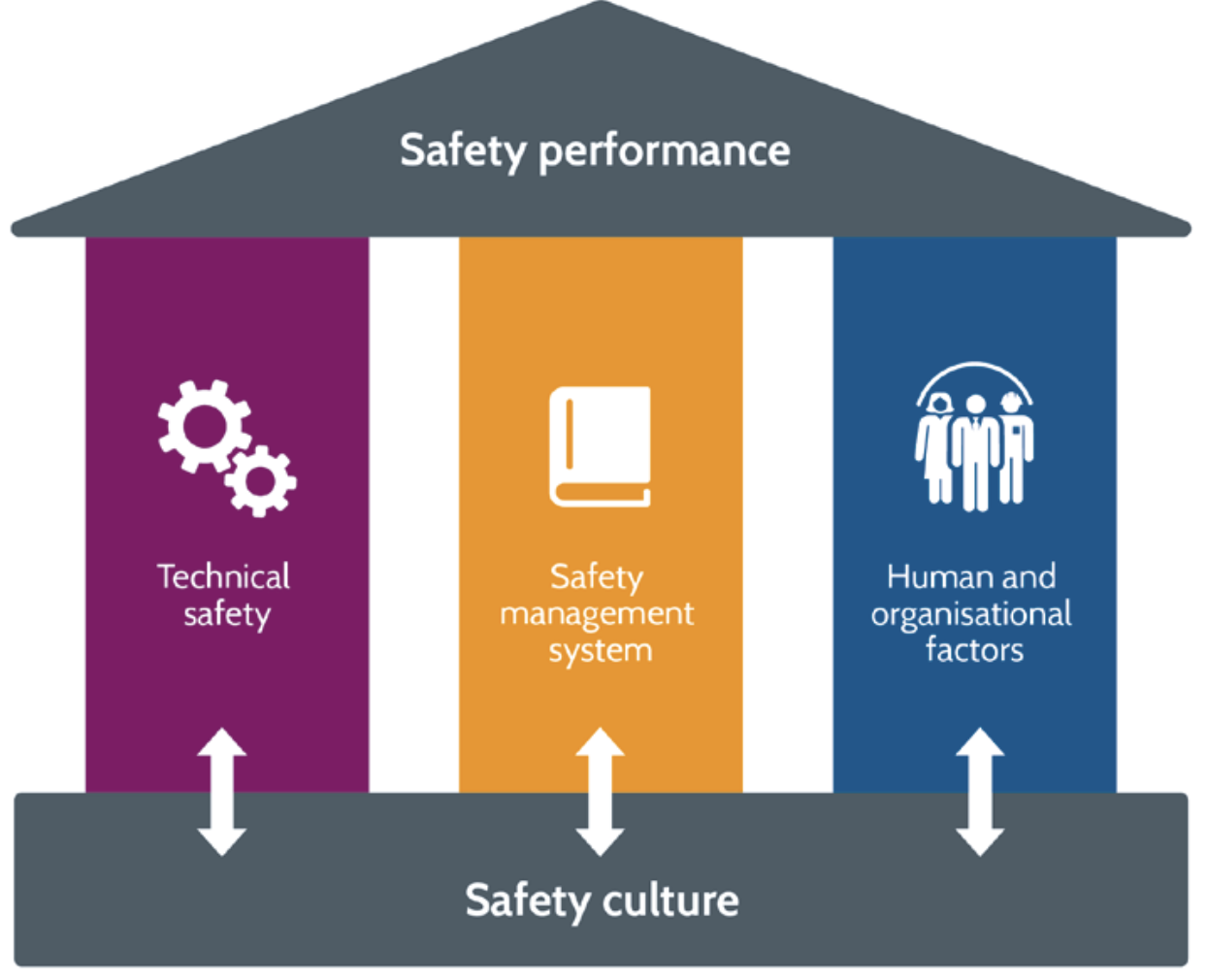
In fact, there is a two-way relationship between safety culture and these three “pillars of safety”:
- The safety culture results from the organization’s technical safety and management systems practices: defective technical systems and rules and procedures that are difficult to apply will be perceived as signs that the organization attaches little importance to safety and will contribute to the disengagement of all actors.
- The organization’s safety culture influences the decisions that are made in terms of technical design and rule formulation: for example, if the company has a participatory culture, operational staff are involved in the facility design process and in the drafting of procedures.
It is impossible to change the safety culture without modifying the signals that the organization sends through the greater or lesser quality of what it offers in terms of technical design, safety management systems, and integration of human and organizational factors.
Source: The ICSI “Safety Culture” working group (2017). Safety Culture: from Understanding to Action. Issue 2018-01 of the Cahiers de la Sécurité Industrielle collection, Institut pour une Culture de Sécurité Industrielle (ICSI), Toulouse, France. Available as a free download from: http://www.icsi-eu.org/