










On August 28, 1992, a cryogenic tank ruptured in Hokkaido, Japan, and is a textbook case study in the catastrophic consequences of completely isolating a cryogenic vessel.
The explosion occurred in the middle of the night at a food processing factory. The blast destroyed the upper half of the facility, damaged 25 surrounding buildings, and wrecked 39 parked vehicles within a 1,300′ radius....
Read More
The purpose of this Safety Alert is to highlight the risks associated with compromised pressure relief circuits on Cryogenic Tank Containers. Cryogenic Tank Containers are commonly used for transportation and/or storage of cryogenic liquids, including, but not limited to, Nitrogen, Oxygen, and Argon.
A large explosion occurred at a cryogenic gas transport depot in Tamworth, NSW, in a cryogenic tank...
Read More
The transfer of hazardous materials from a cargo-tank motor vehicle to fixed-site storage poses a critical vulnerability in chemical handling. While high-speed highway collisions capture more attention, the Pipeline and Hazardous Materials Safety Administration (PHMSA) estimates that roughly 25% to 50% of serious HAZMAT transportation incidents actually occur during loading and unloading operations.
These...
Read More
At all times relevant to this CA/FO, Respondent operated a facility (the “Facility”) that utilizes anhydrous ammonia for cooling to pack, process, and distribute its food products. On July 11, 2024, EPA performed an inspection of the Facility to evaluate compliance with the Comprehensive Environmental Response, Compensation and Liability Act (“CERCLA”) Section 103, the Emergency Planning and Community...
Read More
At all times relevant to this CA/FO, Respondent operated a facility (the “Facility”) that utilizes anhydrous ammonia to manufacture and produce citrus products, to develop frozen fruit concentrate, juice, oils, and pulps from oranges, lemons, and grapefruits. On October 24, 2023, EPA performed an inspection of the Facility to evaluate compliance with the Comprehensive Environmental Response, Compensation...
Read More
When we introduce a pipe welding machine (such as an orbital welder) into the fabrication process, the focus of the certification fundamentally shifts. Under industry codes such as ASME Section IX, the individual operating the equipment is no longer classified as a “Welder”; they are designated as a “Welding Operator.” Because the machine handles the actual puddle manipulation...
Read More
I am working with a client who is making every effort to comply with the Maximum Allowable Quantity (MAQ) limits for a flammable liquid process area. This process is a PSM-covered process, so I offered up how to work beyond the MAQ of 480 gallons1 for a fire control area. This compliance option 5001.3 was officially introduced in the 2015 edition of the IFC; however, a version of it first appeared...
Read More
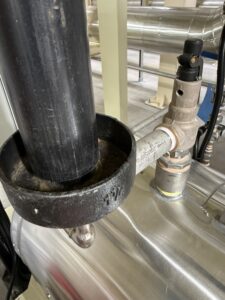
It is designed to collect and remove condensate while isolating the relief valve from the mechanical stresses of the discharge piping.
Here is a breakdown of its primary functions and operational mechanics:
…
HomeRead More »
Read More
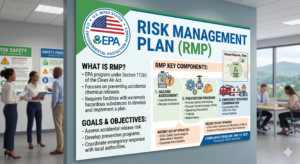
One state and two territories no longer implement the program, and the Regional office has taken over implementation for those three (3) areas. One (1) county in KY and three (3) counties in NC have been delegated enforcement authority. FL, ND, and MO have a partial delegation for either LPG or NH3.
The current list of delegated states is:
…
HomeRead More »
Read More
I grew up in the process industries doing PSM/RMP; however, most of the air receivers at my plants were NOT associated with the PSM/RMP-covered process(es). And yet they were all in our MI program for routine inspections and testing of their PSVs. In fact, every pressure vessel in service on the plant site and its associated PSVs were managed the same way we managed our PSM/RMP pressure vessels....
Read More
OSHA has made significant changes to Chapter 4, The VPP Safety and Health Management System. Chapter 4 now requires VPP participants’ SHMS to consist of the seven (7) core elements described in OSHA publication 3885, Recommended Practices for Safety and Health Programs, October 2016, and in OSHA publication 3886, Recommended Practices for Safety and Health Programs in Construction, December 2016. These...
Read More
NOTE: If you’re in an INDUSTRIAL facility, especially one with a PSM/RMP-covered process, B31.9 is NOT your piping RAGAGEP!
IFC 5703.6.3 dictates that piping for flammable and combustible liquids must be hydrostatically tested to 150% of the maximum anticipated pressure (or pneumatically tested to 110%). However, it offers a carve-out:
“Unless tested in accordance with the applicable...
Read More