













At 5:00 p.m. on January 30, 2023, two employees, 24 and 48, were performing operations pertaining to an autoclave. The atmosphere was oxygen deficient due to the presence of argon gas. The employees were asphyxiated and killed.
Source: https://www.osha.gov/ords/imis/accidentsearch.accident_detail?id=153529.015
Read More
At 6:45 a.m. on February 18, 2023, an employee, 31, was removing trays from a hydrogen reactor. The employee was on SUPPLIED BREATHING AIR. The employee attempted to exit the confined space at the end of the shift when he reported to the attendant that he could not breathe.
The attendant told the employee to turn on his emergency escape bottle. The employee then reported that he was on the bottle.
The attendant...
Read More
At 12:30 p.m. on January 31, 2023, Employee #1, 45, performed cathodic protection maintenance on a 4-inch natural gas pipeline. Employee #1 removed the resin coating off the external portion of the pipeline to test the hull thickness of the pipeline. While removing the coating, the pipeline exploded.
Employee #1 was killed by immolation.
Employee #2 and Employee #3 were injured from the heat, blast,...
Read More
At 11:45 a.m. on February 23, 2023, an employee, 20, working for a city water department, was repairing a leaking 12-inch PVC waterline main valve. The valve was located in a utility vault approximately 5 feet deep. The employee turned off the water to the WEST of the valve by opening multiple fire hydrants. He and a coworker closed the valve, stopping the water from flowing from the west. The employee(s)...
Read More
At approximately 12:00 p.m. on February 24, 2023, an employee, 35, was performing “well site pumping operations” for an oil and gas producer. A coworker had been trying to contact the employee unsuccessfully, so he went to the oil and gas well site where the employee was working to check on him. The coworker found the employee unresponsive in the small 9-foot by 10-foot well shack. The...
Read More
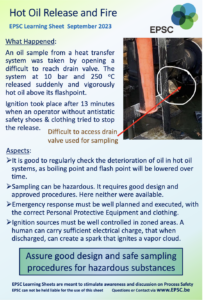
One of the worst injury accidents of my career occurred in a PSM/RMP-covered process but involved a non-HHC/EHS. The chemical was “hot caustic,” a byproduct from the process used in another process’s scrubber. A sister facility had an incident in which it was discovered that the caustic was too weak. Thus in a process upset, the scrubber failed to perform correctly, leading...
Read More
Five (5) workers died after inhaling suspected poisonous gas emanating from a tank at a food factory in Madhya Pradesh’s Morena district. The incident happened in the Sakshi Food Products factory.
Gas began emanating from a tank at the factory that makes food products around 11 am, and two (2) workers entered it to investigate. Both workers lost consciousness after they entered the tank and were inside...
Read More
We are seeing more and more of this type of set-up, where an auxiliary piece of equipment on an assembly/production line has two (2) electrical supplies. One is from the main SWITCH on the line, and one is from a separate source. This is usually done when the auxiliary equipment may need to stay energized during interruptions.
An excellent example is a hot glue machine used in packaging...
Read More
Free
Human Factors Engineering
Motivational Safety Materials
Safety Management System
Safety Thought of the Week
If we reverse the brake and accelerator pedals on your car, even if you are warned, and a sign reminds you, you can be sure that sooner or later you will press the accelerator when you meant to brake.
Source: Human and organizational factors of safety: a state of the art, Daniellou, F., Simard, M. and Boissières, I. (2011)
Read More
Most facilities will have a few pieces of equipment that require using a dozen or more energy isolation devices to achieve a full LO’ed situation. Most businesses, at least early on in their implementation of LOTO for these pieces of equipment, will state ALL energy isolation devices will be utilized regardless of the scope of work being performed. This may seem like the “safest”...
Read More
1101.1 Scope.
This chapter shall govern the design, installation, construction, and repair of refrigeration systems. Permanently installed refrigerant storage systems and other components shall be considered as part of the refrigeration system to which they are attached.
1101.1.1 Refrigerants other than ammonia.
Refrigeration systems using a refrigerant other than ammonia shall comply with this chapter,...
Read More
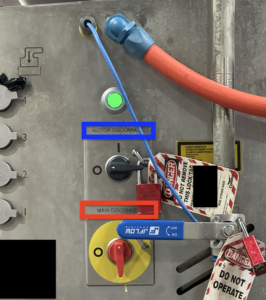
Have you ever seen a setup on a machine, typically those manufactured outside of the USA, with two (2) electrical disconnects?
Most of the time, these disconnects are COLOR-CODED to clearly identify their different uses, although we have seen some that were NOT color-coded, nor were they properly labeled! Here is an example of what this may look like; I have highlighted both switches with...
Read More