








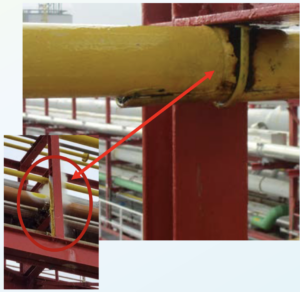
A pipe with 100 psi liquified Chlorine started to leak at the point where the pipe is connected to the plant construction. The pipe was high in a pipe bridge without easy access for inspection, which was done 6 months prior. The inspection missed this critical point.
…
HomeRead More »
Read More

On February 2, 2011, Employees #1 and #2 worked for a petroleum and petroleum product company. Employee #1 was on top of a transport tanker into which the firm’s vice-president transferred #1 diesel fuel, mixing it with about 1,000 gallons of #2 diesel fuel. Employee #2 was on the ground.
After “splash filling” the center tank with about 300 gallons of #1 diesel fuel, the firm’s...
Read More
In this video, we can see BOTH operators fail to vent the gasoline vapors BACK into the truck. Instead, they vent them to the atmosphere at ground level. Gasoline vapors are 2X the weight of air, so they travel along the ground until they find an adequate ignition source (<1 mJ) and accumulate to their LEL (<2%).
We can see a lot of items that should be discussed in the incident investigation...
Read More
A piece of safety to ponder over your weekend…
Auditing is NEVER about the number of findings.
We just experienced a facility with no PSM/RMP elements in place, and they have three (3) covered processes. With nothing to audit, they ended up with less than 25 findings (but they are massive findings that will take years to close).
A sister facility we audited in January with an advanced PSM/RMP...
Read More
Control banding is a generic technique used to guide the assessment and management of workplace risks for chemicals without an occupational exposure limit (OEL). The majority of chemicals in commercial use do not have an established OEL. OELs include NIOSH Recommended Exposure Limits (RELs) and OSHA Permissible Exposure Limits (PELs). OELs help to assess and manage chemical risks in the workplace....
Read More
WHY OIG CONDUCTED THE AUDIT
OSHA is responsible for ensuring safe and healthful working conditions for millions of workers nationwide and does so partly by conducting inquiries and inspections of potential hazards. For Fiscal Year (FY) 2019 and FY 2020, inspections from complaints and referrals were slightly greater than 40 percent of OSHA’s total inspections.
A complainant expressed concern that OSHA...
Read More
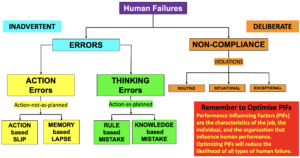
I have written extensively about James Reason’s Human Failure model and how it applies to almost all workplaces. Today I want to discuss specifics on how to use his model in our causal analysis.
For those already using some form of a Fault-Tree Analysis, such as TapRoot, you already have this capability built into your software. But many are not using commercial software to...
Read More
Inside storage rooms (Liquid Storage Rooms) are normally used:
when the containers are opened for mixing, pouring, dispensing, or transfer of flammable liquids;
if the quantity is too large to fit into an approved cabinet;
if the quantity is excessive for any one fire area; and/or
if the opened containers cannot be separated from potential sources of ignition.
As defined by NFPA 30 paragraph...
Read More
Recently we worked with an organization that was struggling to control its risks around the use of ATVs and UTVs. After several serious accidents involving these machines, we were asked to review their “Barriers,” “Controls,” and “Safeguards” in place to control the risks associated with these machines. We found a program and training on the said program...
Read More
The Department of Industrial Relations Occupational Safety and Health Appeals Board (OSHAB) has issued a precedential decision regarding the provision of water at outdoor worksites, affirming that it must be as close as practicable to the areas where employees are working to encourage frequent consumption.
The case clarified the definition of what “as close as practicable” means with water placement...
Read More
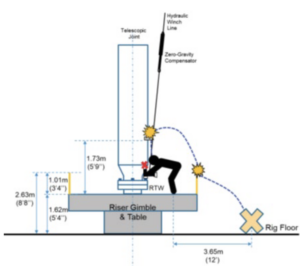
During well operations, a fatality occurred on a drillship in the Gulf of Mexico. While unlatching the lower Marine Riser Package from the Blowout Preventer in preparation for ship relocation, a crew member was lifted into the air after being struck by a hydraulic torque wrench (HTW), hitting a riser clamp approximately six feet above the elevated work deck before falling to the rig floor. The...
Read More
Think about the kids who came from abusive homes vs. those who came from supportive homes where they knew they were loved.
It isn’t all peaches and cream, but they KNOW when they are loved and supported, and it shows in how they live their lives and in how they make decisions.
We hold our kids responsible when they fail but look at the number of posts on social media of parents celebrating their...
Read More