







At 8:15 a.m. on February 1, 2022, an employee poured paraformaldehyde into an aqueous ammonia solution inside a vessel. There was a chemical reaction, resulting in an explosion. Two employees suffered chemical burns to their backs and arms, and one of the employees was hospitalized.
…
HomeRead More »
Read More
At 3:10 p.m. on February 2, 2022, an employee, 26, performed maintenance on a Raven AccuFlow System Applicator. The employee began the ammonia bleeding procedure wearing safety glasses and rubber gloves. After approximately 20 to 30 minutes, the employee no longer heard a whistling sound and believed that the system was completely bled out. When the employee removed the filter cap, the remaining anhydrous...
Read More
The Respondent is a wholesale gas supplier. Operations include the filling, storing, and transfer of industrial gases. The facility receives bulk gases in tanker trailers and then transfers them to storage tanks before transferring them to smaller containers or back into tanker trailers for wholesale. Additionally, the facility receives nearly empty bulk trailers and containers that must be emptied...
Read More
OSHA’s PRCS standard defines the terms Blinding and Blanking in the same definition, but there is actually a difference between these practices. Here is OSHA’s definition:
Blanking or blinding means the absolute closure of a pipe, line, or duct by the fastening of a solid plate (such as a spectacle blind or a skillet blind) that completely covers the bore and that is capable of withstanding...
Read More
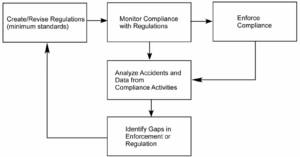
As my time in the railroad industry comes to an end, I broke the ice with the FRA through some close friends in DOT/PHMSA to understand why/how the railroads are 50 years behind the times in how safety is managed. Through our many and lengthy discussions (many thanks to E.J. and others), I received a “White Paper” on a study that the FRA did after the 2005 Graniteville, SC accident...
Read More
The rupture of the V-1 vessel appears to have caused a boiling liquid expanding vapor explosion (BLEVE, pronounced ‘blev-ē). A BLEVE is the “sudden loss of containment of a pressure-liquefied gas existing above its normal atmospheric boiling point at the moment of its failure, which results in rapidly expanding vapor and flashing liquid. The release of energy from these processes (expanding...
Read More
The City of New Orleans Office of Inspector General (OIG) conducted a performance audit of the City of New Orleans’ (City) Department of Safety andPermits (S&P). The objective of the audit was to determine if S&P inspectors (City inspectors) conducted their inspections in accordance with S&P policies and procedures. The scope of the audit was all building, mechanical and electrical permit...
Read More
Updated on 11/1/22
Effective Date: October 22, 2022
This rule created a new chapter, refinery worker training and certification in high-hazard facilities, implementing the advanced safety training requirements under chapter 49.80 RCW, adopted by the Washington State legislature in 2019. Chapter 49.80 RCW, requires owners of petroleum refining or petrochemical manufacturing facilities to use...
Read More
New York City’s Community Right-to-Know Law (Local Law 92) requires facilities where extremely hazardous substances or regulated toxic substances are present at or above federally determined levels (Threshold Planning Quantity), to prepare and submit a Risk Management Plan to the Department of Environmental Protection on or before March first of every year. In situations where a substance is...
Read More
We have recently heard the phrase “inherent safety” used by OSHA and EPA as both agencies work at revising/updating their process safety standards. But what exactly is “inherent safety,” and why is it at the top of the Hierarchy of Controls for process safety?
Inherently safer practices are an approach to designing safer chemical plants, chemical processes, and storage...
Read More
A manufacturing company that works with dangerous chemicals faces $192,620 in fines for 46 serious and 17 general safety and health violations. The facility formulates products for agricultural fertilizer, airports, pulp and paper, and water treatment. Washington State Department of Labor & Industries (L&I) inspectors found 13 violations relating to confined space entry rules due to workers...
Read More