













I am betting most everyone has heard the old phrase, “that’s an accident waiting to happen.” My brother (also a safety engineer) and I have pondered whether our father, who used that phrase often, influenced our career choices more than we had ever imagined. But how many safety professionals understand what this phrase is saying?
…
HomeRead More »
Read More
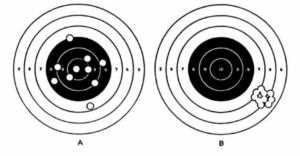
Think about it… Here are the ten (10) elements of your SMS. Of course, we want all 10 to perform in the bulls-eye, but we know safety is a continuous improvement project that takes years. Which process (Target A or Target B) is more advanced, more capable of achieving the desired results, and the one easiest to get to the “bulls-eye”? (Image is from James Reason’s Human Err...
Read More
We see it just about every day; heck, we even see it with safety people… not properly rolling, lifting, inserting, and holding their hearing protection as they insert them. But noise is a “chronic” hazard and thus far too many workplaces fail to respect it. Unfortunately, in the vast majority of projects, we have completed for clients, engineering controls was by far the...
Read More
How did you spend your Friday night and Saturday? Me? I spent mine helping a client manage a traumatic injury to a new employee with less than 3-weeks on the job. And like most employers, this company truly cares about their employees and honestly wants the best for their employees. This business may be the last of the companies that cover 100% of the insurance costs for their...
Read More
Although it may be possible to accept that errors are neither as numerous nor as varied as they might first appear, the idea of a predictable error is a much harder one to swallow. If errors were indeed predictable, we would surely take steps to avoid them. Yet they still occur. So what is a predictable error?
…
HomeRead More »
Read More
Assigning probability values to errors is still very much an art form. Nonetheless, there is sufficient general agreement about the likelihood of errors occurring in various generic tasks to put them into sensible rank order. Their main use is to provide benchmarks for the range of error probabilities over different jobs.Here is a list of several well-researched error-enforcing conditions (EEC)....
Read More
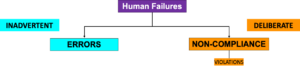
Unsafe acts are of two (2) distinct types:
Errors and
Violations
Errors arise from informational problems and fall into three categories:
…
HomeRead More »
Read More
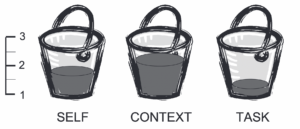
When we were children, adults frequently told us to stop and think—good advice, but they rarely told us what to think about. I have sought to overcome this omission with the ‘three-bucket’ model described below. This model forms the basis of the mental skills designed to impart error wisdom and risk awareness.
The buckets correspond to the three features of a situation that influence the likelihood...
Read More
EPA is proposing to require all facilities with Program 2 and 3 processes to conduct a root cause analysis as part of an incident investigation for an RMP-reportable accident as defined under 40 CFR 68.42. This includes requiring the root cause analysis to include specific elements, requiring the use of a recognized investigation method, and requiring that investigations are completed within 12 months....
Read More
EPA is proposing a requirement in 40 CFR 68.67(c)(9) for some Program 3 regulated processes to consider and document the feasibility of applying safer technologies and alternatives as part of their PHA. This requirement applies to petroleum and coal products manufacturing processes (classified in NAICS code 324) and chemical manufacturing processes (NAICS code 325) that are located within 1 mile of...
Read More
The location of stationary sources, and the location and configuration of regulated processes and equipment within a source, can significantly affect the severity of an accidental release. The location of the stationary source in relation to public and environmental receptors may exacerbate the impacts of an accidental release, such as blast overpressures or concentrations of toxic gases, or conversely,...
Read More
Respondent is the owner and operator of a frozen foods processing facility that includes anhydrous ammonia storage tanks, valves, piping, compressors, freezer tunnels, and other buildings, structures, equipment, installations, or substance-emitting stationary activities from which an accidental release of anhydrous ammonia may occur; which belong to the same industrial group; which are located on one...
Read More