





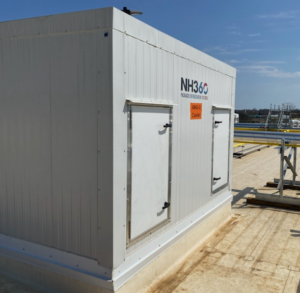
So far, I have discussed Evaporative Condensers and Spiral Freezers, making the case that most of these spaces are indeed Permit-Required Confined Spaces (PRCS). This last space is gaining a lot of traction over the past 10-20 years, and still today, the design of most of these penthouses makes them, without a doubt, a PRCS. In this last article in this series, I will break down the characteristics...
Read More

A worker at a water technology company suffered an injury when a guardrail loosened and he fell and struck his head on a support beam as he lowered himself into a nearly 30-foot deep water test pit. OSHA received the report of the injury on Oct. 29, 2020. Its inspectors later determined that the company exposed employees to walking-working surfaces hazards, failed to provide employees with fall protection...
Read More
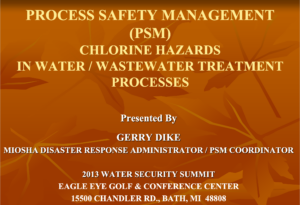
This was buried in my archives by mistake until a member found it while digging through all the PowerPoint presentations. It is from way back in 2008 when I was heavily involved in Water Treatment Plants and their use of Chlorine and the Chemical Facility Anti-Terrorism Standard (CFATS) roll-out. The presentation was put together for a WWTP Summitt by MI-OSHA and is quite detailed as to...
Read More
Monika Chrzaszcz, U.S. EPA, Region 5, presented at this years MI Safety Conference on the matters of Anhydrous Ammonia and how the chemical impacts EPCRA and RMP. Her presentation points out some of the RMP amendments that are in place now and those coming, as well as EPCRA Tier II reporting and release reporting.
Read More
NFPA 499, Recommended Practice for the Classification of Combustible Dusts and of Hazardous (Classified) Locations for Electrical Installations in Chemical Process Areas was updated for 2021 and this update involves a very peculiar reference that has me scratching my head. This reference is also another example of why Safety and Process Safety professionals have come to hate RAGAGEPs and Consensus...
Read More
It’s never a good sign when the EPA inspector is in the process and the operator’s personnel detector goes into alarm and the worried inspector is told… it was typical for the alarm to sound during sampling. This led the inspector to inquire about this level of exposure for a repeated task such as sampling and that opened the door to three (3) SOP findings!
Respondent operates...
Read More
We have discussed this numerous times over the years, but we rarely have a first-hand account of a “bleed” within a DB&B causing an LOPC event. But because CALARP now has a Program 4 Incident Reporting trigger, we get to see firsthand how a 3/4″ bleeder on a 14″ pipe handling a HHC/EHS can cause a serious incident.
On October 5, 2018, a contract employee...
Read More
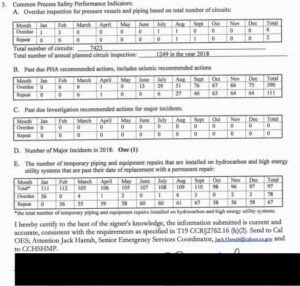
Way back in 2017, the state of California (CA) revised it’s Accidental Release Prevention program by adding a Program Level 4 for the state’s refineries. In addition to the expanded prevention program requirements, the refineries are required to submit investigation reports, including root cause analysis after any major incident. But the one aspect of the Program 4 changes I...
Read More
OSHA currently regulates aspects of emergency response and preparedness; some of these standards were promulgated decades ago, and none were designed as comprehensive emergency response standards. Consequently, they do not address the full range of hazards or concerns currently facing emergency responders, and other workers providing skilled support, nor do they reflect major changes in performance...
Read More
One of the top 5 nastiest checmicals I have encountered during my career is Hydrofluoric Acid and Hydrogen Fluoride (HF). And it just amazes me that humans can convenience themselves that these chemicals are not “really that hazardous”. TRUST ME (and NIOSH), HF has earned its place in my Top 5. Of course, HF is not nearly as prevalent at Anyhrous Ammonia or Chlorine...
Read More
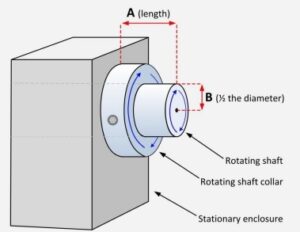
You walk by a power transmission shaft and notice that it is protruding out and seems to be missing its guard/cap. You look all around for it, as we usually can find them sitting on the floor nearby!!!, but no luck. So you report the “hazard” and issue a work-order to install a guard/cap over this protruding powered shaft. Then someone asks… aren’t some of...
Read More
I have to first point out that OR-OSHA is a “state plan” ( and my personal favorite!) and is specific to employers in the state of Oregon (OR), but their 2020 LOI on maintaining SDSs electronically points out something that many (including me) have not considered. I have been telling all my clients for decades that we have to maintain a “hard copy SDS manual” for those...
Read More