







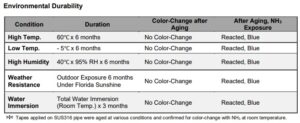
You may have seen this latest and greatest “detection method” in your junk mail, pop-up ads, or in a search of the internet. These tapes work and they work well in my experiences, but as with any product, there are some serious drawbacks that one must understand before using these products. Before I get into specifics, know that the addition of these tapes to your process safety...
Read More

Authorities: Napa man injured by flash fire while cleaning paper shredderA man was hospitalized Saturday morning with a burn injury suffered while cleaning a paper shredder, according to Napa Fire. Firefighters were called to a west Napa house at about 7:50 a.m., where a man was being cooled in a shower after suffering a burn… The man had been using a can of compressed air to clean a shredder...
Read More
Many of you that handle anhydrous ammonia are familiar with The Compressed Gas Association’s (CGA) 2.1, Requirements for the Storage and Handling of Anhydrous Ammonia, which is the baseline RAGAGEP for ammonia fertilizer distributor facilities. But the organization has another ammonia standard, G-2, Ammonia that is an EXCELLENT compliment to CGA 2.1. The G-2 standard is a much broader...
Read More
We have discussed the Maximum Allowable Quantity (MAQ) extensively over the years, but a lot of facilities just can’t stay within the confines of a MAQ so what are they to do? Well, it an easy answer but it is not so easy to meet! In this article, I will explain the four (4) H occupancies and what it means to have an H occupancy – focusing on H-2 and H-3, as these are the most...
Read More
ME-OSHA issues HAZWOPER, PPE, and Calibration Gas citations to Fire Department after Fatal Explosion
ME-OSHA issued two (2) Willfuls and six (6) serious citations to the Fire Department regarding the Sept. 16, 2019 explosion that killed a Captain in a propane explosion. The citations include up to $22,000 in potential fines for the town relating to violations of equipment and training standards.
Here is a breakdown of the citations:
…
HomeRead More »
Read More
In a recent FaceBook Group posting, a member asked about using one of the DOT Special Permits that allows DOT containers/cylinders that came with a 15-year service life to have their service extended to 30 years. I wrote about this very issue in September 2019, explaining the pitfalls of using one of these DOT Special Permits. Bottom line is that DOT allows the cylinders to be re-certified...
Read More
The only item remaining in dispute is Item 3b of the citation. Item 3b alleges a violation of 29 CFR 1910.146(c)(4) for failure to develop and implement a permit-required confined space program to control entry of employees into the Fish Bin Chiller Alley at the Seward plant.
This item was classified as a serious violation with a proposed penalty of $975.
FINDINGS OF FACT
On September 7-8, 2000, Department...
Read More
OSHA has updated their COVID Frequently Asked Questions (FAQ) with the addition of three (3) new Q and A’s regarding COVID vaccinations and recordability related to adverse reactions to the vaccine:
…
HomeRead More »
Read More
I have written many articles on “scrubbing NH3” in preparation for line breaks/equipment openings or emergency removal from a compromised container and with NH3 the scrubbing media is simply water (H2O). I learned these “scrubbing” methods while working one summer in an internship and the safety pro who hired me was also an MSU graduate and he called these simple, yet...
Read More
Chlorine (Cl2) has a strong warning property: most people can detect Cl2 at approximately 0.002 ppm in air (the official odor threshold per the Agency for Toxic Substances and Disease Registry) and 0.31 ppm in water. However, most data indicate an odor threshold of 0.2-0.4 ppm. In other words, even the most minute leak will be detected by most humans, provided that your process is not allowed to run...
Read More
Why can't I pressure my piping and hold it for X hours and if no loss in pressure it passes my test?
This is a common question we get regarding pressure testing and leak testing of process piping. I have written quite a few posts regarding the ASME B31.3 and 31.5 requirements for pressure and leak testing over the years, but this question about holding pressure for 24-hours is one that just will not die. I am not here to say this practice is wrong, I’m just saying it is not one that...
Read More
Most of my clients who are users of Chlorine (Cl2) use it in vacuum systems where the Cl2 is being injected or inducted into a water flow. In these smaller “processes” it is not unusual to find “tubing” being used vs. hard pipe. It took me years to accept the tubing design model as I was always raised that Cl2 is a Category M Hazardous Material per AMSE B31 and thus...
Read More