







I have asked for an official interpretation on this question, but until that arrives I will answer this question as I did for a client this week. Here is the scenario:
There is a significant fire in the RMP covered. The fire does NOT cause a release of the EHS, much less get off-site.
However, out of an abundance of caution, the local emergency response agency (Police, Fire, Sherriff,...
Read More
This is a fascinating case, as the OSHRC has upheld this citation, although they significantly reduced the $ and made it “other-than-serious.” But again, I disagree with this case, as the workers appeared to have been protected during the belt change; they did not follow the LOTO procedure, which I believe was “lazily written.”
This case boils down to a sprawling multi-component...
Read More
OSH ACT of 1970 Section (5)(a)(1): The employer did not furnish employment and a place of employment which were free from recognized hazards that were causing or likely to cause death or serious physical harm in that employees who performed hydrostatic testing were exposed to struck-by hazards due to the lack of specific testing procedures and training necessary to ensure personnel protection.
…...
Read More
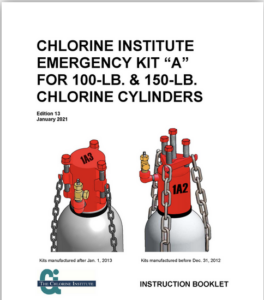
The Chlorine Institute has updated its instruction booklet for applying an A Kit to 100-LB. & 150-LB. Chlorine Cylinders. Remember, these Instruction Booklets can be downloaded for FREE from their bookstore and if your facility is using 100 or 150 pound Cl2 cylinders, the A Kit is a MUST HAVE and training on the proper application of the kit to the cylinder is CRITICAL to containing a leaking...
Read More
Many safety management systems are initially developed in a theoretical environment or for ideal situations with implicit and explicit assumptions about the system’s optimal performance, equipment, and human activities. This is often called WORK-AS-IMAGINED and is formally documented in training, procedures, and equipment operating manuals. Differences between the designed performance or WORK-AS-IMAGINED...
Read More
At 6:52 p.m. on August 10, 2020, three (3) employees attempted to remove a clog from a hydrolyzed. A hydrolyzed apparatus is used to conduct the hydrolysis reaction in starch. The employees were unable to get the steam to release from the pressure vessel. Employee #1, a senior maintenance worker, made the decision to open a flange positioned at the bottom of the pressure vessel to release the steam....
Read More
Knowing the limitation of your respiratory protection can mean the difference between life and death
Once again, a DOT container cleaning company had another fatal PRCS incident (2020) where we have an entrant and a would-be rescuer dying in a hazardous atmosphere – oxygen deficient. In this incident, the would-be rescuer donned a full-face Air Purifying Respirator before he attempted his rescue effort but was overcome by the atmosphere and died. There were so many things done wrong...
Read More
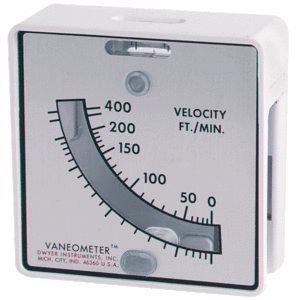
This is a very high-tech and expensive VaneometerTM. I am kidding, it is only around $40 and it may be one of the simplest safety devices we will ever use. But don’t let the price or simplicity fool you – it is an ABSOLUTELY CRITICAL device for those of you that have ventilation systems, especially ventilation intended for flammable vapors/gases. Both the IFC and NFPA...
Read More
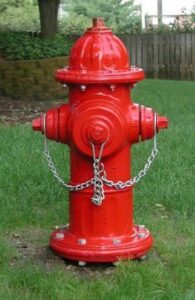
Recently I was at an HOA meeting for my neighborhood because of some concerns some homeowners had after a home fire. Like most folks, everyone can recognize the object to the left – quite possibly one of the most recognized safety objects of all time. And the color of the hydrant is red, but what many folks don’t know is that the color of the hydrant is actually tied to the...
Read More
NFPA has made a major revision to NFPA 1961, Standard on Fire Hose, 2020 Edition. The new requirement that 1½ in. to 3 in. attack hose be tested in accordance with:
…
HomeRead More »
Read More
Respondent operates a “stationary source” and has registered an RMPlan with the EPA for its Facility and has developed an RMProgram accidental release prevention program for the stationary source. Respondent operates an ammonia refrigeration process that has on-site storage of 15,416 pounds of anhydrous ammonia.
On December 11, 2018, the EPA conducted an on-site inspection of the RMProgram...
Read More
Technical Safety BC (British Columbia) has issued two new safety orders regarding ammonia in refrigeration plants. Failure to comply with the requirements of these safety orders may result in enforcement action under the Safety Standards Act and associated regulations.
These two (2) safety orders are:
Safety Order SO-BP-2021-01: Secondary Coolant
Safety Order SO-BP-2021-02: Emergency Discharge...
Read More