







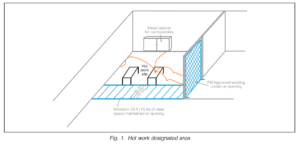
A few weeks back one of my good friends and a hell of a process safety professional contacted me about OSHA’s Hot Work (HW) referenced RAGAGEP, NFPA 51B. He wanted to be sure he was not missing something, as OSHA still references the Year 1962 Edition of NFPA 51B. Just to show how broken OSHA rulemaking is, NFPA 51B has been revised/updated eleven (11) times since!!! And each...
Read More

During our process safety audits and engineering reviews for existing processes, the #1 deficiency that we still come across is the lack of piping MI inspections. However, there seems to be a major effort in getting these types of inspections completed as most auditors will now take issue if there are no “official” inspections by a “qualified person” on the process piping. So...
Read More
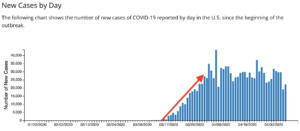
So have the measures that the USA (Federal, State, and Local governments) caused more harm than good? That seems to be the debate at this stage in this pandemic. So as a profession we have been conditioned (hopefully this is changing) that the OSHA rates are a measure of safety performance. I think anyone working at a factory with 100+ people has heard of the OSHA rate – heck...
Read More
I said it and I am proud to have said it. Back in the earliest of days when they were discussing all of the extraordinaire measures that we would need to take to “flatten the curve”, I stated that after the measures work, we will then be faced with the idea that “this was all overkill and it was not necessary” based on the success of those very measures.
We see it...
Read More
We have tons to still learn from this event, but under the current economic conditions due to the virus, India has been in “lockdown” for five (5) weeks. This incident, happened last night, lends itself to being a “polymerization event” based on the video and photographic evidence I have seen from my India members. The ONLY way to Styrene to vent like that is during...
Read More
When is a pressure vessel not really a pressure vessel? A question that comes up often. And the answer may surprise you. The NBIC and ASME agree on this topic…
…
HomeRead More »
Read More
Several cases of counterfeiting have already been reported. The Center for Disease Control and Prevention (CDC) has listed out some suspect characteristics of counterfeit respirators. Table 1 below summarizes the main suspect characteristics of counterfeit compared to appropriate FFR. Among the suspect features, there are ear loops designs, the absence of markings or references to national regulation...
Read More
In light of the coronavirus disease 2019 (COVID-19) pandemic, OSHA understands that some employers may face difficulties complying with OSHA standards due to the ongoing health emergency. Widespread business closures, restrictions on travel, limitations on group sizes, facility visitor prohibitions, and stay-at-home or shelter-in-place requirements may limit the availability of employees, consultants,...
Read More
Under the Clean Air Act Section 112(r)(1), the General Duty Clause states:
“The owners and operators of stationary sources producing, processing, handling or storing such substances [i.e., a chemical in 40 CFR part 68 or any other extremely hazardous substance] have a general duty [in the same manner and to the same extent as the general duty clause in the Occupational Safety and Health Act (OSHA)]...
Read More
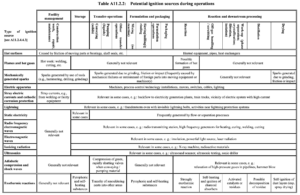
In the most recent revision of the Globally Harmonized System of Classification and Labelling of Chemicals (GHS), they list some very interesting potential ignition sources for dust explosions; several I have never ever even considered being an ignition source. Check these out…
…
HomeRead More »
Read More
As we have discussed, the latest revisions of the Globally Harmonized System of Classification and Labelling of Chemicals (GHS) has a new criterion for categorization of flammable gases. The GHS now has sub-categories of CAT 1 Flammable Gases: 1A and 1B. CAT 1B flammable gases have a fundamental burning velocity of less than 10 cm/s. Never have I dealt with burning velocities...
Read More
Your inquiry relates to the enforcement of OSHA’s Process Safety Management (PSM) standard, 29 CFR 1910.119, to two hypothetical scenarios you provided that are related to upstream oil and gas production facilities.
Background/Scenarios: In your letter, you describe the following scenarios involving natural gas processes that are in the production phase of upstream oil and gas operations. Both...
Read More