













Many of us use Safety Data Sheets (SDS) on a regular basis and most of us have come to the realization that these documents fall far short of providing us the safety information we really need. For example, when working with flammable liquids do you trust the SDS data to provide an accurate Flash Point for the material? Because of the inherent errors in standard flash point measurements…...
Read More
Bonding and grounding is a critical safety function when transferring flammable liquids. But for the ground to function properly, how good must it be or in technical terms, how much resistance to ground is acceptable in the design of the safety system?
…
HomeRead More »
Read More
2020 UPDATE on EPA's Initiative to Improve Safety of Ammonia Refrigeration Facilities in New England
Although anhydrous ammonia is an effective refrigerant, it is also a toxic chemical that can injure or kill people when accidentally released. The death of a worker at a Seafood plant in South Boston in 2016 is the most tragic example recently here in New England. In 2018, the U.S. Environmental Protection Agency (EPA) launched a pilot initiative to improve compliance with the General Duty...
Read More
The risk management program regulations require the owner or operator of a covered stationary source to develop and implement an emergency response program as described in 40 CFR §68.95, which MUST include:
an emergency response plan,
emergency response equipment procedures,
employee training, and
procedures to ensure the program is up-to-date.
But do all facilities subject to the risk management...
Read More
Respondent owns and operates an agricultural chemical manufacturing facility. On November 2, 2017, Respondent had an accidental release of chlorine at the Facility. Respondent determined the amount of chlorine released to be 0.014 pounds and reported that the release occurred when hooking up a rail car containing chlorine in which an unloading valve was inadvertently opened when Respondent’s employees...
Read More
Must an owner or operator conduct and document a compliance audit at the time of an update required under §68.190 if the update is made within three years of the original RMP submission?
…
HomeRead More »
Read More
In the world of process safety, every little detail adds up; so as one of my favorite bosses always said… “sweat the small stuff”! This became crystal clear during an incident investigation where a flanged connection was the point of release. Most people look at a flanged connection as a simple means to connect to ends of pipe together, but oh it is so much more and thus...
Read More
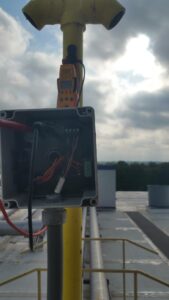
Several years ago, we discussed this picture in terms of a Relief Design Basis, the NH3 vent header sensor placement in terms of NFPA 70 HAZLOC, and the risk of doing maintenance/calibration on the sensor when the process is live. As usual, I got some nice feedback, and the usual haters chimed in that I was off my rocker once again, stating their usual mantra… “that is industry practice...
Read More
On March 6, 2018, a pipefitter (49) was hit in the chest by a pressurized 12-inch diameter polyvinyl chloride (PVC) pipe during a hydrostatic pressure test of a fire suppression system. The sudden pipe movement was attributed to a pipe joint connection failure in a buried section of the pipeline. The failure was due to torque shear bolts at the joint connection that were not tightened, which was missed...
Read More
On November 19, 2019, an employee was unloading his semi-truck tanker of flour and hooked up a blower hose that is powered from the truck’s transmission. The employee climbed to the top of the tanker while trying to get a better seal and opened the hatch before entering. Emergency Services was contacted and removed the employee’s body, who was killed from asphyxiation.
…
HomeRead...
Read More
At 2:00 p.m. on November 28, 2017, Employee #1 and a coworker were looking for drainage valves at a mine water treatment pond facility. Employee #1 went down a ladder into a manhole next to one of the ponds to look for the valve. Employee#1 fell off of the ladder as soon as his head got to ground level. He fell into the bottom of the twelve-foot deep manhole and collapsed against a wall.
…...
Read More
Here is a look at OSHA’s Respiratory Protection compliance activity in 2019 (October 2018 – September 2019). As you can see, OSHA did 1,298 inspections and issued 2,931 citations for a total of $3,808,871 in fines. Here is a quick breakdown of activity:
NAICS Code: 33 / Manufacturing was #1 in # of citations with 1,009
NAICS Code: 32 / Manufacturing was #1 in $’s with $1,042,903
NAICS...
Read More