










The corrections concern the following regulations and standards:
…
HomeRead More »
Read More
In November 2019 a manager, 32, of a restaurant, a national chain, was overcome by chlorine gas and died. The investigation established that a worker at the restaurant spilled a “cleaner” on the floor during the day. Then later that night, a different employee started to clean the floor with a “floor cleaner”. The mixture of the previously spilled “cleaner”...
Read More
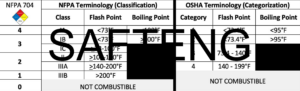
A client has allowed me to share work I did several years ago when OSHA’s GHS threw a wrench into the flammable liquids world! There was so much confusion between Class and Category of flammable liquids, and during an engineering review, it was discovered that the engineering group had made a conversion error when going from OSHA’s Categories back to Classes in order to meet local...
Read More

When most ordinary people hear the term “Hazardous Location” many conjure images of a dangerous location associated with typical hazards; however, when a safety engineer or engineer from the process industries hear the phrase we immediately elvate our antenna and sit up and pay close attention to what is being said. But for those outside of chemical processing indutries, most have...
Read More
In 2014, the Occupational Safety and Health Review Commission (OSHRC) issued a judgment on an OSHA case, and in the case, they made it clear that “magnitude” matters in lockout/tagout (LOTO). But for some reason, this piece of data is absent from many machine-specific LOTO procedures and OSHA always takes issue with this oversight. So where is “magnitude” required...
Read More

In 2013, we discussed the OSHA and NFPA requirements for “identifying fire extinguishers” in Fire Extinguishers… Did you know they have to be identified?
In that article, we touched on the OSHA and NFPA requirements for how fire extinguisher LOCATION(s) (not the actual fire extinguishers) are to be identified.
But how many of us see this just about everywhere we go:
Do...
Read More

What do you get when you have no “qualified/competent” person on site who fully understands the implementation of a Confined Space program AND OSHA’s eTool Industry page is being read literally by the unqualified worker? The answer: SERIOUS PRCS PROBLEMS! I had a smile on my face the entire time I was thinking about how to write this article in the hopes that industry...
Read More
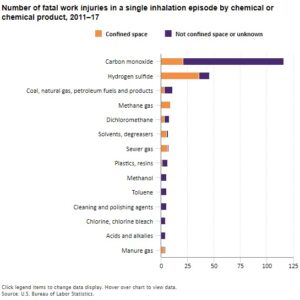
With year 2020 already claiming 7 lives inside PRCSs within the USA, I have to ask the question: Has OSHA’s Permit-Required Confined Space standard meet its goal? In OSHA’s Preamble for 1910.146, published in 1993, OSHA stated:
OSHA has determined that permit spaces pose significant risks to employees (62 fatalities and 12,643 injuries and illnesses annually)...
Read More
Why is this article posted in the Permit-Required Confined Space section of the website? Because there seem to be a large number of safety professionals that are under the impression that ANY occupational hazard can turn a confined space into a Permit-Required Confined Space. Noise is a recognized occupational hazard – I think we can all agree on this; however, noise is NOT a hazard...
Read More
The Joint TDG-GHS informal working group (IWG) dealing with the categorization of flammable gases was organized in Brussels from 9 to 11 March 2015 by the Belgian and the Japanese delegations to the TDG and GHS sub-committees. The participants (physically/by phone) list can be found in Annex 1of this report. The purpose of this IWG was to review the current criteria and discuss possible...
Read More
The requirement for pressure and leak testing on PSV vent piping depends entirely on whether the piping is classified as Boiler External Piping (BEP) or Non-Boiler External Piping (NBEP).
If the vent line is part of the BEP (directly attached to the boiler safety valves under the jurisdiction of ASME Section I), the testing requirements are strict:
…
HomeRead More »
Read More
So many learnings! This happened in the Year 2000. Listen to the radio traffic where the IC is asking for a “headcount”!!!!
Read More