












Respondent owned and operated a facility that stored and used sulfur dioxide, a “regulated substance” under 40 C.F.R. § 68.3, at the facility when it brined cherries. At all times relevant to this CAFO, Respondent’s brining process contained more than the threshold quantity (5,000 pounds) of sulfur dioxide. Respondent’s brining process did not meet the eligibility requirements...
Read More
OSHA has cited a meat packing company for exposing workers to releases of hazardous chemicals. The company faces $615,640 in penalties. OSHA determined that the meat-packing facility failed to implement a required Process Safety Management (PSM) program for operating an ammonia refrigeration unit containing over 10,000 pounds of anhydrous ammonia. The employer also failed to provide fall protection,...
Read More
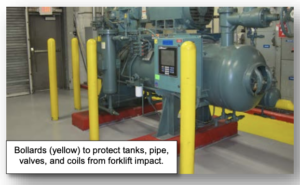
Bollards… they are more than sticks in the ground! In fact, there is an actual code design basis for bollards (i.e. posts). There are six (6) CRITICAL METRICS for bollards, of which five (5) we can see and one (when done properly) is invisible to those of us who inhabit the surface of the earth. So what can we see with the EPA’s picture from their...
Read More
On October 4, 2005, Employee #1 was working as a refrigeration mechanic. An ammonia system valve in freezer Number 7 was being turned, when the bonnet came loose with the wheel, releasing approximately 100 to 200 lbs of ammonia. Employee #1 was 35 feet up without fall protection, and he had to slide down racking to escape. He gave notification to shut the system down and summoned the city’s hazard...
Read More
As I have written about numerous times… PRESSURE TESTING a process is not only a “good idea” – it is REQUIRED for those of us in the process safety world. It is a critical path in process safety, ensuring our “primary containment” system (e.g. piping) was installed properly and can withstand process pressures. But with these tests comes some inherent risks and as...
Read More
Here is a look at OSHA’s Emergency Action Plan (1910.38) compliance activity in 2018 (October 2017 – September 2018). As you can see, OSHA issued 80 citations from 66 inspections for a total of $155,698 in fines. Here is a quick breakdown of activity:
49311 / General Warehousing and Storage with 4 citations totaling $21,878
32221 / Paperboard Container Manufacturing...
Read More
Here is a look at OSHA’s Employee Emergency Alarm (1910.165) compliance activity in 2018 (October 2017 – September 2018). As you can see, OSHA found issues with complying with this standard on 10 inspections and issued 10 citations for a total of $17,147 in fines. Here is a quick breakdown of activity:
49111 / Postal Service with 2 citations totaling $10,878
31141...
Read More
On May 31, 2012, Employees #1 through #6 were working when an evaporator that had been deactivated was mistakenly activated by a worker. Approximately 68.5 pounds (31 kilograms) of ammonia were released on an overhead catwalk. Employees #1 through #6 inhaled the fumes, and they were transported to a hospital. Employee #1 was not hospitalized, but Employees #2 through #6 were. The narrative did...
Read More
In our daily work as safety professionals, we are guided by a lot of codes, standards, regulations, and rules that are intended to establish a baseline, albeit a minimum level of risk control. These codes, standards, regulations, and rules can be confusing to many who tried to read or interpret what the agency/group intends with their requirements. In fact, there are two (2) itty...
Read More
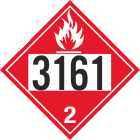
An MC331 tanker truck arrives at your facility and is placard with the following placard:
And you have three (3) storage tanks that are labeled with NFPA 704 Diamonds, which tank do you think is the best fit for this material if you had to make the decision:
In order to decide, you look up what a “Class 2” Flammable Gas assigned the UN # of 3161 is and you...
Read More
With all the chatter these past few weeks about flammable gases and their NFPA 704 Diamond “Degree of Hazard”, it was suggested by several SAFTENG members that I write an article explaining what a “flammable gas” actually is, as some of our group text indicate some may not fully understand the true hazard of working with/around a liquified pressurized gas. So here we go…
First...
Read More
This has been a fun week with all the dialogue I have had with so many SAFTENG members; I only wish more were comfortable having these discussions online, but the fear of being traced back to an employer or being trolled by a lawyer I guess is a legitimate fear in our technical/risk profession. One of the most popular responses I have received is “why does it matter if the chemical...
Read More