














Chemical
Road
Rail
Water
Total
% of Total
Domestic Shipping
Totals\by Route
(U.S. Tons)
Ammonia (NH3)
5,793,000
3,470,592
1,718,974
10,982,566
52.8%
75%
Chlorine (Cl2)
724,000
3,750,372
137,202
4,611,574
22.2%
Sulfuric Acid (H2SO4)
257,000
207,560
2,057,721
2,522,281
12.1%
95%
Acrylonitrile (C3H3N)
29,000
277,200
671,474
977,674
4.7%
Ethylene...
Read More

This document is a gem to have if you’re in a role that requires the use of multi-gas detectors such as those used for entry into permit-required confined spaces and check an area before Hot Work begins. It has been around since 2016 and I have used the information in it for years in my HAZMAT and PRCS training courses. It is a MUST READ for all safety professionals who use these...
Read More
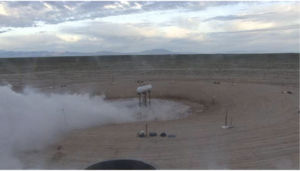
In this picture from the Jack Rabbit, we can see the Liquid NH3 that has pooled under the container. This occurred under 95F temperature with a high wind speed, which blew the cloud away from the pool making the pool visible. The picture below was taken 10-seconds after the container was empty. Also, notice the impact that wind had on the “cloud” of NH3 vs. what it looked...
Read More
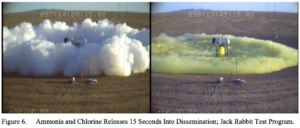
The data from the Jack Rabbit tests done over the past decade is immense and exceptional learning tools. I always make sure my students, whether it be a HAZMAT responder class or a Process Safety course, fully understand how Vapor/Gas Density impacts us in a LOPC event. Using Chlorine and Ammonia, the contrast is stark and unforgettable…
…
HomeRead More »
Read More
This video is from 2013, but I thought they did such an excellent job explaining 1234yf and how we went from 134a to this new refrigerant I should share it for context. I have been very hard on the suppliers of this new Low GWP refrigerant over the years and this video sums up the journey well. The only thing I take issue with is comparing a Cat 1 Flammable GAS with other flammable...
Read More
Question: Would you/Do you permit 2-way radios, and their attachments, that do NOT carry a rating for HAZLOCs (Class I, Div 1/2) to be used inside a Level A suit?
Recently I was asked to help a client in the great state of NM with their emergency response capabilities. Our first step was to assess their needs and their in-house capabilities and to use the local fire department(s) to...
Read More
At approximately 7:00 p.m. on November 15, 2006, Employee #1 was a process operator at the Chlorine Liquefaction Unit, Block A-19. He was preparing to bleed off chlorine on a process line, to clear the line for maintenance work. The valve handle indicated that it was in a CLOSED position. Employee #1 opened the cap to the bleed valve to insert a tube to clear the chlorine. However, the bleed valve...
Read More
At approximately 2:30 p.m. on March 2, 2011, six workers were employed as milling or planing machine operators at a corn and flour milling facility in Lincoln, NE. A chlorine leak was detected in the chlorine room, so the milling superintendent and a miller/operator entered the chlorine storage room and closed a manual valve on a manifold. The facility was evacuated, and members of the local fire department...
Read More
This is a lesson in why “Unloading” any hazardous material is such a high-risk task. In this incident, the facility had their connections locked (but the driver was told the combination), they were using the driver’s procedure, the connections were properly labeled, the driver could not see the tank he was pumping to, the company dock attendant who was supposed to be involved...
Read More
At approximately 5:00 a.m. on February 8, 2014, Employee #1, a K2 Pure Solutions operator, was depressurizing a line that contained chlorine gas. Two attempts were made to depressurize the line. The first attempt resulted in a small chlorine release and employees having to evacuate to shelter and the second attempt resulted in the employee opening a valve upstream of the 2 in. bleed valve releasing...
Read More
PRESSURE TEST, then LEAK TEST piping BEFORE the introduction of the Hazardous Material!
At 8:30 p.m. on May 11, 2017, two employees had been welding a pipe assembly and installed it on a chlorine tank. Employee #1 opened a valve to transfer the liquid chlorine from a supply tank into the weigh tank. A flanged fitting was not tightened and both employees were sprayed with liquid chlorine. Both employees...
Read More
At 9:15 a.m. on June 17, 2017, an employee was conducting routine daily checks on Well Number 1 and Well Number 2 chlorine cylinders and noticed that they needed to be changed out for full chlorine cylinders. The employee noticed the regulator was feeding chlorine gas without the pumps running and noted that there was a chlorine leak somewhere. The employee checked all connection and found no leaks...
Read More