













At 11:30 a.m. on January 23, 2018, an employee was moving product in a freezer with a forklift. The forklift struck UNPROTECTED refrigeration piping, breaking a valve and releasing anhydrous ammonia. The employee’s face, eyes, and chest were exposed to the anhydrous ammonia and the employee was hospitalized.
…
HomeRead More »
Read More

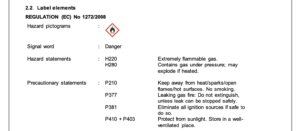
The NFPA 704 Diamond still reigns supreme as the labeling system for bulk tanks in the chemical industry and recently I posted an article about a Category 1 Flammable Gas and it’s “Degree of Hazard”. It is my professional opinion that a CAT 1 Flammable Gas is a “4” in the NFPA Flammability Hazard; however, based on texts/e-mails/phone calls I can say we are...
Read More
Over the past four (4) years, I have been involved in an industry that I would have never thought would be some of my Process Safety clients and over these same four years, I have come to feel sorry for an entire industry. This industry was forced to change to an alternative chemical in order to “protect the environment”; albeit their new chemical is NOT a less “hazardous”...
Read More
Most emergency responders know that NH3 loves water and well-placed fog pattern will go a long way to “scrubbing” a large NH3 cloud. But after what we witnessed on Thursday morning, I do wonder if we all know the do’s and don’ts of using water around NH3. Yes, the incident Thursday was catastrophic and impacted hundreds of citizens and responders, but does this permit...
Read More
At 4:00 p.m. on January 5, 2018, Employee #1, employed by an industrial cleaning company, was working at a multiemployer project. He was working from an 8-foot stepladder. He was 2 feet above the ground and monitoring and adding water as necessary to evaporator pans to prevent freezing. The float system on the evaporator failed, a pipe connector broke, and 89 gallons (450 pounds) of anhydrous (liquid)...
Read More
OSHA defines entry as:
“Entry” means the action by which a person passes through an opening into a permit-required confined space. Entry includes ensuing work activities in that space and is considered to have occurred as soon as any part of the entrant’s body breaks the plane of an opening into the space.
Here is a tragic reminder as to why they consider the space as being enter...
Read More
Many thanks to Luke Dam, CEO of Safety Wise, for having some fun and making these SAFTENG videos. If you’re looking for a great incident investigation tool be sure to check out Luke’s company… they are worldwide and they make root cause analysis easy (something many struggle with).
Read More
ABSOLUTELY! One of my engineering managers early in my career was the founder of the “engineering geek squad” and was an absolute stickler for details when it came to technical matters. He always told me I was driving him to the insane asylum with my improper interchangeable use of the terms “vapor” and “gas” when referring to our HAZMATS. To this day, I remember my “white board session”...
Read More

This morning, North of Chicago, a 2,000-gallon (8,750 pounds of NH3) nurse tank appears to have suffered a catastrophic failure releasing all 1,700 gallons/8,750 pounds of NH3 onto the road and ditches. The reason I wonder if this was in the realm of a “Worst Case Release Scenario” is that we had Temps in the low 50’s, Night-time (the event occurred at 4:30 am) and we...
Read More
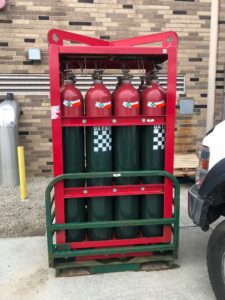
You’re getting ready to perform your pressure testing and the boss says the six-pack of Nitrogen or Oxygen (he can’t remember which) is out back. You walk out back and this is all you see… what do you do? By the way, pressure testing with Oxygen is illegal in most states and VERY UNSAFE in the first place! But your boss said these are the cylinders for the testing…
Upon...
Read More
Once or twice a year I check on the top 10 or 20 RMP accident histories to find any interesting trends. I have been doing this for about 12 years and since starting them, Anhydrous Ammonia always finds it’s place as the top Toxic involved. There are some who want to believe that Anhydrous Ammonia should not even be on the OSHA/EPA list of HHC/EHS and many more who believe that 10,000...
Read More
Failing to report a 172-pound release of NH3 (RQ=100 pounds) via an RV to the NRC, SERC, and LEPC in a “timely manner” can be costly!
Respondent is a Wisconsin corporation, with a cream cheese and yogurt manufacturing facility. At all times relevant to this CAFO, the Facility was a facility at which a hazardous chemical was produced, used or stored. On April 17, 2017, EPA representatives...
Read More