












You are the entry supervisor for entry into a Carbon Monoxide (CO) Tank. Your meter is equipped with an Oxygen Sensor, but it does NOT have a CO sensor. You proceed with your atmospheric testing, as you were told years ago that as long as the Oxygen was over 19.5% that all will be OK. What you do not know is that CO is a “magic asphyxiant”, technically called a “Chemical...
Read More
We have an uncontrolled release from our PSM/RMP covered process today, February 5, 2019. We have trained for this day. We have inspected our gear, well most of it, each month for years. We don our LEVEL A suits, which have been pressure tested annually and cared for per every single manufacturer’s requirements. Under our LEVEL A’s, are our SCBAs; again inspected...
Read More
UPDATED on 2/6/19, based on feedback from my friend and Refrigeration PSM Extrodinare Brian Chapin over at RCE (A former Partner in Safety). I have shared his analysis and my rebuttal/agreement…
By a long shot, these are the top three (3) issues found with Ammonia Refrigeration RMPs:
The NH3 is “Liquified by Pressure” – not by refrigeration!
Process Purgers are NOT the...
Read More
This 10-minute video provides an overview of the OSHA inspection process under the agency’s Regional Emphasis Program for Fertilizer Grade Ammonium Nitrate and Agricultural Ammonia Facilities.
Read More
One of my favorite parts of teaching the 1-day PSM Intro course at ASSE SeminarFest is the vast numbers of students and all of their learnings and experiences being shared. This year was even better than years before – in fact, we had so many side-bar discussions because of the great input from the students – that I ran out of time (also due to a 90-minute lunch break this year). The one...
Read More
Those in the PSM/RMP world know that the facility is REQUIRED to have an Emergency Action Plan (1910.38) and by virtue of having to comply with 1910.38, we also have to comply with 1910.165 Employee Alarm System. The language in 1910.165 is really vague and causes much confusion when it comes to the emergency alarm system initiating means, especially when asked: “how many pull stations do I need?”
Here...
Read More
Breathing… we do it all day long, every day, and yet we never even put a thought to it. But so many respirator users do not understand the basics of how we get the air (more importantly, the oxygen in the air) into our lungs so that it can enter our bloodstream for survival. As I said, breathing is an involuntary act – meaning we are not sucking air into our lungs. In...
Read More
Recently I had a client who made alterations to a pressure vessel (PV) in an ammonia refrigeration process that required the PV to be re-certified. The state where this PV resides is a “coded state”, meaning they have adopted ASME Code for the PVs within the state. So, the contractor making the alterations had scheduled the Authority Having Jurisdiction (AHJ) (in this case it was an insurance...
Read More
If API 570 is your facility’s piping inspection/repair RAGAGEP, the battle over “repair requirements” just got easier! A very popular question in PSM/RMP circles has become…
“Do we have to make repairs in the same manner as we did the initial install of the pipe?”
In other words, what is being asked is…
“Can we bypass some of the ASME B31 requirements...
Read More
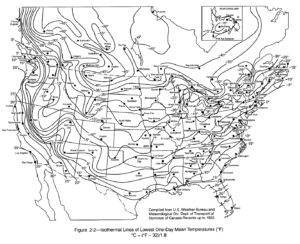
In my travels to our friends north of the US border, it is not uncommon to find “used vessels” in service that were never intended to be used that far north and for the record, this occurs in the USA northern states as well. The figure below is one that is used by many to establish the Minimum Design Metal Temperature (MDMT) of their vessels based on where in North America the vessel...
Read More
Scenario 1: The first scenario you described has the following attributes:
Your firm is engaged in the design and construction of a manufacturing (processing) facility which includes OSHA Category 2, 3, and 4 flammable liquids as raw materials and processing intermediates.
The Food and Drug Administration and countries in Europe, the Middle East, and Africa regulate the facility due to the manufacture...
Read More