










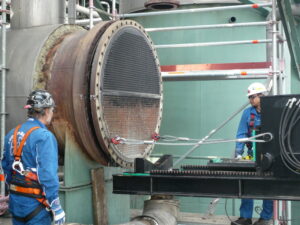
In many industries where the heating or cooling process comes into play, the process will probably have some type of heat exchanger or condenser. In large-volume processes, these units can be enormous; easily large enough to bodily enter and do assigned work. But many of these units may not get identified as a Permit-Required Confined Space (PRCS) during the site evaluation because of their design;...
Read More
OSHA has just released a new PSM Booklet titled “Process Safety Management for Petroleum Refineries,” which contains “Lessons Learned” from their Petroleum Refinery Process Safety Management National Emphasis Program (NEP). This publication is a MUST READ for any practicing process safety professional, regardless if your process(s) is a refinery or not! The publication...
Read More

On May 14, 2014, EPA conducted a compliance inspection of Respondent’s facility to determine its compliance with the Risk Management Program (“RMP”) regulations promulgated at 40 C.F.R. Part 68 under Section 112(r) of the Act. EPA found that Respondent had violated regulations implementing Section 112(r) of the Act by failing to comply with the regulations as noted on the attached...
Read More
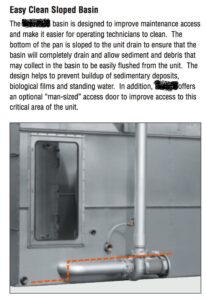
As the debate continues in the refrigeration industry regarding the classification of evaporative condensers, I had someone send me a picture from one of the main manufacturers of evaporative condensers showing me an example of an evaporative condenser that no longer has “limited means of egress.” Therefore it is no longer a Confined Space and therefore is not a Permit-Required Confined Space. The...
Read More
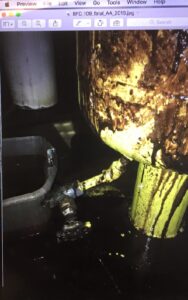
This is my second and probably the last post regarding this incident. This post will cover the Boston Fire Department’s (BFD) activities that took place at the facility AFTER the fatality. As you can see, these guys are true pro’s and they know hazardous materials as well as did a nice job using IIAR-2, American National Standard for Safe Design of Closed-Circuit Ammonia...
Read More
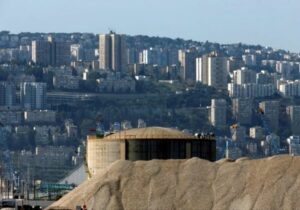
This anhydrous ammonia (NH3) refrigerated storage tank (photo source: Jerusalem Post) was feared to be a target of terrorist and as one report claimed, imminent failure. The battle heated up in 2013 when “Hezbollah” (a recognized terrorist group) threatened to blow up the tank (or the ship delivering the NH3) with missiles and the courts got involved. It seems the tank was built...
Read More
Fire officials have an idea how much ammonia leaked from a cold-storage business but can’t say exactly how long it spewed. Roughly 60 pounds of the material leaked fire Capt. James Brown said. Investigators believe the leak was caused by a valve that wasn’t completely closed while the business was closed. No one was required to evacuate when the leak occurred. This isn’t the...
Read More
It certainly looks like EPA has been busy with their review of the proposed amendments to the RMP Rule. To that fact, they have released this Q&A explaining what they are keeping, what they eliminated, and what they revised in their NEW FINAL RULE. This new FINAL RULE is set to take effect on 2/19/2019 and includes several implementation deadlines for some specific tasks. As usual,...
Read More
The power of a vacuum… caused only by the condensing of the hazardous material. The loading temperature of the mono-isopropylamine, a flammable liquid, was reported to be between 70°F and 80°F. When the tank collapsed, the ambient air temperature was approximately 10°F…
On January 4,1988, an MC 307 tank trailer departed with 39,000 pounds of mono-isopropylamine, a flammable...
Read More