










At approximately 9:50 a.m. on October 24, 2012, Employees #1 and #2 were working as mechanical engineering technicians at a food cold storage facility. The two workers were troubleshooting a Hansen Technology Model AP08 Auto-Purger. The Auto-Purger removed non-condensable material from the refrigeration system. It was mounted on a wall inside the facility’s anhydrous ammonia compressor room....
Read More
Its 2017 and we still debate the flammability of anhydrous ammonia (NH3). It is a fact that NH3 is not classified as a “flammable gas” due to its high Lower Explosive Limit (16%) and it’s flammable range being less than 12 percentage points. But there is one other fact that we seem to lose sight of… NH3 has an LEL and it will burn! Here is a 2013 OSHA fatality...
Read More
Mr. Burns is not a safety professional, but that did not stop him from absolutely nailing this very short and concise video on what it looks like to a SAFETY LEADER. It may be the best 7-minutes of “self-help” advice for safety professionals who are ready to be a LEADER rather than a “safety manager”. And folks, if you do not have a mentor yet – our profession...
Read More
I have finally received the investigation information regarding the anhydrous ammonia fatality at a refrigerated seafood warehouse in Boston in March 2016. Sadly these reports do not indicate the cause of the accident and it does not appear that the AHJ used the state’s 527 CMR 33.00: Hazardous Material Process or Processing to enforce the PSM type requirements on this process. The...
Read More
Respondent owns and operates a beef slaughter and packaging facility and has Anhydrous Ammonia in excess of 10,000 pounds. On or about September 9, 2015, EPA conducted an inspection of Respondent’s Facility to determine compliance with Section 112(r) of the CAA and 40 C.F.R. Part 68. From the time Respondent first had onsite greater than 10,000 pounds of ammonia in a process, Respondent...
Read More
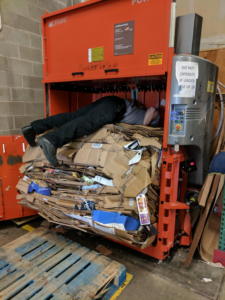
I have heard of this happening several times off the span of my career, but this is the first time I have seen it. I will also add that “gravity” is the most often overlooked/ignored energy source when it comes to LOTO. With “electrical” being the most recognized energy source, somehow the one source that is constant is the one that is overlooked.
Read More
Once again I turn to the professionals up North to provide us with some great information. Transport Canada has once again done an excellent job explaining the difference between a Boiling Liquid Expanding Vapor Explosion (BLEVE) and a Heat-Induced Tear (HIT) type explosion. So often when we see the large fireball, we will call the event a BLEVE; however, this is oftentimes an incorrect...
Read More
In both their General Industry and Construction Confined Space Standards, one of OSHA’s criteria for a “Confined Space” is that the space is “not designed for continuous employee occupancy.” These six (6) words seem to cause much confusion on both ends of the CS debate. I have seen it misused to claim a space is a CS, and I have seen it misused to claim a space is not...
Read More
In the process safety arena, OSHA’s PSM Standard (and EPA’s RMP rule) made it official… doing “hot work” in/on/adjacent to the “covered process(s)” required a WRITTEN PERMIT. Before PSM/RMP, OSHA only “preferred” the permission to perform Hot Work be in written form. OSHA PSM (and RMP)intent was to require employers to control, in a consistent...
Read More
One of the best books in my career is the first edition of “Field Guide to Human Error Investigations” (pdf) by Dr. Sidney Dekker (Ph.D. in Cognitive Systems Engineering); which then became “The Field Guide to Understanding Human Error” (2nd Edition). Those of you in the Process Safety arena have some baseline knowledge of “Human Factors”. Heck OSHA and EPA actually regulated...
Read More
WARNING! The video contains graphic images of a worker’s death. Worker is pulled into a paper machine calendar as he is applying a label. As can be seen, by the video, the RPMs were low, but the torque of the machine was too much for him. His foot hits the E-stop bar but it was too late.
Read More