











A Process Hazard(s) Analysis (PHA) is a great tool to look at an entire process, and a Job Hazard Analysis (JHA) is a great tool to use to analyze the hazards within specific tasks within the covered process. They are different tools for different scopes of work, but they can work in unison to make the process and the work within the process much safer. This is how I have been using both tools for...
Read More
While the terms are often used interchangeably, there is a distinct semantic and practical difference between them, particularly when dealing with formal codes like ASME and API. The distinction essentially comes down to execution versus interpretation.
…
HomeRead More »
Read More
As we have discussed here many times, check valves tend to be one of the most relied-on designs but also one of the most forgotten devices in process safety. We see check valves that have been in service for 30+ years and have never once been inspected or tested, yet they are listed every 5 years as a safeguard in the PHA. Finally, API has included some excellent inspection protocols for check valves...
Read More
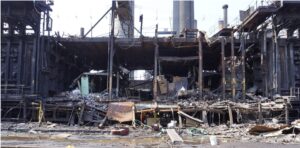
Today, the U.S. Chemical Safety and Hazard Investigation Board (CSB) released its final report on the fatal August 11, 2025, explosion at the Coke Works facility in Clairton, Pennsylvania. The incident occurred when toxic flammable coke oven gas was released and exploded — fatally injuring two people, injuring 11 others, five of them seriously, and causing an estimated $52.5 million in property...
Read More
How many flammable liquid cabinets can I have inside a single "control area"? (1910.106 and NFPA 30)
Tip: In the “good old days,” this was crystal clear, such that a 3rd grader could audit these requirements! Today, one needs a calculator and a long tape measure to make this determination!!! Let’s break this down by OSHA first, then NFPA, then IFC…
…
HomeRead More »
Read More

Regional OSHA activity and compliance publications over the past month highlight renewed inspection scrutiny surrounding flammable liquid transfer, storage, and bonding/grounding:
…
HomeRead More »
Read More
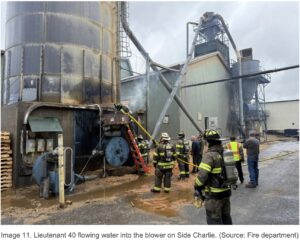
NIOSH has released its Fire Fighter Fatality Investigation report regarding the Maine Lumber Mill COM DUST explosion. Lots of learnings in this report.
Fire origin and explosion cause
The State Fire Marshal’s Office and Bureau of Alcohol, Tobacco, Firearms and Explosives (ATF) cause-and-origin preliminary investigation classified the fire as accidental. It indicated that the area of origin was...
Read More
I almost never write about construction safety matters as I do not practice in that safety arena. But lighting crosses all industrial sectors, and this effort by OSHA to recind the Construction Lighting standard(s): 1926.26 and 1926.56 is very puzzling to me.
29 CFR 1926.26 requires construction areas, aisles, stairs, ramps, runways, corridors, offices, shops, and storage areas where work is in...
Read More
A coalition of 75 major industry organizations (led by the American Chemistry Council) submitted a joint petition to OSHA, the EPA, and the Office of Management and Budget (OMB).
The Goal is to establish a single, unified federal chemical safety standard to eliminate conflicting regulatory requirements between OSHA standards and the EPA’s Toxic Substances Control Act (TSCA) framework at processing...
Read More
The CSB examines two (2) high-consequence incidents in 2025 that were caused by workers mistakenly disassembling the wrong equipment.
…
HomeRead More »
Read More
The development of the 2027 edition is currently underway, with several proposals aimed at industrial operations and complex facilities:
…
HomeRead More »
Read More
The 2024 IBC and IFC now require CO alarms or detection systems for all types of occupancies. Previously, the focus was only on residential and schools.
…
HomeRead More »
Read More