













Who at your place of business calls the National Response Center after your business has experienced a chemical incident. Not many people have ever had to call this center (luckily!) but if your business ever does have a “reportable release” a call just like this one MUST BE MADE within 30 minutes after you have determined that the release exceeds the “Reportable Quantity”.
PLEASE...
Read More

Generating static electricity in flammable liquids involves charge separation that occurs whenever the liquid moves relative to a surface. The process follows a specific sequence:
Generation,
Accumulation, and
Discharge
…
HomeRead More »
Read More
Human Performance Improvement (HPI) is the systematic process of determining desired performance, continually monitoring performance, discovering and analyzing performance gaps, designing and developing effective interventions, implementing these interventions, and continually evaluating the results of improvement interventions within performance monitoring to ensure that the improvement process takes...
Read More
Humans are integral to the safe operation of a nuclear power plant. In the late 1970s, NRC began to focus on protecting and ensuring adequate training of plant staff to perform their assigned tasks. The NRC studied factors affecting performance, such as the effects of shift work on health and whether control room simulators would improve training. As a result of this focus, NRC created the Human Factors...
Read More
I could have sworn I had already written about this hazard, but I’m guessing it was inside one of my social media groups. So BUCKLE UP, Buttercup, as this is going to make a lot of folks unhappy.
Question: Do I have to isolate my fixed fire suppression system protecting my PRCS?
…
HomeRead More »
Read More
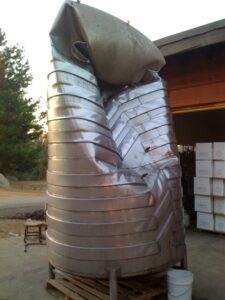
What happens when you try to pull water out of a tank using a 3HP pump and leave the vent closed
…
HomeRead More »
Read More
In the world of flammable liquids processing, we have two (2) types of flammable liquids:
Conductive
Non-Conductive
Members can read all my articles on how these flammable liquids get classified as “conductive” vs. “non-conductive. This post is to explain HOW and WHY the traditional “bonding and grounding” used in the transfer of flammable liquids may be inadequate...
Read More
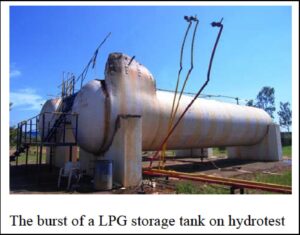
I have posted numerous fatal accidents that occurred during the pressure testing of piping and pressure vessels. Although hydrostatic testing involves less energy release should something fail vs. using pneumatic pressure, the hazard(s) are still HUGE and must be respected. This incident involved a propane bullet built in 1994 and placed into service in 1996, so do not think this was some...
Read More
Before an employee enters the space, the internal atmosphere shall be tested, with a calibrated direct-reading instrument, for oxygen content, for flammable gases and vapors, and for potential toxic air contaminants, in that order.
We test for oxygen before testing for flammability (LEL) for two (2) critical reasons:
One is a technological limitation of the equipment, and
The other is an immediate...
Read More
A 43-year-old assemblyman died on May 26, 1999, from chest injuries he received earlier that day when struck by a high-pressure water jet emitted after the failure of a gasket during a hydrostatic test of a cooling coil for an air-cooled heat exchanger. At the time of the incident, the victim was part of a two-man team conducting hydrostatic testing at a heat exchanger manufacturing company. The laborer...
Read More
The rule—”Add Acid to Water” (AA)—is one of the most important safety practices in a chemistry lab. It all comes down to how much energy is released when they mix and how the liquid behaves as a result.
Let’s explore the science behind this safety rule together. I’ll ask guiding questions along the way.
…
HomeRead More »
Read More
Employee #1 entered a semi-trailer truck to wash out the inside, which had contained a fatty acid (linseed oil). A short time later, he was found lying at the bottom under the hatch opening. Employees #2 and #3 jumped in to rescue him and were nearly overcome.
Employee #1 died, and blood tests conducted two hours after exposure revealed carboxyhemoglobin levels of 56 percent for Employee #1, and...
Read More