












In process safety, we deal with a lot of pressure vessels and even some boilers. It took me years to understand the differences between the U-1, P-2, and P-3 forms and all the requirements for the placement and management of these pressure-retaining containers. This article is intended to help safety pros who may have to deal with these types of pressure-retaining containers; so this is a 30,000-foot...
Read More
Below is OSHA’s official position on the need for hydrostatic relief valves in an Ammonia Refrigeration process. This is a bold move on OSHA’s part as the Ammonia Refrigeration industry and their trade groups have consistently stated that a “trained operator” is better than a hydrostatic RV.
(emphasis added by me)
…
HomeRead More »
Read More
I recently worked with a client on their emergency response efforts, and we continue to find businesses that do not understand the different requirements of qualifying a worker to use a respirator under CONTROLLED workplace exposures vs. UNCONTROLLED emergency response exposures. So, I wanted to write this article to make it as straightforward as possible…
Employee A is hired into a job...
Read More
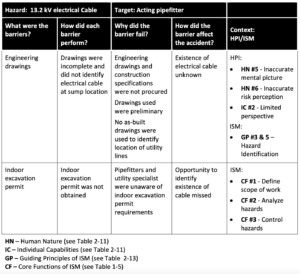
When analyzing barriers, investigators should first consider how the hazard and target could come together and what was in place or was required to keep them apart. Obvious physical barriers are those placed directly on the hazard (e.g., a guard on a grinding wheel); those placed between a hazard and target (e.g., a railing on a second-story platform); or those located on the target (e.g., a welding...
Read More
One of my favorite examples of Human Factors Engineering is the Center High-Mounted stop Lamps. We have all seen them on every personal vehicle manufactured today. They are now a safety requirement. But it was not always that way. So, what is a CHMSL? CHMSL are red stop lamps mounted on the center line of the rear of a vehicle, generally higher than the stop lamps on the...
Read More
Retail facilities are exempted from PSM requirements. At first glance, it appears this is a pretty broad exemption, as the standard just states.
This section does not apply to:1910.119(a)(2)(i) Retail facilities;
But as I wrote about last month, not all retail facilities selling a PSM Highly Hazardous Chemical (HHC) in the USA are exempt. In 2010, the state of Oregon began covering retail businesses...
Read More
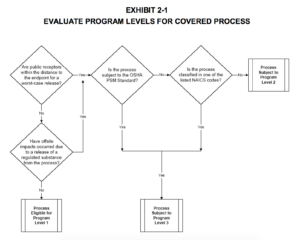
As we have discussed before, the EPA broke down its RMP rule into three (3) programs, and each program has criteria that will place the process in one of the three. However, the one criterion that confuses some businesses is how the EPA used the North American Industry Classification System (NAICS) to qualify a process for Program 3. Here is what the RMP rules state.
…
HomeRead More &ra...
Read More
The proper installation of bonding and grounding systems is important in the protection of personnel and property. At the time of installation, a resistance test is needed to confirm electrical continuity to ground. Evaluating the maintenance requirements, the bonding and grounding system can be divided into three categories:
…
HomeRead More »
Read More
Jan 26, 2006 – An accident occurred in a factory in Brazil during pneumatic pressure testing with air from pipework around a tank. There were no blind flanges placed to isolate the pipework to the tank; only the valves were closed. Probably one or more valves failed or were not closed as the tank underwent a pressure test. As a result, tremendous energy was built up in the tank,...
Read More
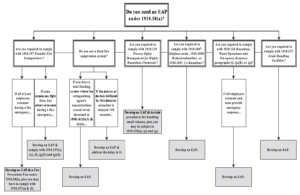
In the world of process safety, this is a no-brainer; but in normal manufacturing facilities, the answer can be quite confusing. Bottom line… if your facility has a PSM-covered process (even an RMP Program 2 or 3 process) we are REQUIRED to have an EAP that complies with 1910.38. But when we are not a PSM/RMP facility the answer is much harder to come by…
…
HomeRead...
Read More
Imagine taking a snowball and rolling it down the side of Mount Everest. As the ball rolls down the mountain, it gets bigger and faster. If we can stop it early in its travel down the mountain, BEFORE it gets to BIG and FAST, we can save the town at the base of the moutain. But there comes a time and place in this snowball’s journey down the side of the mountain where it has gotten TOO BIG...
Read More