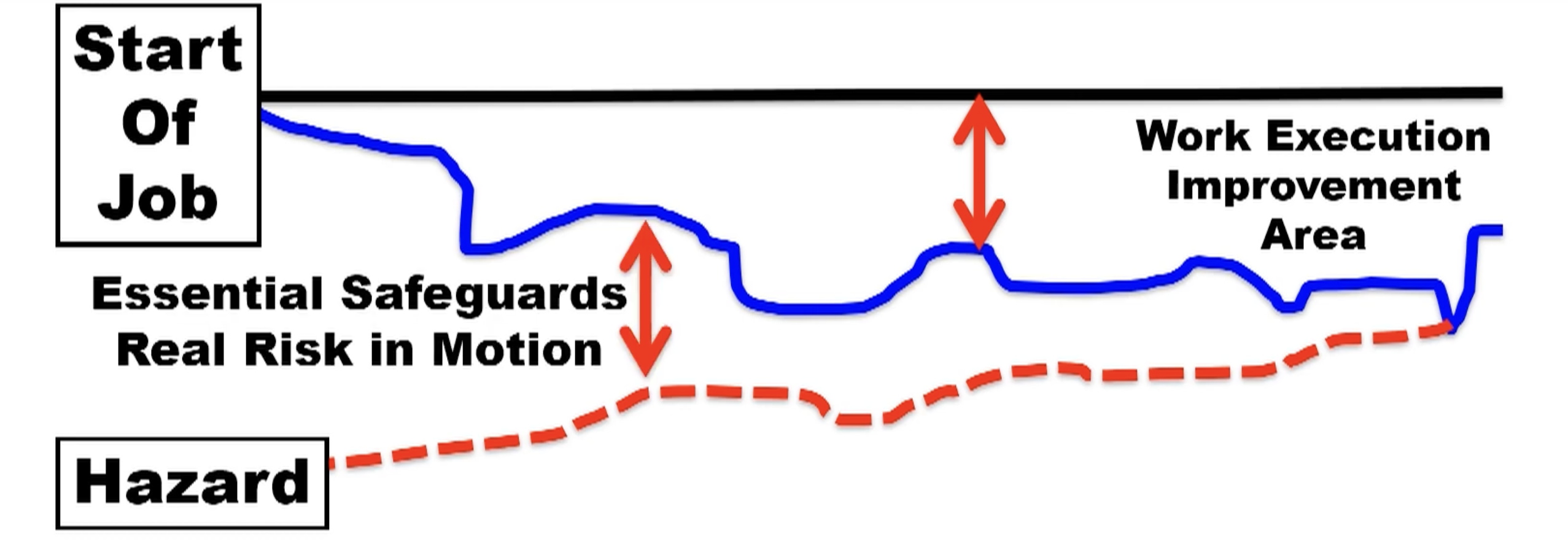
 This single image captures all we need to recognize about “real-world safety.”
The straight black line represents “work as imagined”; this means the work done “by the book” every time. Anyone who believes humans follow all the rules 100% of the time is living in a fantasy land. We are wired to find the easy, most efficient, and fastest way to do things. And we are quite good at doing so.
The blue line represents “work as done.” This is the real world. Our job in safety is to CLOSE THE GAP, but first, we must recognize there is a gap. Notice how the blue line changes and is erratic – this represents all the variations in our daily work schedules.
When we do catastrophic accident investigations, we can almost chart the course using the blue line and its continual fall further from the standard (i.e., the black line).
Image Credit: Dr. Todd Conklin
The risk increases as the blue line falls from the black line. The ups and downs of the blue line can almost always be traced to some type of event like an accident. After the accident, the blue line goes up as work falls more in line with safety and procedures and rules; however, over time, the blue line will begin to fall again. We call this the “accident cycle.”
The red line represents the “hazard(s)” associated with the work. If we have done our hazard analysis well and recognized all the risks, we write our procedures to ensure the “work as imagined” is as far away from the hazard as we can reasonably achieve. The safeguards are between the red and black lines to keep the risk under control. But as the blue line (work as done) drifts further away from the black line, those safeguards get manipulated and weakened, setting up an accident, represented by the blue and red lines meeting each other.
For many organizations, this image is a hard pill to swallow as it means the organization has come to grips with these facts: workers, rules/procedures, and their reliance on following these rules to the letter each and every time is a fallacy in the real world. The concept of “Layers of Protection” rose out of this realization – people are fallible, but this should not be a direct cause of accidents. We need barriers/safeguards/controls to ensure we can:
1) monitor the digression of the blue line and set expectations as to how much DEVIATION from the standard (i.e., the black line) the organization is willing to accept
2) continuously test and validate the safeguards/controls that are between the blue and red line are in place and functioning as we intend to ensure these lines never meet
3) EDUCATE the workforce on risk so they understand that they can FULLY CONTROL the blue line; but that every deviation from the rule/procedure moves them further from the black line and closer to the hazard