








This is an interesting “press release” from the Chinese Government regarding the country’s accident history in May.
History: Hazardous chemical accidents in May
Petrochemicals
…
HomeRead More »
Read More
I get it, it’s a 19-second video, and it will probably stir more questions than responses, but this topic is one that needs MUCH discussion. I have made this page FREE for anyone who wishes to chime in. A couple of items to consider:
NH3 gas is invisible – what we are seeing is the cold gas condensing the “humidity”, making the cloud
It takes around 5,000 ppm to condense...
Read More
Chemical Process Safety (PSM/RMP)
Hazardous Materials
Lockout Tagout
OSHA Compliance
Process Safety Material
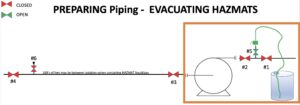
Establishing a Double Block and Bleed (DB&B) positive isolation is a critical safety protocol when preparing piping and equipment for opening, especially when dealing with Extremely Hazardous Substances (EHS). This process ensures that hazardous materials (HAZMAT) are effectively evacuated and isolated to protect workers from accidental releases.
Members can download my .ppt file at bottom of...
Read More
As with my NH3 article, I wanted to verify and document the same scenario for scrubbing 1 pound of Cl2 with 50% Sodium Hydroxide (NaOH). Here is what Gemini+ had to say…
When Chlorine (Cl2) gas is safely scrubbed with Sodium Hydroxide (NaOH), the reaction produces sodium hypochlorite (bleach), sodium chloride (salt), and water.
Bottom line: 0.23 Gallons of 50% NaOH is needed for each pound...
Read More
Throughout my career, I have been taught that to safely “scrub” 1 pound of NH3, 1 gallon of water is required. I have firsthand experience in this ratio working. So I decided to ask Google Gemini+ to explain this ratio.
Looking back at IIAR-2, when we sized a Diffusion Tank for PSV discharge(s), it was always 1 gallon of water per pound of ammonia (e.g., IIAR -2, 5.5.3 Discharge Through...
Read More
As I have written many times, our bulk chemical transfer hoses MUST be part of an Inspection and Testing Program. These tests follow the same logic as pressure testing piping, and Hydrostatic Testing is far safer than pneumatic testing. So I asked Google Gemini+ to show me the difference in failure energies to demonstrate this point. NOTE: This scenario also applies to our Fire Hose annual testing!
Hint:...
Read More
To determine the internal static overpressure generated by the catastrophic failure of a liquid Nitrogen (LN2) dewar, we look at the physics of a Boiling Liquid Expanding Vapor Explosion (BLEVE) and the resulting rapid phase transition.
…
HomeRead More »
Read More
So I asked Google Gemni + to calculate the pressure wave in a room that is 40′ X 40′ X 20′ tall with the catastrophic failure of a 1-ton chlorine cylinder. In a 32,000 ft3 room, we must determine the volume of gas released during the “instantaneous flash” and the resulting internal static overpressure.
…
HomeRead More »
Read More
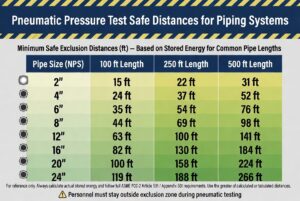
DISCLAIMER: This is a “cheat sheet” for safety professionals to get a general idea of the “safe distances.” ALWAYS refer to ASME PCC-2, Mandatory Appendix 501-III) for the exact distance. Just understand, ALL pneumatic pressure testing REQUIRES a “safe distance”.
According to ASME PCC-2, Mandatory Appendix 501-III, determining safe distances for pressure testing—specifically,...
Read More
So I asked Google Gemni + to calculate the pressure wave in a room that is 40′ X 40′ X 20′ tall with a 5,000-gallon pressure vessel 85% full of liquid NH3, and it catastrophically fails. How much of a pressure wave will this event create in psig? I promise you this… No Engine Room I have ever been in could withstand this event! Google Gemini + equated it to TNT!
…...
Read More
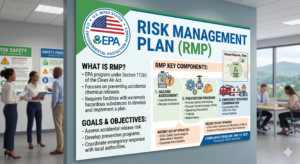
The risk management program in 40 CFR Part 68 requires facilities to conduct an off-site consequence analysis (OCA) to provide information to state, local, and federal governments and the public about the potential consequences of an accidental chemical release. When does a facility need to revise its OCA?
…
HomeRead More »
Read More
For the purpose of analyzing the worst-case release scenario required as part of the hazard assessment at 40 CFR Part 68, Subpart B, the worst-case release quantity is identified as the greatest amount held in a single vessel or pipe, taking into account administrative controls that limit the maximum quantity (40 CFR §68.25(b)).
Are mechanical controls, such as alarms, considered administrative...
Read More