







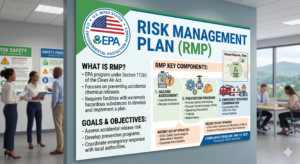
Pursuant to the risk management program regulations, facilities must perform an offsite consequence analysis for the worst-case release scenario.
Do the quantities of two (2) separate vessels that are interconnected with a closed valve need to be aggregated for the worst-case release scenario analysis?
…
HomeRead More »
Read More
In section 2, element 2.5, of an RMP, facilities must report the quantity of toxic chemical that the facility used for the worst-case analysis. When reporting this data element in RMP*eSubmit for a mixture, should facilities report the entire weight of the toxic mixture potentially being released or only the amount of the regulated toxic substance in the mixture?
…
HomeRead More »
Read More
Pursuant to the Risk Management Program regulations, the owner or operator shall identify and analyze at least one (1) alternative release scenario for each regulated toxic substance held in a Program 2 or Program 3 process above its threshold (40 CFR §68.28).
If a facility has both ammonia and ammonia (anhydrous) on site above their respective thresholds, does the facility owner or operator need...
Read More

Tentative Interim Amendment (TIA) 27-1 refers to a significant update to the 2027 Edition of NFPA 30: Flammable and Combustible Liquids Code.
Issued on April 15, 2026, with an effective date of May 5, 2026, this TIA (Log #1886) was processed by the Technical Committee on Flammable and Combustible Liquids to address safety gaps regarding the handling of ignitible liquids in specific occupancy types....
Read More
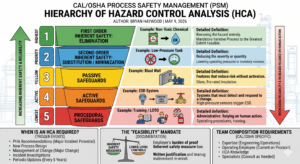
Under Cal/OSHA’s Process Safety Management (PSM) standards (specifically Title 8 §5189.1 for refineries and §5110.16 for other facilities), the Hierarchy of Hazard Control Analysis (HCA) is a formal, documented requirement that goes significantly beyond the traditional OSHA “inverted pyramid.”
While standard safety protocols often treat the hierarchy as a suggestion, Cal/OSHA makes it...
Read More
A new report from the EPA Office of Inspector General (May 6) highlighted that the U.S. Chemical Safety Board (CSB) is currently operating at only 40% board capacity (two out of five members), which restricts its ability to formally approve investigation reports and safety recommendations. The Clean Air Act Amendments of 1990 established that the CSB’s board shall consist of five board members, including...
Read More
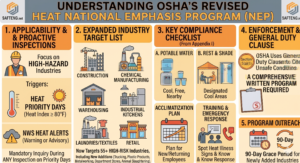
The revised Heat National Emphasis Program (NEP), relaunched on April 10, 2026, represents a major shift in how OSHA handles heat-related enforcement. This isn’t just a renewal of the 2022 program; it is a full five-year directive (running through 2031) that gives inspectors more power to enter workplaces without a prior complaint.
OSHA no longer waits for a heatwave to act. The program defines...
Read More
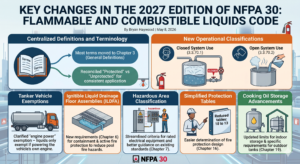
The 2027 edition of NFPA 30 introduces significant structural and technical updates designed to improve clarity, streamline protection requirements, and integrate emerging safety technologies. Here are the primary changes professionals need to know.
…
HomeRead More »
Read More
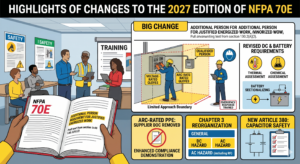
I do some shock-prevention training for electrical work (Gloves, Meters, LOTO, etc.), but I leave the big stuff like arc flash to those better qualified than me. But as safety pros, we have to stay informed of changes to this world-class standard. We see some crazy situations in our audits and assessments regarding electrical installations and work practices, and many facilities just do not have Electrical...
Read More
Chemical Process Safety (PSM/RMP)
Emergency Response
Hazardous Materials
OSHA Compliance
Respiratory Protection
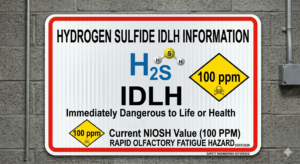
The Evolution of the Hydrogen Sulfide IDLH: From Lethality to Escape Impairment
The history of the Immediately Dangerous to Life or Health (IDLH) value for Hydrogen Sulfide (H2S) reflects a critical evolution in industrial safety. It highlights a shift from focusing purely on survival to understanding the physiological “tipping points” that prevent a worker from escaping a toxic environment.
The...
Read More
Chemical Process Safety (PSM/RMP)
Emergency Response
Hazardous Materials
OSHA Compliance
Respiratory Protection
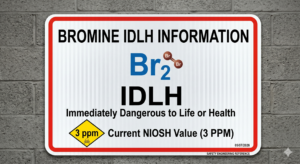
The Immediately Dangerous to Life or Health (IDLH) history for bromine follows a trajectory similar to that of chlorine, though the data pool has historically been smaller, leading to greater reliance on comparative toxicology.
…
HomeRead More »
Read More