











The 2027 edition of NFPA 704, Standard System for the Identification of the Hazards of Materials for Emergency Response, includes new definitions of the terms “battery energy storage system” and “lithium-based battery,” along with associated annex material. Updates have been made in Section 6.2, Degrees of Hazards for Flammability Hazards, to align with NFPA 1 regarding Category...
Read More
NFPA has updated its NFPA 497, Recommended Practice for the Classification of Flammable Liquids, Gases, or Vapors and of Hazardous (Classified) Locations for Electrical Installations in Chemical Process Areas, with a few minor revisions. Probably the most significant revision is NFPA’s position on “intentional releases and maintenance venting.” The most beneficial revision was NFPA...
Read More
In the 2027 edition of NFPA 30, the standard now provides a NEW schematic illustrating the spatial layout of hazardous (classified) locations for indoor areas with process equipment containing ignitible (flammable or combustible) liquids at pressures of 100 psig or less. I am not sure why they included this in NFPA 30 (Chapter 7) or why the new schematic differs from that in NFPA 497, but I will discuss...
Read More
The new means to analyze risks associated with flammable gases is their “burning velocity,” and the new limit is 10 cm/s. So I wanted to provide some real-world examples of what this looks like. So I asked AI to compare 10 cm/s flame front with the speed of a person walking and a jackrabbit.
OSHA defines a CAT 1B Flammable gas as: Gases which meet the flammability criteria for Category...
Read More
As the experts begin their investigation into the tragedy, I was curious about whether the Co-Gen facility on site played a role. So, using some aerial images, I pieced together the scene as best I could from the accident image and drone footage. This is just how I do my scene examination when my services are hired for these types of investigations. Just letting you see it through my eyes…
There...
Read More
I recently was helping a client with some questions regarding their CAT 1B Flammable Refrigerant Process and was surprised to see that the “new” MAQ for these refrigerants is 10,000 pounds. Add the footnote exceptions, and we could have 30,000 pounds of this flammable refrigerant in a single fire area, either in “storage” or in a “closed system.”
NOTE: these flammable...
Read More
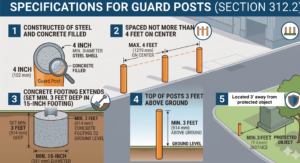
You just knew it was a matter of time before I did this. It took me only 4 revisions to get to this final product. It is NOT perfect, but it is an ACCURATE rendition of how they must be built/installed. The second infographic was me asking the question in a different way and it turned out the product on the 1st try. Take your pick, both are well done.
…
HomeRead More »
Read More
Yes, we can absolutely max out the Maximum Allowable Quantities (MAQs) for multiple different hazard classes within a single control area and still avoid triggering a Group H (Hazardous) occupancy. However, there is also a major caveat regarding how those materials are categorized and whether they pose overlapping physical or health hazards.
Here is how the International Fire Code (IFC) handles this....
Read More
5703.6.8 Piping supports have three (3) recognized methods to protect piping that may be exposed to a “pool fire”. First lets look at the code language:
5703.6.8 Piping supports. Piping systems shall be substantially supported and protected against physical damage and excessive stresses arising from settlement, vibration, expansion, contraction or exposure to fire. The supports shall...
Read More
NFPA 496 (Standard for Purged and Pressurized Enclosures for Electrical Equipment) is one of the most powerful engineering tools available for hazardous locations, but it is also one of the most abused standards for HAZLOCs. Like the Combustible Gas Detection System (CGDS) provisions in NFPA 70, NFPA 496 allows a facility to install ordinary, non-classified electrical hardware inside a Class I or Class...
Read More
In NFPA 70 (National Electrical Code / NEC), the use of a Combustible Gas Detection System (CGDS) is a highly specialized engineering provision. It essentially acts as a “get out of jail free” card—or more accurately, a reclassification tool—for specific industrial locations. When you install a qualified CGDS, the NEC allows you to lower the electrical classification of an area (e.g.,...
Read More
Auto-Refrigeration & Flashing and Cold Ambient Exposures
We see around a half dozen pressure vessels in a “service” they were not initially designed for. There are literally hundreds of excuses as to why we find these issues, but they are simply excuses. It was not uncommon for us to find a PV in an NH3 refrigeration process with an MDMT of -20°F being operated in the -40°F range,...
Read More