













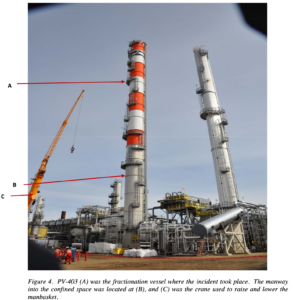
A tower mechanic was entering a fractionation vessel at a gas facility to prepare a final inspection of the vessel. The interior of the vessel was under a nitrogen purge, and the worker was using supplied air. Shortly after entering the vessel, the worker went into distress.
The on-site emergency response team extracted the worker and provided first aid. The incident resulted in a fatality.
…...
Read More
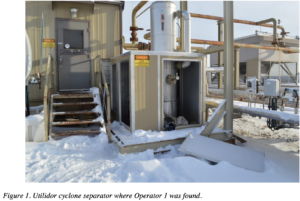
An operator was found unresponsive at an Oil Battery. The operator’s body was found lying inside a partially open utilidor where a valve was open and gas escaping. The battery is a sour gas (oil & gas with hydrogen sulphide) site. The Medical Examiner report stated the cause of death was due to hydrogen sulphide exposure.
Operator 1 (fatally injured worker) had been working to unblock a needle...
Read More

A bleeder valve was left open during transport truck anhydrous ammonia delivery, causing a large amount of ammonia to enter and violently rupture an aluminum caged plastic Intermediate bulk container (IBC or tote) filled with water. The IBC/Tote rupture released ammonia and the delivery driver suffered fatal injuries and other workers, including a facility employee, a responding deputy sheriff, and...
Read More
NOTE: this occurred in 2007 – I just missed it in my research and just now posting it.
At a meat product processing plant Employee #1 and Employee #2 were working on the production floor near a section of piping that had been removed the prior day during the rerouting of an ammonia refrigerant line.
The accident happened when the plant coordinator and two maintenance supervisors tried to move...
Read More
At approximately 5:40 pm. on October 17, 2007, a wiring employee came to a press brake to get more pieces from Employee #1, a press operator. Employee #1 turned and put down a piece, collapsed to the floor, and experienced convulsions. The wiring employee panicked and asked the laser operator for help. The laser operator cleared the area. As he stood from the kneeled position, he also became lightheaded...
Read More
On December 31, 2008, a welder was preparing to conduct TIG welding on a 2″ X 65″ run of pipe located in the vent trunk compartment of an aluminum vessel under construction. The estimated height where the pipe entered the compartment was about 1.5′ from the bottom of the deck.
…
HomeRead More »
Read More
It is not unusual to hear many engineers lay claim that by using stainless steel piping, that they are fully eliminating the risk of corrosion under insulation (CUI) within their piping circuits. But could stainless steel piping be susceptible to CUI much like it’s cousin in the piping family… carbon steel?
The short answer is YES, even stainless steel can fall prey to corrosion in...
Read More
At 1:30 p.m. on May 14, 2000, an employee was painting the inside a 200,000-gallon potable water storage tank. At some point, the employee collapsed and was rescued from the space by two coworkers who provided CPR until emergency medical services arrived. The employee died of Cardiomegaly (enlarged heart).
Even though this death was NOT related to the PRCS work, OSHA still took serious issue with the...
Read More
On or about May 28th, 2020 at approximately 15:30 hours three (3) employees were exposed to fire and explosion hazards when a remediation repair (on a produced water tank) involved a grinder for preparing the surface and a heat gun for preparing an epoxy on a tank which had accumulated hydrocarbon vapors from the produced water contained earlier in the day.
The result of not monitoring hydrocarbon...
Read More
At 6:15 a.m. on May 22, 2020, an employee and a coworker were in the process of transferring chemicals from totes on a delivery truck into tanks inside the facility.
The deceased employee was responsible for hooking up a hose to the fill line on the building and monitoring the transfer from inside the facility.
A coworker was responsible for hooking up the hose to the pump and tote inside the truck.
The...
Read More
At 9:00 a.m. on May 29, 2020, Employee #1 and #2, coworkers, discussed entry into a manhole to clear a blockage.
Employee #1 entered into the manhole without personal protective equipment, without training, and without performing any air quality testing.
Employee #1 successfully placed the line to clear the blockage and began to climb out.
Before he could exit, he was overtaken, likely by hydrogen...
Read More
If you have ever participated in or facilitated a Process Hazard(s) Analysis before you have certainly heard the phrase “never happened before” and the implication that we would be wasting our time if we spent any more time discussing the scenario. As a facilitator, it is our responsibility to force the discussion, as we should NEVER accept the fact that just because no one in the...
Read More